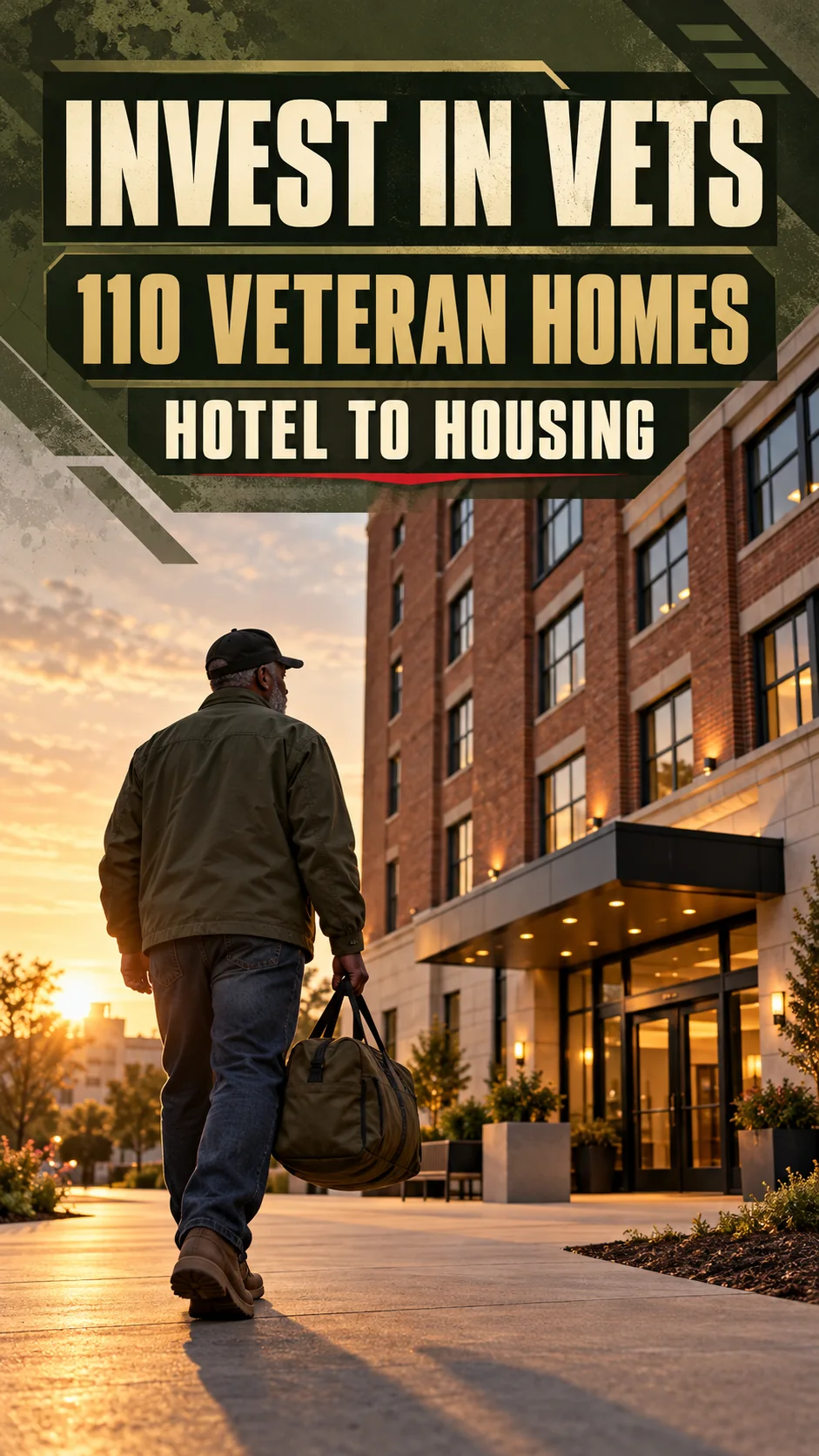
Memphis Veterans Village Converts a Hotel Into 110 Homes
Status checked Oct 5, 2026. The property opened on Aug 14, 2026; public sources reviewed for this article do not establish that all 110 apartments are occupied.
From Shuttered Hotel to Permanent Housing
Memphis has moved one Veteran-housing project past the language of plans and pledges. On Aug 14, 2026, the Tunnel to Towers Foundation opened Memphis Veterans Village at 7060 Riverdale Bend Road. The organization converted a former hotel into 110 units of affordable permanent supportive housing for Veterans who have experienced homelessness. The City of Memphis confirmed the same address, use, and unit count in its August 14 newsletter.
The sequence matters. Tunnel to Towers announced in 2024 that it had purchased the shuttered hotel, then held a groundbreaking on July 25 of that year. Two years later, the opening converted an acquired building into a functioning housing resource. This is not a proposed development or an award awaiting construction. The facility is open, the operator identifies it as permanent supportive housing, and an application route is publicly available.
It is also important not to overstate what the ribbon cutting proves. The verified total is 110 completed units, and the project is designed to serve Veterans. The sources reviewed do not publish a current occupied-unit count, move-in pace, waiting-list total, or housing-retention rate. Invest in Vets should describe 110 homes as delivered capacity, not as 110 Veterans already housed.
Verified Project Snapshot
FACT | VERIFIED STATUS |
Location | 7060 Riverdale Bend Road, Memphis, Tennessee |
Responsible organization | Tunnel to Towers Foundation |
Delivery model | Conversion of a former hotel into permanent supportive housing |
Total units | 110 completed affordable units |
Veteran-designated units | All 110 units are described by the operator and City as housing for Veterans |
Current stage | Open since Aug 14, 2026; current occupancy not publicly verified |
Capital cost | Not itemized in the authoritative public sources reviewed |
Housing Plus the Work of Staying Housed
The physical conversion is the center of the story, but the service design explains why the project is described as supportive housing. Tunnel to Towers lists onsite job training and employment assistance, VA-benefits navigation, education assistance, financial counseling, legal advocacy, mental-health and post-traumatic-stress counseling, and addiction-recovery services. Those functions can reduce the distance between a front door and the next stabilizing appointment.
That proximity is especially relevant for deployed Veterans who may delay seeking help because asking feels inconsistent with self-reliance, leadership, or the identity they carried through service. A Veteran may be willing to ask about work, education, or a housing application before being ready to discuss trauma or a service-connected condition. A building that offers several entry points can let trust develop without forcing every first conversation to begin with disability.
Memphis also has a separate low-barrier counseling option. The Memphis Vet Center provides confidential, no-cost help in a non-medical setting. Its official page says eligible Veterans do not need to be registered for VA health care or have a VA service-connected disability to participate. That distinction can be decisive for someone who deployed, is struggling, and is not ready to file a disability claim or enter a hospital setting. Vet Center eligibility still depends on qualifying service, and staff can help establish it when a Veteran does not have documents in hand.
Access Requires a Clear Referral Lane
Tunnel to Towers maintains a public Veterans Village application form and notes that a background check may be used to verify eligibility. Public materials reviewed for this case study do not provide a complete Memphis-specific list of income limits, discharge criteria, rent calculations, required documents, or unit-availability rules. Veterans and referring partners should therefore treat the form as a starting point, not a guarantee of placement.
VA Memphis offers another access lane for Veterans who are homeless or at risk because of financial hardship, unemployment, addiction, depression, or transition from jail. Its homeless-care page directs people to a care coordinator and lists help with immediate shelter, permanent housing, job training, education, re-entry, prevention assistance, treatment, and health care. Strong local systems connect these lanes: street outreach, VA care coordination, the Village application, document recovery, and move-in support should operate as one navigable pathway rather than as separate doors a person must discover alone.
Benefits Are Different Tools, Not a Cash Stack
Veterans encountering this project may also hear about VA disability compensation, HUD–Veterans Affairs Supportive Housing, and Post-9/11 GI Bill education benefits. These programs should never be presented as one automatic package. VA disability compensation is tax-free monthly cash for eligible service-connected conditions, with the amount tied to the rating and, in some cases, dependents. A Veteran can seek housing help without first receiving a disability rating.
HUD-VASH combines a housing voucher administered through a public housing agency with VA case management for eligible Veterans experiencing homelessness. The voucher is rental assistance paid through the housing system; it is not spendable cash in the Veteran’s pocket, and local payment standards, rent reasonableness, unit inspection, income, and program rules matter. The Post-9/11 GI Bill may provide a monthly housing allowance to an eligible student, but the amount depends on the individual’s eligibility tier, enrollment rate, training modality, and the school’s location. It is an education benefit, not a universal homelessness payment. No source reviewed says a Memphis Veterans Village resident automatically receives any of these three benefits.
What Memphis Still Needs to Measure
The project’s biggest remaining evidence gap is not the number of doors; it is what happens after opening. Useful public reporting would include monthly occupied units, the number of Veterans referred and accepted, average time from referral to move-in, exits to stable housing if the Village is not the final destination, returns to homelessness, and resident retention at six and twelve months. Reporting should protect privacy while making performance understandable.
The funding story also needs precision. Authoritative materials confirm that Tunnel to Towers purchased and converted the hotel, but the sources reviewed do not publish a Memphis-specific development cost or an itemized capital stack. It would be inaccurate to assign the project a dollar figure or attribute unlinked federal, state, or local grants to the conversion. Transparent project finance would help other communities determine what elements are replicable and what philanthropic, public, or operating commitments are required.
What Invest in Vets Can Adapt
Memphis offers a practical playbook: identify a building that can be converted, secure control of the property, define a Veteran-serving use, plan services with the housing, publish an access route, and carry the project through to opening. Invest in Vets could adapt that sequence by mapping viable hotels or multifamily properties, convening local housing authorities and VA homeless-program teams before acquisition, recruiting operators capable of long-term supportive services, and asking funders to underwrite both construction and post-opening operations.
The nonprofit can also contribute where large developments often struggle: trust-building and navigation. Peer outreach can meet deployed Veterans without making a disability claim the price of the first conversation. Landlord and investor partners can help identify units or buildings, but commitments should be tied to clear affordability, habitability, referral, and service standards. Supporters can fund the practical bridge work—documents, transportation, application help, move-in needs, and consistent follow-up—that turns available housing into sustained housing.
A Mission-Focused Next Step
Veterans, landlords, investors, service providers, and supporters can help build the next local housing lane. Donate to Invest in Vets to support the cause, or buy a $5 practical guide through the Mission Support Shop. The shop listed every digital guidebook at $5 when verified on October 5, 2026. Donating supports Invest in Vets’ mission; buying a guide provides a practical resource while supporting its work. A purchase is separate from a charitable donation, and no housing or benefit outcome is guaranteed.
VETERAN RESOURCES
Where to Start
Tunnel to Towers Veterans Village application — Apply or request screening for a Veterans Village placement.
VA Memphis homeless Veteran care — Connect with local VA homeless-services coordination and prevention resources.
National Call Center for Homeless Veterans — Call 877-424-3838 for 24/7 confidential assistance for Veterans who are homeless or at risk.
Memphis Vet Center — Confidential, no-cost counseling in a non-medical setting. Call 901-522-3950; after-hours support is 877-927-8387.
Veterans Crisis Line — Call 988 and press 1, text 838255, or use online chat.
SOURCES
Reporting Sources
Project operator — Opening announcement dated August 14, 2026 (accessed October 5, 2026).
Project operator — Veterans Villages program and Memphis project description (accessed October 5, 2026).
Project operator — Memphis acquisition and Jul 25, 2024 groundbreaking announcement (accessed October 5, 2026).
City of Memphis — Weekly newsletter confirming opening, address, use, and unit count (accessed October 5, 2026).
Local reporting — Daily Memphian coverage of the opening (accessed October 5, 2026).
U.S. Department of Veterans Affairs — VA Memphis homeless Veteran care (accessed October 5, 2026).
U.S. Department of Veterans Affairs — Memphis Vet Center services and eligibility notes (accessed October 5, 2026).
U.S. Department of Housing and Urban Development — HUD-VASH program overview (accessed October 5, 2026).
Invest in Vets — Mission Support Shop with verified $5 digital guidebooks (accessed October 5, 2026).
Invest in Vets — Donation page (accessed October 5, 2026).