INVEST IN VETS • DAILY FIELD REPORT
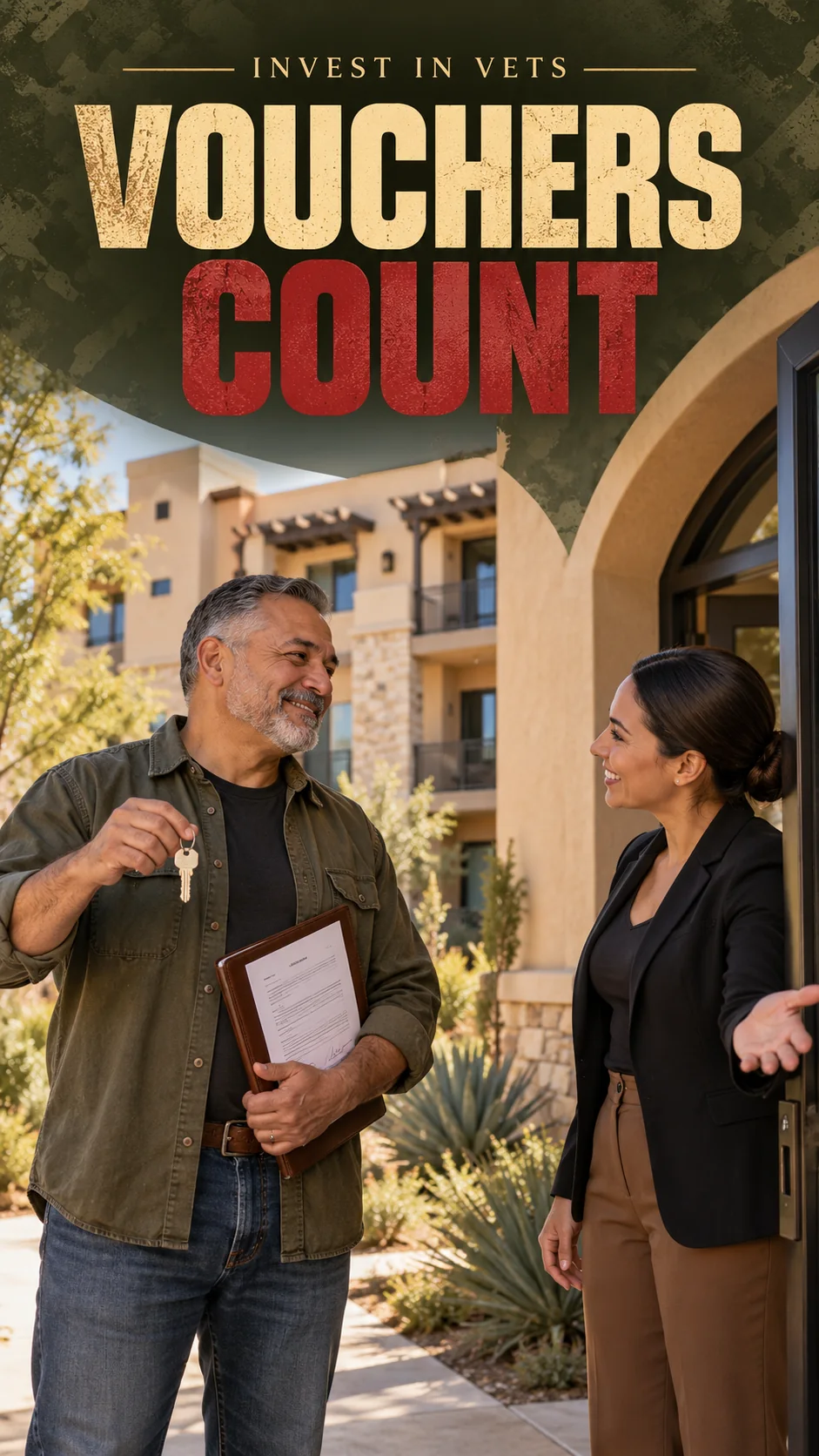
San Antonio Makes Veteran Housing Vouchers Count
A new civil-rights protection and a funded landlord incentive attack the same leasing bottleneck from opposite sides.
Verified case study • San Antonio, Texas • Oct 3, 2026
THE LOCAL RESPONSE
A Voucher Is Useful Only If a Landlord Opens the Door
San Antonio has chosen a practical target in the fight against Veteran homelessness: the moment when rental assistance meets a landlord’s “no vouchers” policy. On May 7, 2026, the City Council approved a source-of-income ordinance focused on Veterans. The rule took effect May 8. It bars covered housing providers from rejecting an otherwise qualified Veteran solely because the applicant uses federal rental assistance, including a Housing Choice Voucher or HUD–Veterans Affairs Supportive Housing voucher. That is not a new apartment complex, and it does not create a new voucher. It is a local access rule designed to make existing federal help usable in the private rental market.
The distinction matters. HUD–VASH combines HUD rental assistance with VA case management and clinical support for eligible Veterans experiencing homelessness. The housing authority pays the approved subsidy toward rent; it is not spendable cash handed to the Veteran. The Veteran still must locate a qualifying unit, meet lawful screening standards, complete the housing authority process and lease the home. When owners refuse vouchers as a category, a benefit can expire or sit unused while a Veteran remains in a shelter, motel, car or doubled-up arrangement.
May 7 Council passage | 5+ UNITS Covered portfolios | 36 HUD–VASH holders searching on May 6 | 311 City complaint line |
What San Antonio Passed
The ordinance applies to owners or operators of five or more rental units inside San Antonio. A portfolio with four or fewer units is exempt. Covered owners may still use documented, lawful and consistently applied standards involving affordability, credit, rental history, background checks and unit inspection. What they may not do is end the inquiry merely because a Veteran will pay with a federal voucher. The City’s property-owner FAQ identifies escalating civil enforcement: a written warning for a first offense, mandatory training for a second, and a $500 fee plus City Attorney referral for a third.
For Veterans, enforcement begins with a complaint rather than an automatic placement. Someone who believes a voucher caused a denial or termination can call 311 or the City’s Fair Housing Program at 210-207-5309. City staff may contact the Veteran, housing provider and witnesses, then issue a finding. This gives a Veteran a local pathway that did not exist before, but it also makes documentation important: save listings, application messages, denial emails, screenshots and the name and date of every conversation.
STATUS CHECK The protection is passed and effective. It is not a declaration that Veteran homelessness has ended, and it does not require an owner to rent an unsafe or unaffordable unit. It requires covered providers to evaluate an otherwise qualified Veteran without treating the voucher itself as disqualifying income. |
The Scale—and the Limit
The City estimated that the ordinance reaches at least 227,000 rental units. San Antonio’s May 2026 briefing also counted 90,474 Veterans in the city and 852 HUD–VASH vouchers in local circulation. As of May 6, 2026, 36 HUD–VASH voucher holders were still searching for a unit, down from 109 in October 2024. Staff separately estimated that 61 Veterans using general Housing Choice Vouchers were searching. Those figures show a real leasing bottleneck, but they are snapshots—not proof that the ordinance caused a later decline. The public presentation also contains an inconsistent combined search total, so this article reports only the program-specific figures that can be read directly from the City’s tables.
The rule also leaves a meaningful gap: the smallest landlords are outside its scope unless another requirement applies. Properties that received City incentives after May 2021 are already subject to San Antonio’s Housing Voucher Incentive Policy, which requires voucher acceptance at the assisted property regardless of Veteran status. Between those two policies, the City is building broader access, but neither creates enough low-rent units by itself. Voucher holders still face tight supply, inspection timelines, security deposits, application fees and rent levels above payment standards.
From Protection to Landlord Recruitment
San Antonio paired the “stick” of enforcement with a separate “carrot.” On Apr 28, 2026, city staff recommended a $500,000 housing-voucher incentive pilot for the FY 2027 Rental Assistance Program budget. The design calls for payments of up to $500 when a participating owner signs a qualifying lease, with an estimated capacity to support about 900 households and priority for Veterans and property owners new to voucher programs. This incentive is not Veteran-only; it is a broader voucher-market tool with a stated Veteran priority.
The funding moved beyond proposal status when the City Council adopted the FY 2027 budget on Sep 17, 2026. The fiscal year began Oct 1, making the pilot funded in the current budget. However, as of this Oct 3 review, the City’s public materials do not yet confirm that applications or payments are open. The accurate status is therefore funded and entering implementation—not fully launched, not completed and not an outcome. Invest in Vets should watch for operating rules, administrator instructions, landlord enrollment, lease counts, Veteran-specific results and the share of participating owners who are new to vouchers.
Reaching Veterans Who Will Not Ask Twice
A deployed Veteran may describe the problem as “I need a place,” not “I am homeless.” Pride, identity, fear of stigma or reluctance to discuss service-connected conditions can delay contact with the VA and local systems. A failed apartment search can deepen that withdrawal. San Antonio’s model creates a practical outreach message: federal housing assistance is lawful income, a blanket voucher rejection by a covered provider can be reported, and a housing navigator can help preserve the paper trail. That message should be delivered through Veteran service officers, VA teams, shelters, colleges, employers, faith communities and peer Veterans—not only through homelessness intake sites.
Benefits must remain clearly separated. VA disability compensation is a tax-free monthly benefit tied to a VA disability rating and individual circumstances. HUD–VASH is rental assistance plus VA case management for eligible Veterans experiencing homelessness; the subsidy is paid under housing-program rules and is not cash income. Post-9/11 GI Bill housing payments are education benefits that depend on eligibility, rate of pursuit, enrollment modality and school location. No Veteran automatically qualifies for all three, and San Antonio’s ordinance does not change federal eligibility for any of them.
What Invest in Vets Can Adapt
The strongest lesson is that a community can work both sides of the leasing equation. Invest in Vets could partner with the City, Opportunity Home San Antonio, the Housing Authority of Bexar County, South Texas VA teams and landlord associations to create a Veteran-facing denial log, train navigators on the new complaint process and recruit owners for the incentive pilot. A small flexible fund for deposits, application costs, inspection repairs or short hotel stays could address expenses that a voucher does not cover, while philanthropic or investor partners could help property owners bring units up to inspection standards.
Measurement should be designed before success is claimed. A useful public dashboard would track Veteran voucher issuance, search time, expirations, lease-up rate, complaint volume, findings, repeat violations, landlord enrollment, incentive payments, Veteran-priority households served and housing retention after six and twelve months. Results should be disaggregated without exposing individual Veterans. The ordinance has opened a door; the test is whether more Veterans can walk through it and remain housed.
San Antonio’s response is credible because it names the blockage and assigns responsibility. The City has made voucher-based discrimination against covered Veterans enforceable, funded a landlord-recruitment pilot and preserved lawful screening. What remains is implementation: timely investigations, clear landlord guidance, fast inspections, enough units at workable rents and transparent outcomes. For Veterans who have already waited too long to ask for help, the difference between a policy announcement and a signed lease is everything.
ACTION & RESOURCES
For Veterans, Landlords and Partners
- Veterans facing homelessness: Call the National Call Center for Homeless Veterans at 877-424-3838. It is free, confidential and available 24/7. Ask about local VA homelessness services and HUD–VASH screening.
- San Antonio voucher discrimination: Call 311 or the City Fair Housing Program at 210-207-5309. Keep written records of the listing, application, denial and communications.
- Immediate emotional crisis: Call 988, then press 1; text 838255; or use VeteransCrisisLine.net. A Veteran does not need to be enrolled in VA care to contact the crisis line.
- Landlords and property managers: Review the City’s property-owner FAQ, document neutral screening criteria and watch for FY 2027 voucher-incentive enrollment instructions.
INVEST IN VETS CALL TO ACTION Veterans: let a navigator help before a voucher clock runs out. Landlords: open qualified units and learn the City’s new rules. Investors and supporters: fund inspection repairs, deposits, navigation and outcome tracking—the small gaps that determine whether a voucher becomes a home. |
Sources
- City of San Antonio — Property Owner FAQ: Veteran Source of Income Protections (accessed Oct 3, 2026)
- City of San Antonio — Source of Income Protections for Veterans Ordinance and housing-policy links (accessed Oct 3, 2026)
- City of San Antonio — Housing Voucher Incentive Program briefing, Apr 28, 2026
- City of San Antonio — FY 2027 budget adopted Sep 17, 2026
- City of San Antonio — Sep 1, 2026 budget work session transcript (voucher-incentive pilot)
- San Antonio veteran housing ordinance and City presentation, May 2026
- KSAT — “Carrots and a stick” Veteran voucher proposals, Apr 28, 2026
- U.S. Department of Veterans Affairs — HUD–VASH and National Call Center for Homeless Veterans (accessed Oct 3, 2026)
- U.S. Department of Housing and Urban Development — HUD–VASH overview (accessed Oct 3, 2026)
Research cutoff: Oct 3, 2026. Status labels reflect what the cited public materials confirmed by that date. No source reviewed reported a post-ordinance Veteran lease-up total.