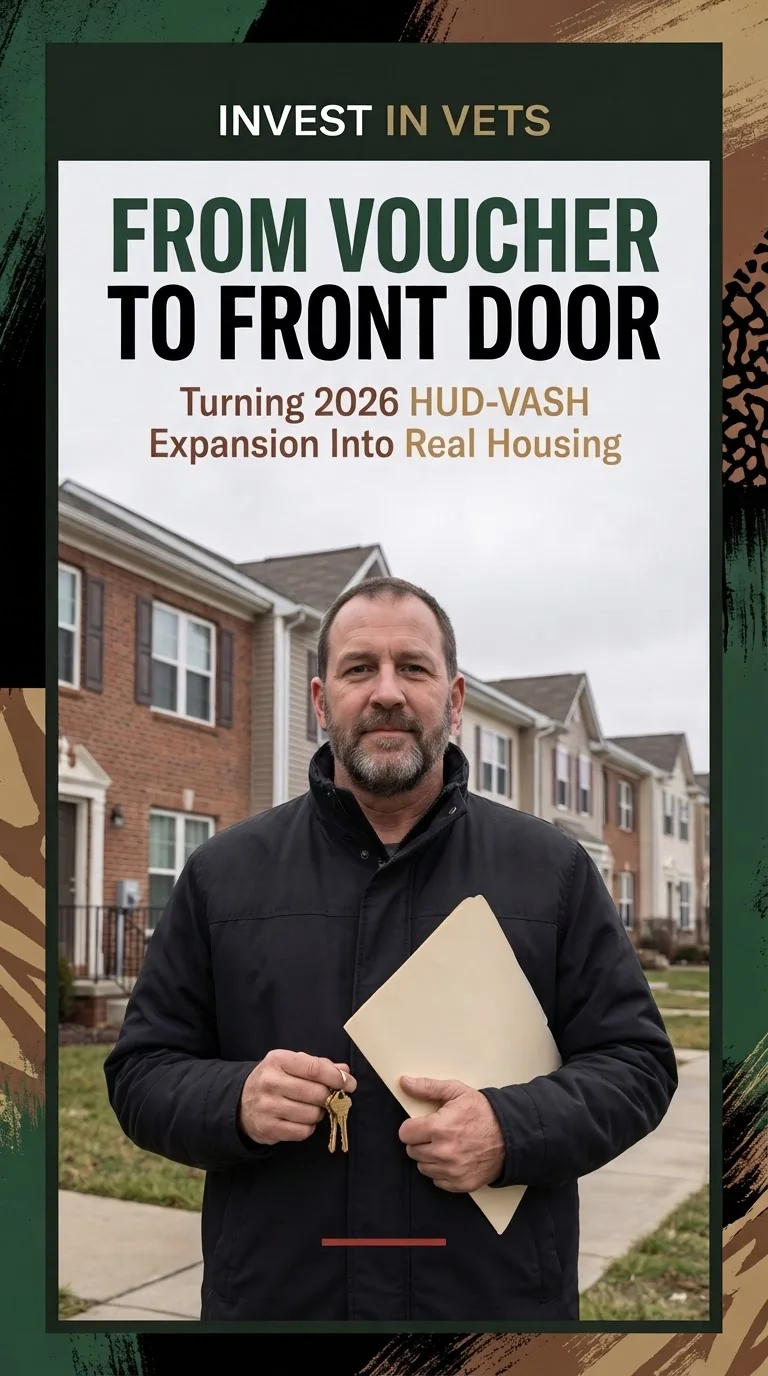
FROM VOUCHER TO FRONT DOOR
Turning 2026 HUD-VASH Expansion Into Real Housing
Published: September 13, 2026
Focus: HUD-VASH leasing, landlord recruitment, Ohio and New York City
A voucher is a powerful housing tool, but a voucher by itself is not a front door.
That distinction matters right now. On June 26, 2026, the U.S. Department of Housing and Urban Development and the Department of Veterans Affairs announced $33 million to support 2,532 new HUD-VASH vouchers across 265 public housing authorities in 44 states. HUD also announced $10 million in administrative fees for 289 housing authorities in 46 states to support leasing activity and program delivery. The expansion is meaningful because HUD-VASH combines rental assistance with VA case management, but the next test is operational: can communities turn those allocations into signed leases quickly enough for Veterans who are already waiting?
THE NATIONAL PICTURE IS IMPROVING — BUT THE WORK IS NOT FINISHED
The latest national Veteran homelessness estimate available today comes from the January 2025 Point-in-Time Count, whose results were announced in 2026. HUD and VA reported 32,495 Veterans experiencing homelessness on a single night in January 2025. Of that total, 18,977 were in sheltered settings and 13,518 were unsheltered. The 2025 total was 56.1% lower than the 2010 level and represented the lowest national Veteran homelessness count since HUD began reporting this measure in 2009.
Those numbers show real progress, but they should not be confused with a complete solution. A Point-in-Time Count is a one-night snapshot, not a count of every Veteran who experiences housing instability over a full year. VA also reported that 51,936 unique Veterans were permanently housed during fiscal year 2025, its strongest result in seven years under the current tracking method. Together, the two measures show a system moving in the right direction while still serving tens of thousands of Veterans who cycle through homelessness, emergency shelter, temporary housing, or housing searches during the year.
HUD-VASH remains one of the central tools in that system. As of March 2026, VA reported that more than 95,000 formerly homeless Veterans were living in homes through HUD-VASH. HUD’s June 2026 funding announcement said the number of active HUD-VASH vouchers nationwide had risen above 118,000. The gap between an allocated voucher and an occupied home is where landlord participation, housing supply, inspections, rent levels, transportation, paperwork, and local coordination become decisive.
WHAT THE 2026 AWARDS LOOK LIKE LOCALLY
The June 2026 HUD award notice gives Invest in Vets a concrete outreach map rather than just a national headline. In New York City, the New York City Housing Authority received two housing-assistance-payment awards covering 20 and 28 new HUD-VASH vouchers — 48 vouchers total — with $865,042 in combined housing assistance funding listed in the award document. That does not mean 48 apartments are automatically ready. It means 48 additional opportunities now need eligible Veterans, workable units, landlords willing to participate, inspections, rent approvals, and completed leases.
Ohio’s awards show the same last-mile challenge on a smaller local scale. The Cincinnati Metropolitan Housing Authority received an award for 5 new HUD-VASH vouchers with $37,205 in housing assistance funding. The Clermont Metropolitan Housing Authority, serving the area east of Cincinnati, also received 5 new vouchers with $39,517 in housing assistance funding. The same federal award document lists separate administrative-fee support for existing HUD-VASH operations, including $60,446 for Cincinnati Metropolitan Housing Authority. Other Ohio housing authorities appearing in the new-voucher awards include Youngstown, Cuyahoga County, Akron, Trumbull County, Columbiana County, Medina, Erie County, and Wayne County.
For a housing-focused nonprofit, this is actionable information. Instead of simply saying that more vouchers exist, outreach can be organized around the specific public housing authorities receiving new capacity. A landlord campaign in Cincinnati should speak directly to the leasing steps landlords actually face. A New York campaign can focus on the much larger pool of units needed to absorb voucher capacity in a tight rental market. The mission becomes less abstract: identify units, educate property owners, connect the right local partners, and reduce the time between referral and lease signing.
WHY LANDLORD RECRUITMENT IS THE REAL FORCE MULTIPLIER
VA’s landlord guidance makes clear that HUD-VASH depends on private-market participation. A property owner generally connects with the local public housing authority or VA, reviews the unit requirements, screens and selects a Veteran tenant, submits the Request for Tenancy Approval, completes the required inspection process, agrees on rent and the Housing Assistance Payments contract, and then signs the lease with the Veteran. VA notes that leases are usually for 12 months.
The value proposition for landlords deserves to be communicated accurately. VA describes the program as offering reliable rental income through the public housing authority’s voucher payment, while the Veteran pays any required tenant portion. HUD-VASH participants also receive VA case management and supportive services, which can give landlords an additional point of contact when lease or stability issues arise. This is not a guarantee that every tenancy will be problem-free, and VA itself does not directly pay HUD-VASH landlords. The subsidy is administered through the local housing authority. Clear explanations like these build more trust than overselling the program.
The practical lesson for Invest in Vets is simple: every landlord relationship can unlock more than one future placement. A property manager with five suitable units can become part of a repeatable housing pipeline. A small investor renovating a duplex may be more valuable to the mission than a one-time donor if that investor is willing to keep units available to qualified voucher holders. A real estate agent who understands HUD-VASH can refer owners who have vacant apartments. Housing supply is not only a policy issue; it is a relationship-building problem that local organizations can help solve.
THE LAST MILE ALSO INCLUDES TRANSPORTATION AND BASIC NEEDS
A newer VA development reinforces this point. On August 14, 2026, VA announced a $29 million fund authorized to provide eligible homeless Veterans and Veterans participating in HUD-VASH with certain goods, services, and transportation through the end of fiscal year 2027. VA specifically described transportation that can help Veterans attend medical appointments, search for housing and employment, or obtain food and supplies. The program can also support items such as phones and other technology that help Veterans stay connected with service providers, prospective landlords, and family.
That matters because housing searches often fail for reasons that look small from the outside. A Veteran may have the voucher but no reliable ride to view a unit. A landlord may be ready, but the Veteran lacks a working phone to receive calls. A lease may be possible, but move-in coordination stalls. The strongest housing strategy therefore connects the subsidy, the unit, the landlord, the case manager, and the practical supports that make the move possible.
A FIELD STRATEGY FOR INVEST IN VETS
The opportunity now is to build a simple local “voucher-to-door” pipeline. First, maintain a live list of participating or voucher-friendly landlords and available units. Second, map each property to the public housing authority that administers the voucher and the VA team serving the Veteran. Third, learn the local inspection and Request for Tenancy Approval process well enough to prepare landlords before a referral reaches them. Fourth, keep a small network of real estate professionals, property managers, investors, and nonprofit partners who can surface units quickly. Finally, track the outcome that matters: not how many landlords were contacted, but how many Veterans reached a signed lease and moved into stable housing.
For Ohio outreach, the June awards make Cincinnati, Clermont County, Cleveland/Cuyahoga County, Akron, Youngstown, and other participating communities logical places to recruit landlords. In New York City, the new NYCHA voucher capacity adds urgency to landlord and broker relationships because the housing market itself is a major constraint. The same model can be repeated anywhere: new voucher capacity should trigger new landlord outreach capacity.
The larger lesson is hopeful but demanding. Veteran homelessness has fallen dramatically from its 2010 level, and HUD-VASH has helped hundreds of thousands of Veterans obtain permanent housing since the program’s expansion began. Yet the next phase of progress will be won one unit, one landlord, one inspection, and one signed lease at a time. Funding opens the door. Communities still have to help Veterans walk through it.
VETERAN HELP & RESOURCES
If you are a Veteran who is homeless or at imminent risk of homelessness, call the National Call Center for Homeless Veterans at 1-877-4AID-VET (1-877-424-3838). The line is free, confidential, and available 24/7. You can also visit https://www.va.gov/housingresources/ to connect with VA homeless-program support.
In Ohio, HUD’s state resource page lists 2-1-1 as a statewide connection point and directs Veterans to their nearest VA medical center or the National Call Center for Homeless Veterans. In Hamilton County, the Central Access Point shelter helpline is listed as (513) 381-SAFE (7233).
Veterans: If you are homeless or at risk, make the first call and ask specifically about homeless-program services and HUD-VASH eligibility.
Landlords and property managers: If you have a safe, code-compliant unit, consider opening it to a Veteran using HUD-VASH. Start with your local public housing authority or VA medical center and review the participation steps before the unit is needed.
Investors and real estate professionals: Help build a repeatable inventory of voucher-friendly units rather than waiting for an individual emergency. A stable pipeline of willing owners can shorten the distance between a voucher and a home.
Supporters: Share verified housing resources and connect Invest in Vets with landlords, property managers, brokers, or owners who want to be part of the solution.
SOURCES
1. HUD, “HUD and VA Announce Funding to Support Over 2,500 Homeless Veterans,” June 26, 2026.
https://www.hud.gov/news/hud-no-26-052
2. HUD, FY25 HUD-VASH Awards — Housing Assistance Payments and Administrative Fees, published with the June 26, 2026 announcement.
https://www.hud.gov/sites/default/files/PIH/documents/OCIR-Template-Filetwo-2026-102-PHVP.pdf
3. VA Homeless Programs, “Homeless Veterans in the United States: Point-in-Time (PIT) Count,” updated September 2026; January 2025 PIT data.
https://department.va.gov/homeless/point-in-time-pit-count/
4. VA Homeless Programs, HUD-VASH program overview, updated August 24, 2026.
https://department.va.gov/homeless/hud-vash/
5. VA Homeless Programs, “How Landlords Can Help End Veteran Homelessness,” last updated December 9, 2025.
https://www.va.gov/homeless/landlords.asp
6. VA, “VA launches new program to help homeless Veterans with emergency supplies, transportation,” August 14, 2026.
https://news.va.gov/press-room/va-launches-new-program-to-help-homeless-veterans-with-emergency-supplies-transportation/
7. VA, “VA houses largest number of homeless Veterans in seven years,” November 18, 2025.
https://news.va.gov/press-room/va-houses-largest-number-of-homeless-veterans-in-seven-years/