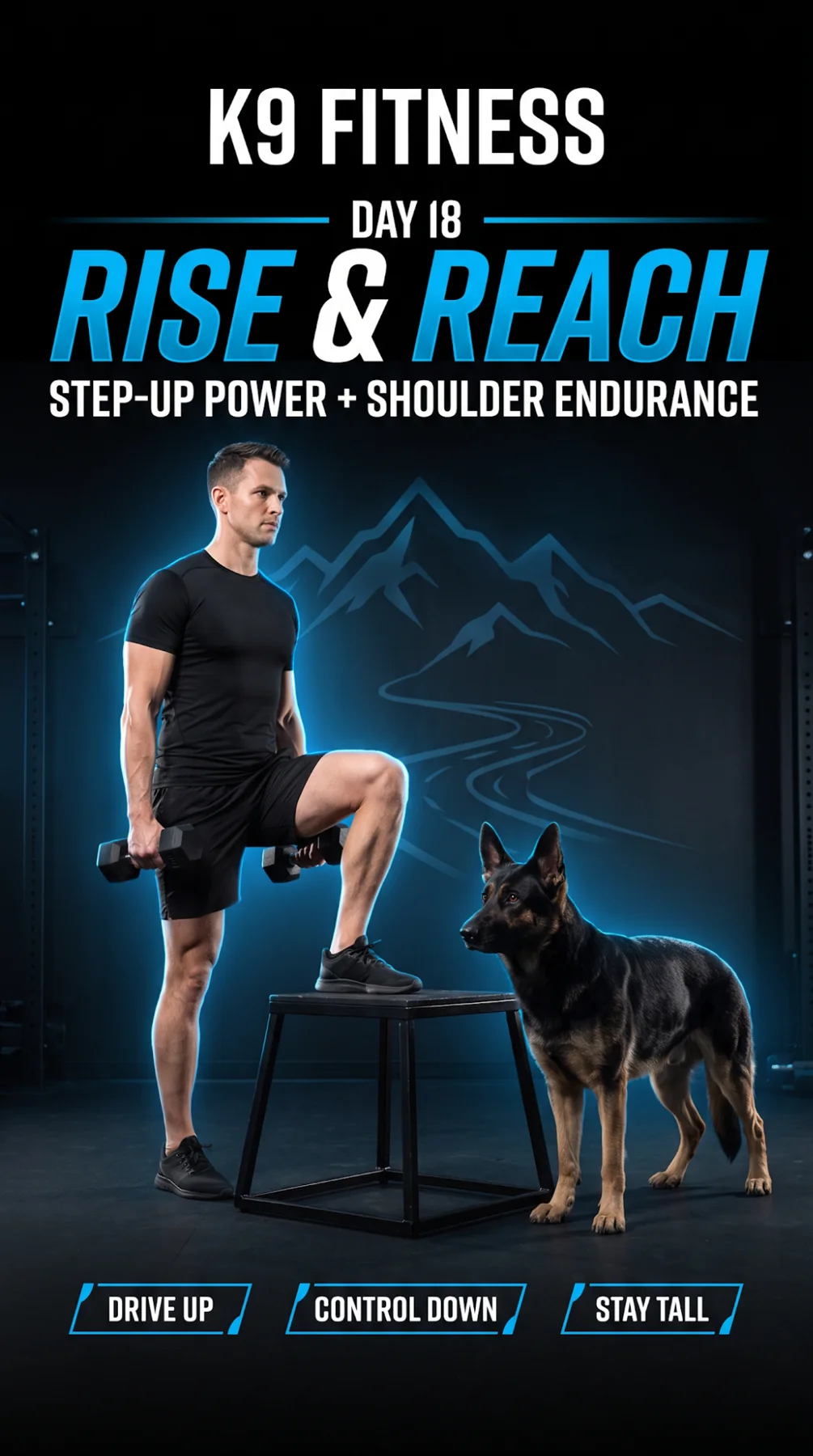
K9 FITNESS — DAY 18 OF 30
RISE & REACH
Step-Up Power + Shoulder Endurance
Day 17 taught you to control force on the way down. Day 18 turns that control into deliberate upward drive. The goal is not jumping, rushing, or chasing fatigue; it is learning to produce force smoothly through a stable foot, a steady trunk, and shoulders that can keep working as the legs get tired. That makes today a natural progression from eccentric control into practical power.
Step-ups are the centerpiece because they connect strength to something almost everyone does outside a workout: climbing stairs, stepping onto curbs, getting into a vehicle, moving uphill, or lifting the body onto uneven ground. The shoulder work follows the same idea. Rather than testing one heavy press, you will accumulate clean, moderate repetitions that teach the upper body to stay organized while the lower body is already working.
This session also keeps the human-and-canine partnership practical. A calm hill walk or a route with a few gentle elevation changes can mirror the day’s theme without turning your dog into exercise equipment. You train controlled climbing and posture; your dog gets purposeful movement, attention, and environmental variety at an appropriate pace.
WHY THIS DAY MATTERS
Day 18 is about converting control into usable force. Yesterday’s slow lowering work taught the legs and shoulders to manage tension while lengthening. Today asks those same areas to reverse direction and create motion without losing the positions you practiced. The better you can transition from “absorb” to “drive,” the more useful your strength becomes for stairs, hills, lifting, carrying, and everyday tasks that require repeated effort.
The shoulder component is deliberately endurance-focused. Real life rarely gives the shoulders one perfect repetition and a long rest. Reaching into a cabinet, carrying bags, working overhead, holding a child, handling tools, and managing a leash on changing terrain can require repeated low-to-moderate effort. The purpose of today’s pressing, raising, and bracing is to build that work capacity without turning every set into a grind.
SESSION OVERVIEW
• Target time: 35–45 minutes
• Equipment: sturdy low step or platform; one or two light-to-moderate dumbbells; wall or counter for balance if needed
• Effort: moderate; finish most strength sets with about 2 clean repetitions still available
• Primary focus: step-up power, single-leg stability, shoulder endurance, and posture under fatigue
• Day 18 rule: drive up smoothly, control down completely
WARM-UP — 6 TO 7 MINUTES
Today’s warm-up prepares the ankles, hips, knees, upper back, and shoulders for repeated climbing and pressing. Keep the first few minutes easy. The purpose is to improve movement quality before the main work begins, not to tire yourself out early.
1. EASY WALK OR MARCH — 90 seconds
Start relaxed, then gradually increase the pace. Let the arms swing naturally and keep the shoulders away from the ears.
2. ANKLE ROCKS — 8 reps per side
Face a wall with one foot slightly forward. Keep the heel down as the knee travels gently toward the wall, then return. Use a comfortable range.
3. BODYWEIGHT STEP-UP REHEARSAL — 6 reps per side
Use a low step. Place the whole foot on the surface, stand tall through the working leg, then return under control. Hold a wall if balance is limited.
4. ARM CIRCLES — 10 forward + 10 backward
Use a comfortable circle size and keep the ribs quiet instead of arching the back.
5. SCAPULAR WALL SLIDE — 8 reps
Slide the arms upward through a pain-free range while keeping the neck long and ribs stacked over the pelvis.
6. BODYWEIGHT SQUAT TO CALF RAISE — 8 reps
Sit into a comfortable squat, stand, then rise onto the balls of the feet with control. Pause briefly before lowering the heels.
BLOCK A — RISE STRONG
3 rounds • Rest 60–75 seconds between rounds
This block teaches you to create upward force without losing balance. Use loads that let every repetition look similar. If you have to push off hard with the trailing leg, twist to finish a press, or crash back down from the step, reduce the load or the step height.
1. STEP-UP WITH CONTROLLED KNEE DRIVE — 8 reps per side
Place one full foot on a sturdy low step. Drive through that foot to stand tall and bring the opposite knee forward to a comfortable height. Pause for one second at the top, then place the free foot down and return to the floor under control.
FORM CUE: Whole foot on the step; stand tall through the working hip; do not bounce off the back foot.
MODIFICATION: Remove the knee drive or hold a wall/rail for balance. Lower the step height if the working knee caves inward or the pelvis drops.
2. HALF-KNEELING SINGLE-ARM DUMBBELL PRESS — 8 reps per side
Set up with one knee down and the opposite foot forward. Hold a light dumbbell at shoulder height, press overhead through a comfortable range, then return smoothly. Keep the glute on the kneeling side lightly engaged so the torso does not lean backward.
FORM CUE: Ribs stacked; wrist over elbow; finish tall without shrugging.
MODIFICATION: Perform the press seated or standing if kneeling is uncomfortable.
3. SPLIT SQUAT TO CALF RAISE — 8 reps per side
Use a split stance and lower through a comfortable range. Stand by pressing through the front foot, then finish with a gentle calf raise before lowering the heel and beginning the next repetition.
FORM CUE: Front foot stays planted; torso remains tall; rise smoothly instead of snapping upward.
MODIFICATION: Hold a support and remove the calf raise if balance is the limiting factor.
4. INCLINE PLANK SHOULDER TAP — 10 taps per side
Place the hands on a sturdy bench, counter, or wall. Create a straight line from head to heels and slowly lift one hand to tap the opposite shoulder. Return the hand before switching sides.
FORM CUE: Keep the hips quiet; press the support away; move one hand at a time.
MODIFICATION: Use a higher surface to reduce the load.
BLOCK B — REACH + STABILIZE
3 rounds • Rest about 60 seconds between rounds
The second block builds shoulder endurance while the legs continue to work in different directions. The pace should feel athletic but controlled. You should be able to breathe normally and finish every repetition without rushing through the last few inches of range.
1. LATERAL STEP-UP — 8 reps per side
Stand sideways next to a low step and place the inside foot fully on top. Push through that foot to stand tall, then lower with control. Keep the pelvis level and avoid letting the knee collapse inward.
FORM CUE: Knee follows the toes; hips stay level; quiet landing.
2. DUMBBELL SCAPTION RAISE — 10–12 reps
Hold light dumbbells with the arms slightly forward of the body rather than directly out to the sides. Raise through a comfortable range, usually no higher than shoulder level, then lower slowly.
FORM CUE: Reach outward; keep the neck relaxed; stop before the shoulders shrug.
MODIFICATION: Use no weight or perform one arm at a time.
3. SUPPORTED SINGLE-LEG RDL — 8 reps per side
Stand on one leg with a light hand on a wall or chair. Soften the working knee, hinge at the hip, and reach the free leg behind you as the torso tips forward. Squeeze the glute to return to standing.
FORM CUE: Hips stay square; spine remains long; movement comes from the hip.
MODIFICATION: Keep the toes of the back foot lightly on the floor as a kickstand.
4. SUITCASE MARCH — 30 seconds per side
Hold one dumbbell at your side and march slowly in place. Keep the torso vertical instead of leaning away from the weight. Switch hands after 30 seconds.
FORM CUE: Stay tall; quiet feet; breathe behind the brace.
5. WALL SLIDE OR WALL ANGEL — 8 reps
Move the arms upward through a comfortable range while maintaining gentle abdominal tension. Do not force the hands or elbows flat against the wall if your mobility does not allow it.
FORM CUE: Ribs stay down; shoulders stay away from the ears; smooth motion.
FINISHER — CLIMB + HOLD
2 rounds • Rest 45 seconds between rounds
The finisher combines repeated leg drive with static shoulder and trunk control. Keep the movement crisp. If your posture starts to collapse, stop the set early rather than racing to the end.
• ALTERNATING LOW STEP-UPS — 30 seconds
• FRONT-RACK DUMBBELL HOLD — 20 seconds
• BODYWEIGHT SQUAT TO CALF RAISE — 10 reps
• INCLINE PLANK HOLD — 20 seconds
• EASY WALK — 30 seconds
The goal is consistency from the first round to the second. Choose a step height and dumbbell load that let you move with the same posture even when breathing is elevated.
CANINE PARTNER OPTION — EASY HILL WALK
If your dog is healthy, comfortable on leash, and already accustomed to regular walks, choose a 10–20 minute route with one or two mild hills or gentle elevation changes. Keep the climb conversational rather than turning it into a sprint. On the way down, shorten your steps and keep the leash organized so neither partner is being pulled downhill.
Your dog does not need added weight, repeated stair sprints, box jumps, or forced climbing to participate. Puppies, senior dogs, dogs with known orthopedic or neurologic concerns, and dogs showing limping, stiffness, reluctance, or unusual fatigue should stay on comfortable flat terrain. Weather, hydration, paw-surface temperature, and safe footing matter more than completing a specific distance.
The shared lesson is simple: elevation changes the demand without requiring extreme speed. You practice pushing into the ground and staying tall; your dog practices calm movement, footing, and attention on changing terrain. Both partners benefit most when the pace remains controlled.
COOLDOWN — 5 MINUTES
• EASY WALK — 60 seconds
• STANDING CALF STRETCH — 30 seconds per side
• HALF-KNEELING HIP-FLEXOR STRETCH — 30 seconds per side
• SUPPORTED QUAD STRETCH — 30 seconds per side
• CROSS-BODY SHOULDER STRETCH — 30 seconds per side
• DOORWAY CHEST STRETCH — 30 seconds
• SLOW BREATHING — 5 relaxed breaths
RECOVERY NOTE
Today combines unilateral leg work with repeated shoulder effort, so fatigue may show up as reduced balance before the muscles feel completely spent. That is normal information, not a reason to force extra repetitions. If a set becomes wobbly, shorten the set, use support, or lower the load. Preserving clean movement gives you a better training signal than finishing a prescribed number with poor control.
Recovery remains basic and effective: eat normally, include adequate protein and carbohydrate, stay hydrated, sleep as consistently as you can, and use easy walking or light mobility if you feel stiff later. You do not need an additional leg or shoulder “burnout” tonight. The session is complete when the planned work is done well.
DAILY MISSION — TAKE THE HIGHER ROUTE
Choose one ordinary task today that involves stepping up or reaching and do it with deliberate posture. Take a short flight of stairs instead of rushing an elevator ride. Step onto a curb without collapsing into the hip. Put a light object onto a shelf while keeping the ribs stacked instead of leaning backward. The goal is not to turn daily life into a workout; it is to notice whether the strength you are building shows up when you need it.
If you walk your dog today, use one mild hill as a movement check. Keep your pace steady, stay tall, and notice whether you can climb without tugging on the leash or leaning excessively forward. That is real-world training: coordinated effort in an environment that does not look like a gym.
COURSE PROGRESS — DAY 18 OF 30
Day 17 trained deceleration and the ability to absorb force. Day 18 builds directly on that foundation by asking you to reverse direction and create upward force while keeping the same control. You now have a simple two-day pairing: own the descent, then own the rise. That combination is more transferable than chasing speed without positional control.
You are also beginning to accumulate more shoulder volume without relying on heavy loads. That matters for the back half of the course, where strength and endurance will increasingly overlap. Keep one note after today’s workout: which exercise made you lose posture first—the step-up, press, lateral raise, RDL, or carry? That answer helps you identify whether the current limiter is leg strength, shoulder endurance, balance, or trunk control.
SAFETY NOTE
This course provides general fitness education and is not individualized medical care. Use only a stable step or platform that cannot slide, tip, or collapse. Clear the floor around your training area, wear footwear that grips the surface, and use a wall or railing whenever balance support improves your form.
Choose shoulder loads that you can press and raise without sharp pain, aggressive shrugging, leaning backward, or holding your breath. Stop an exercise if you experience sharp pain, dizziness, chest pain, sudden weakness, numbness, unusual shortness of breath, or another concerning symptom. If you have a recent injury or surgery, significant joint or back pain, a condition affecting balance or exercise tolerance, or specific rehabilitation restrictions, use qualified medical or rehabilitation guidance before progressing.