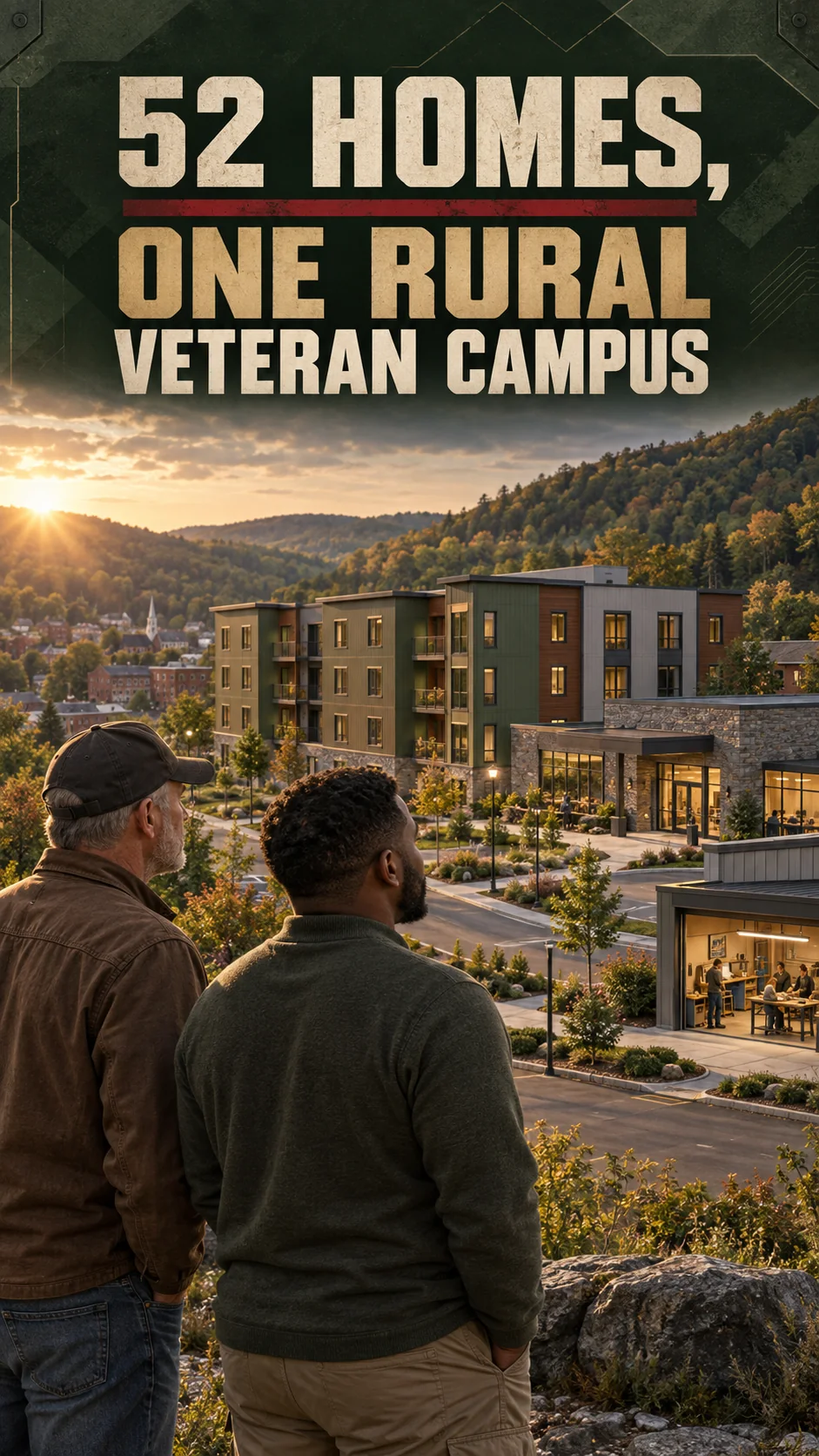
52 Homes, One Rural Veteran Campus
Winsted, Connecticut’s proposed housing-and-innovation center moves forward—with important conditions still ahead
INVEST IN VETS DAILY | Sep 21, 2026
Fresh article-specific cover. Conceptual illustration; not an architectural rendering of the proposed project.
In Winsted, Connecticut, a small-town redevelopment proposal is trying to connect three needs that often sit in separate systems: affordable housing, Veteran health care, and pathways to skilled work. The Northwest Connecticut Housing and Innovation Center, or NCHIC, is proposed for 115 Spencer Street on the Winsted Health Center campus. Its current concept calls for 52 affordable apartments, a renovated and expanded VA community-based outpatient clinic, and a makerspace and innovation center for training, prototyping, and entrepreneurship.
That combination is ambitious, but its status needs to be stated precisely. A Winchester commission granted conditional approval following a public hearing on Sep 14, 2026, according to local reporting published Sep 19, 2026. The project is not open, under construction, or accepting housing applications. Organizers still need final design approval and enough state grants, tax-credit investment, and other financing to proceed with demolition and construction.
For Invest in Vets, the story is valuable because it shows what a rural housing partnership can aim for—and what must be verified before an announcement is treated as housing delivered.
What is actually proposed in Winsted
NCHIC’s current project page identifies one 77,275-square-foot building with 52 affordable housing units. The site says Veterans would receive priority, while the housing would also serve other community members across different area-median-income levels. Local reporting likewise describes Veteran leasing priority but says military service would not be required for every resident.
That distinction matters. The confirmed total is 52 proposed apartments; no public source reviewed for this edition identifies a fixed number reserved exclusively for Veterans. A Veteran preference is not the same thing as a Veteran-only set-aside, and it does not establish who will qualify. The project has not yet published final income bands, rent levels, application procedures, referral rules, voucher policies, or a leasing date. Until those details exist, this is a promising pipeline project—not an available placement.
The campus plan also keeps an existing Veteran health connection on the property. NCHIC describes a renovated and expanded VA Community-Based Outpatient Clinic. Its makerspace concept includes computer workstations, design software, 3D printers, laser cutters, textile equipment, CNC tools, and job-oriented instruction. Those elements could make the site more than an apartment building, especially in a rural region where housing, medical appointments, and training can require separate trips and long travel distances.
The design changed because the numbers changed
The project has evolved substantially. On Jun 3, 2025, construction manager O&G Industries described a roughly $30 million renovation that would convert about 40,000 square feet of the existing health center into 40 affordable apartments while adding training, commercial-kitchen, co-working, and rooftop spaces. The current plan is different: 52 units in a new apartment building, and local reporting says the commercial kitchen is no longer included.
That is not a minor revision. The former Litchfield County Hospital dates to 1902, with a second building opened in 1957. The hospital closed in 1996, and the campus later housed the VA outpatient clinic and other health providers. NCHIC leaders told CT Insider that renovation costs could not be justified for the funding needed, leading the team toward demolition and new construction.
The current NCHIC page lists total development costs of $29,538,750 and identifies a proposed mix that includes environmental-remediation funding, congressional support for the makerspace, predevelopment funding, Connecticut housing resources, low-income housing tax-credit investment, and support for the innovation center. Those line items should be read as the project’s published financing plan, not proof that every dollar has closed. The latest reporting says grants, tax credits, and other financing still must be secured.
The correct progress label is therefore conditionally approved and seeking final approvals and financing. It is not funded in full, under construction, complete, open, or occupied. No Veteran housed count can be attributed to the project today.
Why the model could matter for deployed Veterans
Many deployed Veterans learned to solve problems quietly, carry their own weight, and avoid appearing vulnerable. Those strengths can become barriers when housing instability, trauma, chronic pain, or a service-connected condition begins to affect daily life. A Veteran may avoid a shelter, a disability conversation, or even a first appointment because asking for help feels like surrendering identity.
A campus that places ordinary housing beside a familiar VA clinic and practical skills training may lower that psychological threshold. Someone could enter for health care, a workshop, or employment training without being publicly labeled by homelessness. That is an inference about the potential value of the design, not a measured outcome. The final operating plan will still need confidential, trauma-informed outreach and warm handoffs for Veterans who do not self-identify as homeless.
The benefit systems must also remain separate in public messaging. VA disability compensation is a monthly benefit for eligible service-connected conditions. HUD-VASH combines HUD rental assistance with VA case management for eligible Veterans experiencing homelessness. Post-9/11 GI Bill education payments depend on eligibility, enrollment, training time, school location or online status, and other rules. A housing voucher is not spendable cash, and no source says NCHIC applicants will automatically receive any of these benefits. Outreach should help each Veteran obtain an individual eligibility assessment rather than advertising a guaranteed benefit stack.
What Invest in Vets can learn and pursue
Winsted’s proposal suggests a replicable partnership structure: mission-driven land or building control, an affordable-housing developer and construction team, a health-care anchor, workforce partners, and layered public and tax-credit financing. Invest in Vets could study that structure for smaller versions built around duplexes, triplexes, scattered-site apartments, or rehabilitated properties.
The immediate lesson is to build a verification checklist before promoting a project. Ask who owns the site; whether zoning and final design are approved; which funding sources are awarded versus still sought; how many units are total, Veteran-priority, or Veteran-exclusive; whether vouchers will be accepted; who provides supportive services; when leasing begins; and what outcome data will be reported after move-in.
There is also a practical partnership opportunity. Invest in Vets could approach NCHIC and local Veteran-serving organizations about three narrow contributions: identifying voucher-aware landlords for Veterans who cannot wait for the campus, helping prospective residents assemble legitimate documents when an application process is announced, and recruiting small-business or technical mentors for the makerspace. Any collaboration should be confirmed in writing before it is presented publicly as a partnership.
What to watch next
The next meaningful milestones are final design approval, documented financing commitments, demolition and construction authorization, a construction start, published affordability and Veteran-priority rules, and an official leasing or referral process. Only after residents move in should success be measured by occupied units, the number of Veterans served, housing retention, access to care, and training or employment outcomes.
Winsted has not ended Veteran homelessness, and 52 proposed apartments cannot meet every regional need. But the concept offers a serious question for communities nationwide: can housing, health care, and economic opportunity be designed as one coordinated local response instead of three disconnected referrals? Invest in Vets should follow the answer—carefully, publicly, and milestone by milestone.
Veteran resources and ways to help
Veterans who are homeless or at imminent risk of homelessness can call the National Call Center for Homeless Veterans at 1-877-4AID-VET (1-877-424-3838). The VA says the line is free, confidential, and available 24 hours a day, seven days a week.
Veterans in emotional crisis—or anyone concerned about a Veteran—can dial 988 and press 1, text 838255, or use the Veterans Crisis Line chat. Enrollment in VA benefits or health care is not required to contact the crisis line.
Veterans, landlords, developers, and supporters can connect with Invest in Vets at investinvets.online. Landlords can help by identifying safe, code-compliant units and learning the applicable inspection and rental-assistance process. Investors and developers can help by bringing real sites, realistic financing, and long-term operating partners to the table.
Sources and reporting dates
Reporting cutoff: Sep 21, 2026. Project status reflects sources available by that date.
1. Northwest Connecticut Housing and Innovation Center — Project Overview
https://www.nchic.org/projectoverview
Current project concept, 52-unit count, 77,275-square-foot program, amenities, and published development-cost plan.
2. Northwest Connecticut Housing and Innovation Center — Home and Property Use
Current address, Veteran-priority description, VA clinic, makerspace, and community-use concept.
3. CT Insider — Winchester backs innovative housing plan for historic hospital campus
https://www.ctinsider.com/realestate/article/winchester-winsted-va-veterans-housing-22430629.php
Published Sep 19, 2026; conditional approval, remaining approvals and financing, redesign from renovation to new construction, and current project status.
4. O&G Industries — $30 Million Transformation of Winsted Health Center
Published Jun 3, 2025; documents the earlier 40-unit renovation concept and O&G’s construction-management role.
5. VA — National Call Center for Homeless Veterans
https://www.va.gov/homeless/nationalcallcenter.asp
Current crisis-housing contact and availability.
6. Veterans Crisis Line
https://www.veteranscrisisline.net/
Current crisis contact options and eligibility statement.