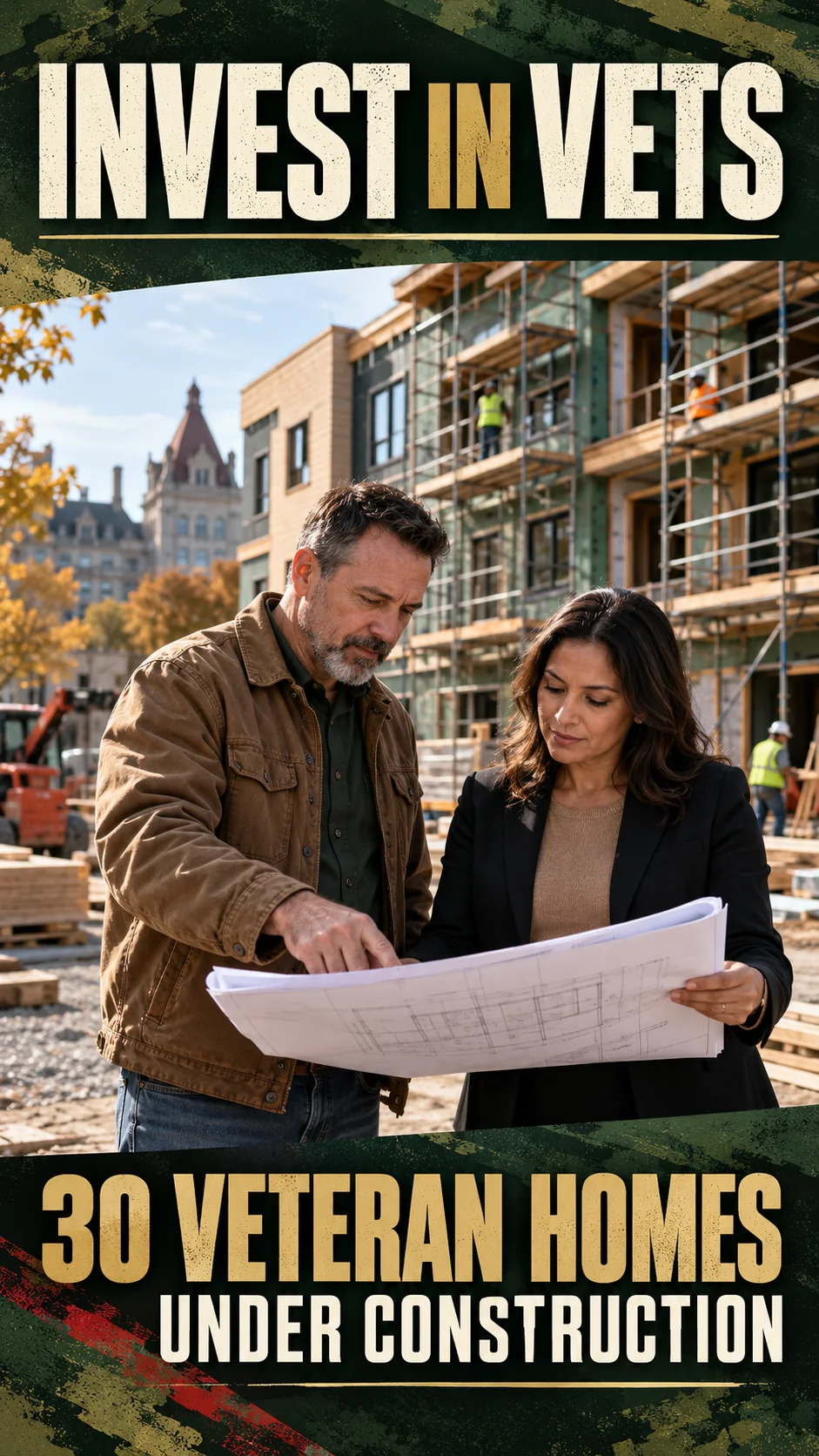
INVEST IN VETS DAILY LOCAL HOUSING CASE STUDY
Albany Freedom Springs Adds 30 Veteran Homes
What a 120 unit affordable housing partnership is building and why occupancy still needs to be verified
ALBANY NEW YORK
Albany Freedom Springs Adds 30 Veteran Homes
Freedom Springs shows how a city, state housing agencies, a mission-driven developer and a Veteran service provider can align capital, tax relief and onsite support. It also shows why projects still under construction must be reported as housing in progress, not people already housed.
Status on Oct 4, 2026: Freedom Springs at 64 Colvin Avenue is under construction. Public sources continue to target fall 2026 for completion, but Invest in Vets found no authoritative announcement of an opening, certificate of occupancy or resident move-ins. The 30 Veteran-designated apartments are units in the pipeline, not a measured count of Veterans already housed.
TOTAL AFFORDABLE UNITS | VETERAN DESIGNATED | SENIOR DESIGNATED | TOTAL DEVELOPMENT COST |
120 | 30 | 30 | $55.63 million |
What Albany Is Building
Freedom Springs is a new affordable-housing development on roughly three acres at 64 Colvin Avenue in Albany. Vecino Group New York is developing a three-story residential complex with a separate community-service building, while Vecino Management is slated to manage the property. The project pairs 120 apartments with community space and amenities that include a community room, fitness facilities, laundry on each floor, outdoor seating and recreation areas, and free high-speed broadband. Its location also matters: state underwriting materials place groceries, urgent care, a public library and transit within practical reach.
The unit commitments are clearer than the bedroom mix. Albany and state sources agree on 120 total affordable apartments, including 30 reserved for Veterans experiencing or at risk of homelessness and 30 reserved for seniors with similar housing vulnerability. The remaining 60 apartments are intended for income-qualified households, reported by Capitalize Albany in April 2024 as serving residents between 50 and 80 percent of area median income. Public materials disagree on the exact one-bedroom and two-bedroom breakdown, so Invest in Vets is relying on the confirmed total and set-asides rather than repeating an uncertain mix.
The 30 Unit Veteran Set Aside
Veteran designation is not simply a marketing theme at Freedom Springs. New York State Homes and Community Renewal underwriting identifies Albany Housing Coalition as the service provider for the 30 Veteran supportive-housing apartments. Referrals are expected to come through Albany County’s homelessness system and the local Continuum of Care, which means eligibility and placement will be coordinated rather than based on a first-come public application. Veterans should contact the Coalition or the VA homeless hotline for screening and navigation instead of assuming that a general leasing inquiry secures a supportive unit.
That access pathway is especially important because “at risk” can look different from street homelessness. A Veteran may be sleeping in a vehicle, rotating among relatives, leaving an institution without stable housing, facing eviction or carrying rent arrears that threaten a lease. A coordinated referral process can match the household to the appropriate intervention, but only if outreach reaches people before a crisis becomes visible.
Services Designed Around Staying Housed
Albany Housing Coalition’s planned role extends beyond handing over an apartment. State documents describe intensive case management, connections to VA medical and mental-health care, employment and job-training support, pharmaceutical assistance, free legal services and help with independent living. A trained peer-support specialist is also expected to live onsite and provide round-the-clock support. Gateway Community Industries is identified separately for the 30 senior supportive-housing apartments.
This design recognizes that a permanent lease is the foundation, not the finish line. A missed benefits appointment, an untreated condition, job disruption or an unresolved legal problem can destabilize housing quickly. Locating peer support and service navigation where people live reduces the number of offices a resident must find, makes follow-through easier and gives the property team a way to respond early without turning the residence into an institution.
A Layered Financing Partnership
Freedom Springs also illustrates the layered capital structure often required to produce deeply affordable housing. A September 2024 state underwriting package listed a total development cost of $55,632,360, or about $463,600 per apartment, with construction costs of roughly $30.81 million. Earlier Albany Industrial Development Agency materials described a $46.3 million investment; the later state figure is the more complete current underwriting total.
The financing package included a request for $28.76 million in tax-exempt construction bonds, with about $8.89 million expected to remain at permanent conversion. Federal Low-Income Housing Tax Credit equity was projected at about $20.81 million. The remaining sources included state housing subsidies, state tax-credit equity and borrower equity or deferred developer fee. Two Empire State Supportive Housing Initiative awards—one connected to the Veteran apartments and one to the senior apartments—were listed at approximately $750,000 each, or $25,000 per supportive unit annually.
Albany’s local contribution was not a standalone grant. The city’s IDA approved a 30-year residential payment-in-lieu-of-taxes agreement and a 15-year abatement for the community space, alongside sales and mortgage-recording tax benefits. The IDA estimated that the project would still deliver roughly $4.77 million in net benefit to local taxing jurisdictions. Citibank was identified as the construction credit enhancer, SONYMA’s Mortgage Insurance Fund for permanent credit support, and Red Stone Equity Partners as tax-credit investor. Each partner closes a different gap; no single funding stream does the whole job.
Progress Is Not Occupancy
Construction began in October 2024, and Albany’s 2025 Housing Audit listed the development as under construction with delivery expected in 2026. Current local reporting continues to place completion in fall 2026. Those milestones are meaningful: land, approvals, financing and construction are real progress. They are not evidence that 30 Veterans have moved in.
The next accountability points are opening and lease-up. Partners should publish the certificate-of-occupancy date, when referrals begin, how many supportive units are leased, how long applicants wait, and whether residents remain housed after six and twelve months. Until those measures are available, the honest description is that Albany has created a funded, active pipeline for 30 Veteran homes inside a larger 120-unit community.
Reaching Veterans Who Avoid the System
For some deployed Veterans, asking for help can feel like surrendering an identity built around self-reliance. Pride, stigma and reluctance to discuss service-connected conditions can delay both benefits claims and housing outreach until eviction, illness or isolation becomes severe. Freedom Springs’ live-in peer model can lower that threshold: a trusted person with relevant experience can start with practical concerns—rent, transportation, work or sleep—without demanding that a Veteran disclose everything at once.
Partners should also explain benefits precisely. VA disability compensation is a monthly cash benefit based on a service-connected disability rating and individual circumstances. HUD-VASH combines a housing-choice voucher with VA case management; the voucher pays an approved housing subsidy and is not spendable cash. The Post-9/11 GI Bill housing allowance is an education benefit whose amount depends on eligibility tier, enrollment level, learning modality and the school’s location. A Veteran may qualify for one, several or none of these programs, and Freedom Springs eligibility does not establish entitlement to all three.
What Invest in Vets Can Adapt
The strongest transferable lesson is the partnership architecture. A local government can assemble land-use approvals and tax tools; a housing agency can provide bonds, tax credits and subsidy; a developer can deliver and manage the real estate; and a Veteran specialist can own the service relationship. Reserving one-quarter of the apartments for Veterans also places supportive housing inside a broader mixed-income community rather than isolating residents in a single-purpose campus.
Invest in Vets could pursue similar projects by convening a city or county housing office, a tax-credit developer, the local Continuum of Care, a VA medical center and an experienced Veteran nonprofit before a site is selected. The service budget should be attached to the operating plan from the start, with peer support, benefits navigation, legal help, employment access and outcome reporting defined before construction ends. The goal is not only to finance doors; it is to create a durable system that helps Veterans enter, remain and recover in a home.
Veteran Resources
• Albany Housing Coalition: Veteran housing and service navigation at 278 Clinton Avenue, Albany. Call (518) 465-5251 or visit ahcvets.org/contact.
• National Call Center for Homeless Veterans: For a Veteran who is homeless or at imminent risk, call 877-424-3838 at any time or visit department.va.gov/homeless/nationalcallcenter/.
• Veterans Crisis Line: For confidential crisis support, dial 988 then press 1, text 838255, or visit www.veteranscrisisline.net/.
• HUD VASH information: Learn how HUD rental assistance and VA case management work together at department.va.gov/homeless/hud-vash/.
Veterans and families: Ask for screening before a housing loss becomes an emergency. A call does not obligate you to disclose more than you are ready to share.
Landlords and property managers: Partner with local Veteran housing teams to accept qualified tenants, coordinate inspections and respond early when a lease is at risk.
Investors and housing partners: Bring patient capital, land, tax-credit expertise and operating support to projects that pair permanent homes with funded services.
Supporters: Fund peer outreach, legal help, transportation, furnishings and flexible stabilization costs that traditional construction budgets rarely cover.
Sources
3. Capitalize Albany. Apr 18, 2024. Affordable housing investment supporting Veterans and seniors at risk of homelessness.
5. Times Union. Dec 31, 2025. Construction began in October 2024 with completion estimated for fall 2026.
6. Times Union. Construction tracker, reviewed Oct 4, 2026. Freedom Springs remains listed with fall 2026 expected completion.
7. Albany Housing Coalition. Contact and Veteran housing services, reviewed Oct 4, 2026.
8. U.S. Department of Veterans Affairs. National Call Center for Homeless Veterans and HUD-VASH program information, reviewed Oct 4, 2026.