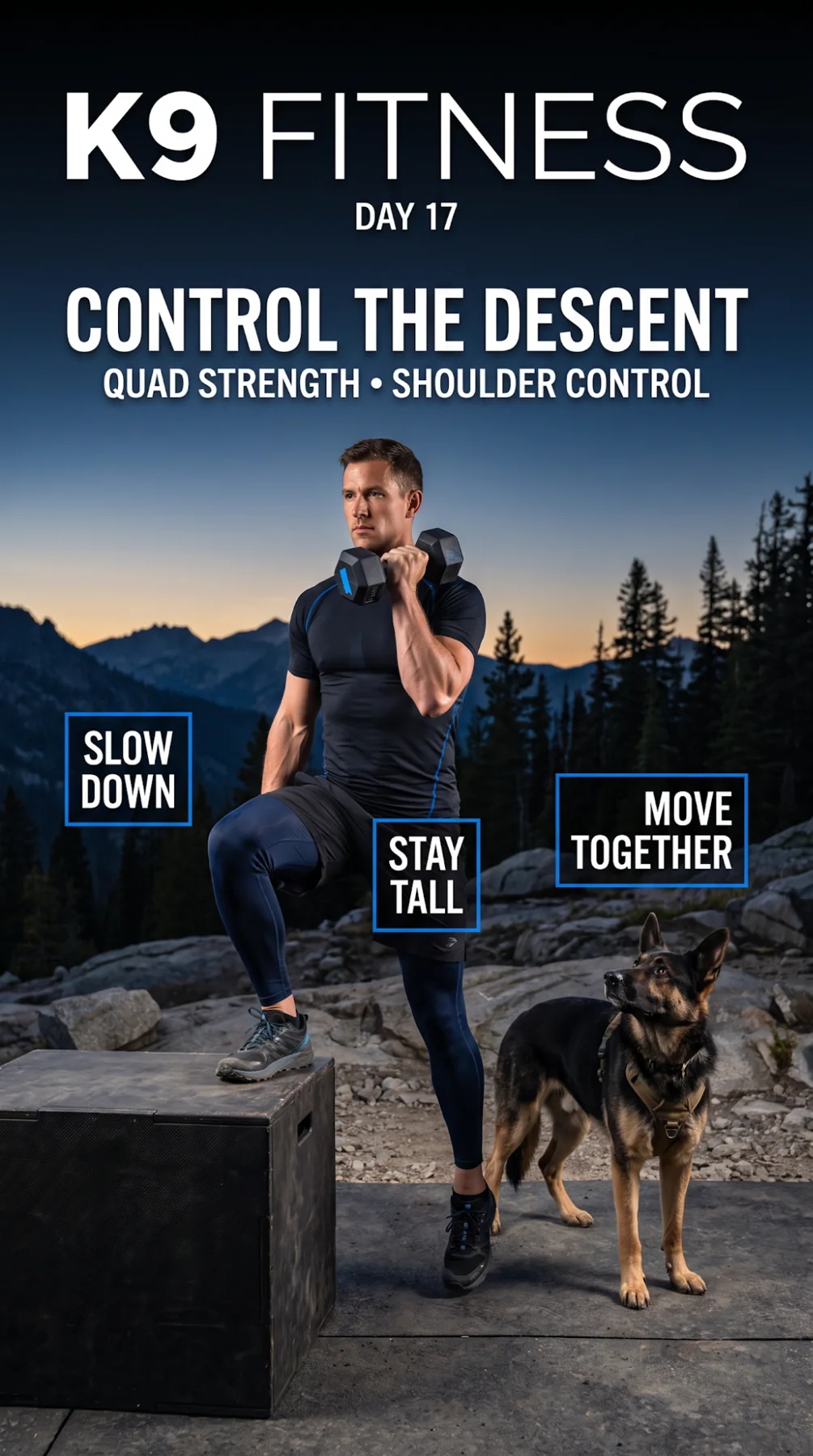
K9 FITNESS — DAY 17 OF 30
CONTROL THE DESCENT
Eccentric Leg Strength + Shoulder Control
Day 16 built force through the hips, loaded carries, and strong bracing. Day 17 changes the question: can you control force on the way down? Today’s session emphasizes eccentric strength—the ability of a muscle to stay active while lengthening—as you lower from a step, sink into a squat, decelerate a lunge, and lower through a press. That slower phase is where a lot of balance, joint control, and body awareness get trained.
The goal is not to make every repetition painfully slow. The goal is to own the transition instead of dropping into it. A controlled lowering phase teaches the legs to absorb force and gives the shoulders time to organize under load. That matters on stairs, curbs, hills, uneven ground, and any situation where you have to lower yourself or an object without collapsing into the movement.
This is also a good day to notice asymmetry without turning it into a problem. One leg may control a step-down more smoothly. One shoulder may feel steadier in a half-kneeling press. Use those differences as information. Keep the range honest, choose loads that let both sides work cleanly, and resist the urge to rush the weaker side just to make the numbers match.
WHY THIS DAY MATTERS
Most people think about strength as the ability to lift, stand, push, or climb. But real-world movement also requires you to slow down, lower, and absorb force. Walking downhill, stepping off a curb, sitting into a chair, descending stairs, lowering a child to the floor, and setting down a heavy bag all ask the body to control motion instead of simply creating it.
That makes eccentric control an important bridge between gym strength and everyday movement. When you lower a split squat under control, the front leg has to manage tension through the ankle, knee, and hip. When you lower a dumbbell from a press slowly, the shoulder and upper back have to keep the arm organized instead of letting the weight fall. Today trains those qualities together.
For the canine partner, controlled terrain work follows a similar principle. A calm walk on a mild slope or over changing surfaces asks the dog to adjust footing, body position, and pace. The purpose is not to turn the dog into a workout prop. It is to create a shared session where both partners practice steady movement, attention, and control.
SESSION OVERVIEW
• Target time: 35–45 minutes
• Equipment: sturdy low step or platform; one or two light-to-moderate dumbbells; wall or counter for support
• Effort: moderate; keep 2–3 clean repetitions in reserve on most strength sets
• Primary focus: eccentric quad strength, single-leg control, shoulder stability, and deceleration
• Day 17 rule: own the lowering phase
WARM-UP — 6 TO 7 MINUTES
Today’s warm-up prepares the ankles, knees, hips, and shoulders for controlled ranges of motion. Move smoothly enough that you can feel where your weight is going. If one drill exposes stiffness or poor balance, reduce the range and use support rather than forcing the position.
1. EASY WALK OR MARCH — 90 seconds
Start easy and gradually increase your pace. Keep the shoulders relaxed and let the arms swing naturally.
2. ANKLE ROCKS — 8 reps per side
Stand facing a wall with one foot forward. Keep the heel down and gently drive the knee forward over the toes, then return. Use a pain-free range.
3. SUPPORTED SPLIT-SQUAT LOWER — 6 reps per side
Use a wall or chair for balance. Start tall in a split stance and take about three seconds to lower into a shallow split squat. Stand normally. The goal is control, not depth.
4. WALL SLIDE — 8 reps
Stand with your back near a wall. Slide the arms upward through a comfortable range while keeping the ribs from flaring. Return slowly.
5. LOW STEP-DOWN REHEARSAL — 5 reps per side
Stand on a low step and slowly reach one heel toward the floor. Keep the working knee tracking over the foot. Use support if needed.
6. SCAPULAR PUSH-UP AT WALL OR COUNTER — 8 reps
Keep the elbows straight. Let the shoulder blades glide toward one another slightly, then push the surface away so they spread. Keep the neck relaxed.
BLOCK A — CONTROL THE LOWER
3 rounds • Rest 60–75 seconds between rounds
This block puts the day’s main principle into practice: lower with intention, then return to the start position with steady force. A three-second lowering phase is enough. If the tempo makes your form fall apart, shorten the range or reduce the load.
1. LATERAL STEP-DOWN — 8 reps per side
Stand sideways on a low, stable step with one foot supported and the other leg hanging off the edge. Take about three seconds to bend the working knee and lower the free heel toward the floor. Lightly tap or stop just before contact, then drive through the working foot to stand.
FORM CUE: Hips stay level; knee follows the toes; lower quietly.
MODIFICATION: Use a shorter step or hold a wall. If knee discomfort appears, replace the movement with a supported sit-to-stand from a chair.
2. HALF-KNEELING SINGLE-ARM DUMBBELL PRESS — 8 reps per side
Kneel with one knee down and the opposite foot forward. Hold a light dumbbell at shoulder height on the same or opposite side, whichever feels more stable. Press overhead without leaning backward, then take about three seconds to lower the weight back to the shoulder.
FORM CUE: Glute lightly engaged; ribs stacked; slow return.
MODIFICATION: Perform the press seated or standing with a lighter weight if kneeling is uncomfortable.
3. HEEL-ELEVATED BODYWEIGHT OR GOBLET SQUAT — 10 reps
Place the heels on a very small stable elevation if that position feels comfortable, or keep the feet flat. Lower for three seconds, pause briefly, then stand at a normal speed. Keep pressure through the whole foot rather than rolling onto the toes.
FORM CUE: Sit between the feet; knees track naturally; stay tall.
MODIFICATION: Use a chair target or hold a counter.
4. WALL SLIDE WITH CONTROLLED LOWER — 8 reps
Slide the arms up through a comfortable range, pause for one second, then take three seconds to return. Keep the shoulders away from the ears and avoid forcing the hands flat against the wall.
FORM CUE: Ribs quiet; neck long; smooth lowering phase.
BLOCK B — DECELERATE + STABILIZE
3 rounds • Rest about 60 seconds between rounds
The second block adds side-to-side movement and trunk control. Keep the pace deliberate. These exercises should make you feel coordinated, not rushed.
1. LATERAL LUNGE TO STAND — 8 reps per side
Step out to the side, sit the hips back over the stepping leg, and keep the opposite leg long but not locked. Take two to three seconds to lower, then push through the stepping foot to return to center.
FORM CUE: Hips travel back; working foot stays planted; stand without bouncing.
2. FRONT-RACK MARCH — 30 seconds
Hold one or two light dumbbells at shoulder height. March slowly in place while keeping the torso tall. Each foot should return quietly to the floor.
FORM CUE: Stay stacked; breathe normally; make every step deliberate.
3. SLOW INCLINE PUSH-UP — 8–12 reps
Place the hands on a sturdy counter, bench, or wall. Lower the chest toward the surface for three seconds, pause briefly, and push away smoothly. Choose a surface height that lets you keep a straight line from head to heels.
FORM CUE: Elbows angle naturally; body moves as one unit; no head-first dive.
4. PRONE OR STANDING Y-RAISE — 8–10 reps
Use no weight or very light weight. Raise the arms in a Y shape through a comfortable range while keeping the shoulders down away from the ears. Lower slowly.
FORM CUE: Reach long, not high; shoulder blades move smoothly; stop before shrugging.
FINISHER — QUIET CONTROL
2 rounds • Rest 45 seconds between rounds
The finisher keeps the theme simple: stay controlled while fatigue begins to rise. Do not race the clock.
• WALL SIT — 30 seconds
• LOW-STEP ALTERNATING TOE TAP — 20 total
• TALL-KNEELING OR STANDING DUMBBELL HOLD AT CHEST — 30 seconds
• SLOW BODYWEIGHT SQUAT — 8 reps with 3-second lowering
• EASY WALK — 30 seconds
Your second round should look almost identical to your first. If your knees cave inward, your shoulders shrug hard, or the tempo disappears, end the round early. Quality is the target.
CANINE PARTNER OPTION — CONTROLLED DESCENT WALK
If your dog is healthy, comfortable on leash, and already used to regular walking, choose a short 10–15 minute route that includes a mild slope or gently changing terrain. Keep the pace easy on the descent. Your job is to avoid being pulled downhill, keep the leash organized, and use shorter controlled steps. Your dog’s job is simply to walk calmly and choose safe footing.
Do not add repeated stair sprints, jumping, weighted vests, or steep downhill work. Puppies, senior dogs, dogs with known orthopedic or neurologic concerns, and dogs showing limping, stiffness, reluctance, or unusual fatigue should use flat, comfortable terrain instead. Heat, surface temperature, hydration, and footing still matter more than completing a prescribed distance.
The connection to today’s human training is direct: slowing down is a skill. You are practicing controlled deceleration in step-downs and squats while your dog practices calm movement on changing ground. The shared challenge is not speed—it is composure.
COOLDOWN — 5 MINUTES
• EASY WALK — 60 seconds
• STANDING QUAD STRETCH OR SUPPORTED HEEL-TO-SEAT HOLD — 30 seconds per side
• CALF STRETCH — 30 seconds per side
• HALF-KNEELING HIP-FLEXOR STRETCH — 30 seconds per side
• CROSS-BODY SHOULDER STRETCH — 30 seconds per side
• DOORWAY CHEST STRETCH — 30 seconds
• SLOW BREATHING — 5 relaxed breaths
RECOVERY NOTE
Eccentric work can create more next-day muscle soreness than faster repetitions, especially if you are new to slow lowering phases. That does not mean soreness is required for progress. Keep the loads moderate, avoid adding extra sets just because the tempo feels different, and let today’s volume be enough. Normal meals, adequate protein, carbohydrate, hydration, sleep, and light movement are more useful than trying to “burn out” the same muscles again later.
Pay attention to where you feel the work. Muscle fatigue in the quads, glutes, upper back, and shoulders can be expected. Sharp pain inside a joint, sudden loss of strength, numbness, dizziness, chest pain, or unusual shortness of breath are different signals. Stop the exercise and seek appropriate medical guidance rather than forcing the session.
DAILY MISSION — DESCEND WITH PURPOSE
Pick one ordinary lowering task today and make it deliberate. Walk down a short flight of stairs without dropping from step to step. Sit into a chair under control instead of collapsing into it. Lower a grocery bag to the floor with a steady hinge and soft knees. The object is not to move in slow motion all day; it is to notice whether you can control the final part of a movement.
That awareness is one of the reasons this course mixes strength with movement skill. Strong muscles matter, but usable strength also depends on timing, balance, and the ability to absorb force. When you can slow yourself down cleanly, you gain options.
COURSE PROGRESS — DAY 17 OF 30
Day 16 began the second half of the course with posterior-chain power, bracing, and loaded movement. Day 17 follows by training the opposite side of force production: deceleration. You are now building strength that can both create motion and control it. That progression sets up later days where power, unilateral work, and endurance can be layered together without losing form.
Keep one simple note after today’s session: which movement was hardest to lower smoothly? It might be the step-down, squat, press, or push-up. That answer tells you where control is still developing. You do not need to fix it in one day. You need to keep practicing it cleanly.
SAFETY NOTE
This course provides general fitness education, not individualized medical care. Use a stable step that cannot slide or tip, and clear the floor around it before starting. If you need balance support, use a wall, railing, or sturdy counter rather than trying to “earn” instability. For slow squats and lunges, reduce depth before allowing the knees, feet, or trunk to lose position.
Use shoulder loads that you can lower under control without leaning, shrugging aggressively, or holding your breath. Stop an exercise if you experience sharp pain, dizziness, chest pain, sudden weakness, numbness, unusual shortness of breath, or another concerning symptom. If you have a recent injury or surgery, significant joint or back pain, a condition affecting balance or exercise tolerance, or specific rehabilitation restrictions, use qualified medical or rehabilitation guidance before progressing.