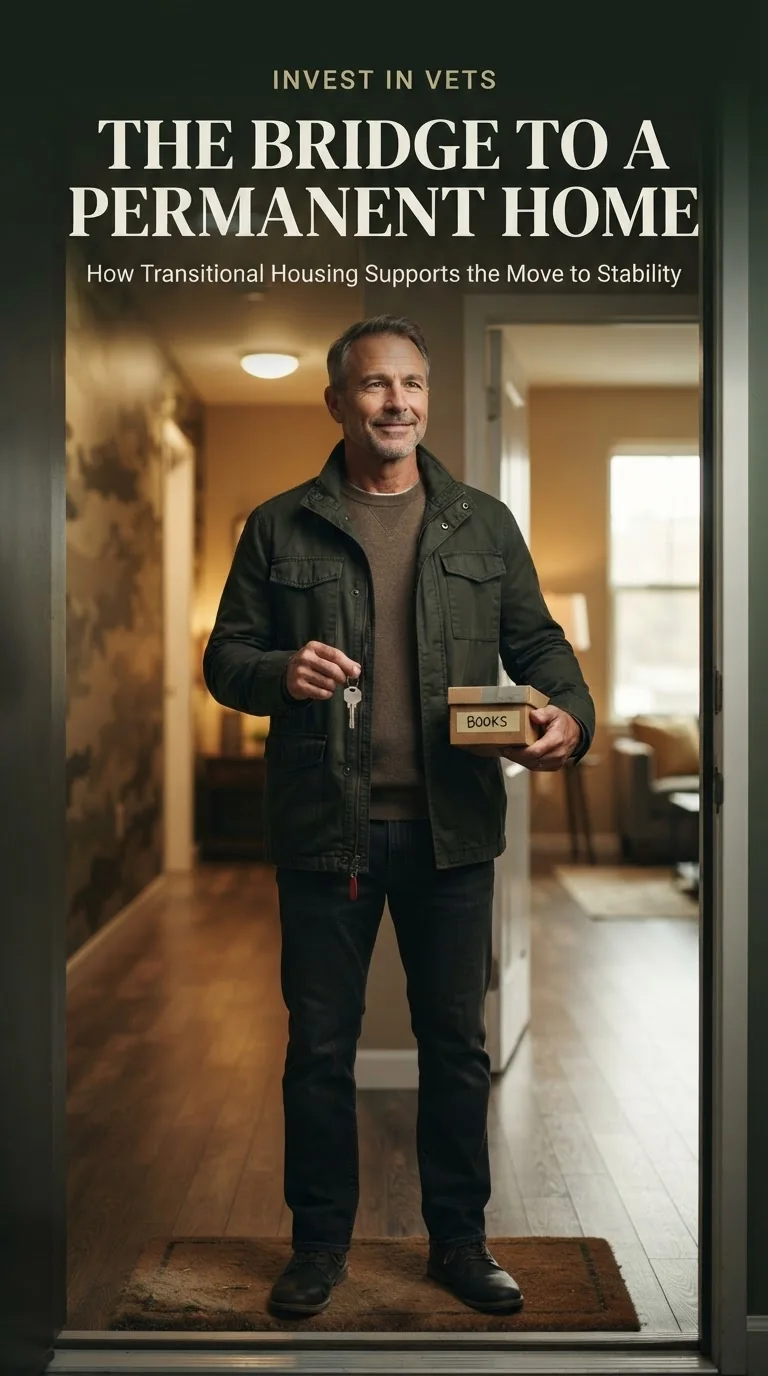
THE BRIDGE TO A PERMANENT HOME
How Transitional Housing Supports the Move to Stability
Published: September 18, 2026
Focus: VA Grant and Per Diem, transitional housing, permanent housing, New York and Ohio
Permanent housing is the destination in the effort to end Veteran homelessness. But for many Veterans, especially those leaving the street, an emergency shelter, a hospital, an unstable living arrangement, or a period of repeated housing loss, the road to that destination may require a structured bridge.
That bridge is one reason the Department of Veterans Affairs’ Grant and Per Diem program remains important. GPD does not replace permanent housing, and it is not a housing voucher. It funds community organizations that provide transitional supportive housing and related services for Veterans experiencing homelessness while they work toward a stable, permanent living situation. The distinction matters because the most effective homeless-response system is not built around one program. It is built around a connected sequence of outreach, immediate safety, transitional support when needed, permanent housing, and long-term stability.
A RECORD FUNDING CYCLE PUTS THE BRIDGE BACK IN FOCUS
On September 14, 2026, VA announced a record $1.17 billion in grants to 680 organizations nationwide to help Veterans who are homeless or at risk of becoming homeless in fiscal year 2027. The announcement separates that investment into two major program streams. About $855 million is going to the Supportive Services for Veteran Families program, known as SSVF, through one-year grants beginning October 1, 2026. Another $318 million is going to Grant and Per Diem through three-year grants that also begin October 1.
Those two programs solve different parts of the same problem. SSVF focuses heavily on preventing homelessness and rapidly re-housing eligible Veteran families. GPD supports transitional housing, service centers, transition-in-place models, and specialized housing for Veterans whose circumstances may require more intensive support before or during the move into permanent housing. The new funding does not mean every community has the same housing inventory or the same service capacity. It does mean local organizations will enter fiscal year 2027 with significant federal resources intended to move more Veterans toward housing stability.
The timing is important. VA reported that 51,936 individual Veterans were permanently housed during fiscal year 2025, the highest number in seven years under the current tracking approach. Separately, the January 2025 Point-in-Time Count estimated 32,495 Veterans experiencing homelessness on a single night nationwide. That included 18,977 Veterans in sheltered settings and 13,518 in unsheltered settings. The January 2025 count was the lowest Veteran homelessness estimate since HUD began reporting this measure in 2009 and was 56.1 percent below the 2010 level. These figures describe different things and different periods: one measures Veterans housed during a fiscal year, while the other is a one-night national homelessness estimate. Together, they show both substantial progress and the size of the work that remains.
WHAT GPD IS — AND WHAT IT IS NOT
VA describes Grant and Per Diem as a program for community agencies that provide transitional supportive housing to Veterans experiencing homelessness. The word transitional is important. A GPD placement is intended to help a Veteran move toward permanent housing; it is not supposed to become an indefinite substitute for a stable apartment or home.
The program uses several models. Traditional per-diem housing can give a Veteran a safe place to live while case managers work on benefits, health care, employment, documentation, housing searches, and other barriers. Service centers can provide help without requiring the Veteran to live on site. Transition-in-Place, often called TIP, is especially notable because it can allow a Veteran to remain in a housing unit as services evolve and the household moves toward permanent stability. VA’s September 2026 grant announcement also identifies specialized GPD housing for populations including women Veterans and Veterans who are chronically mentally ill, frail, elderly, terminally ill, or caring for minor dependents.
GPD funding is also not a cash benefit paid to an individual Veteran. VA reimburses or supports eligible grantee organizations under program rules. Current GPD rate guidance, effective January 1, 2026, lists different maximum rates for Per Diem Only, Service Center, Special Need, and Transition-in-Place models, with certain waiver provisions available to eligible grantees. Those rates are program financing tools for providers; they should not be described as money a Veteran personally receives.
WHY A TRANSITIONAL STEP CAN STILL MATTER
The national push toward permanent housing is correct because homelessness does not end until a Veteran has stable permanent housing. VA’s own permanent-housing guidance makes that clear. Yet permanent housing can be difficult to reach in a single move when a Veteran is managing several problems at once. A person may need replacement identification, help resolving an eviction record, medical care, treatment for a behavioral health condition, benefits assistance, income stabilization, transportation, or simply time to rebuild routines after prolonged homelessness.
A strong transitional program can create the breathing room to solve those barriers without turning temporary housing into the goal. That is the balance. Transitional housing is most valuable when every service is organized around an exit to something permanent: a leased apartment, a subsidized unit, reunification with family where safe and appropriate, or another stable arrangement that ends the Veteran’s homelessness.
For Invest in Vets, that distinction can shape outreach. A Veteran entering GPD may not yet be ready to sign a private-market lease tomorrow, but that Veteran can become a future HUD-VASH or other rental-assistance tenant. A landlord may not be able to solve the immediate crisis, but a landlord can become part of the permanent-housing inventory that makes the next step possible. A nonprofit can help most when it understands where the Veteran is in the housing process instead of treating every housing program as interchangeable.
NEW YORK AND OHIO SHOW THE SCALE OF THE LOCAL NETWORK
The federal announcement is national, but the implementation is local. On September 14, 2026, VA announced $65,900,117 in combined SSVF and GPD grants to 24 community organizations serving New York in fiscal year 2027. On September 15, VA announced $35,195,123 in combined grants to 27 community organizations serving Ohio. Those state totals should not be read as GPD-only funding; each announcement covers both SSVF and GPD awards. What they do show is the size of the community-provider network supporting Veterans before, during, and after a housing crisis.
For New York, this network operates in one of the most expensive and supply-constrained housing environments in the country, particularly in New York City. Transitional providers, SSVF organizations, HUD-VASH teams, public housing authorities, brokers, landlords, and nonprofit partners all have to coordinate across a market where finding an available unit can be difficult even after rental assistance is in place. In Ohio, the housing market is different, but the need for coordinated local relationships is just as real. Veterans may face transportation barriers, limited unit availability in smaller communities, or long distances between services and housing.
This is where a nonprofit such as Invest in Vets can add practical value without duplicating government programs. The organization can help build the connective tissue between providers and the private housing market: identifying landlords willing to work with Veteran-serving programs, maintaining a current inventory of possible units, educating owners about voucher and inspection processes, connecting investors with mission-aligned housing opportunities, and helping Veterans understand which program is handling which part of their housing journey.
THE HANDOFF TO PERMANENT HOUSING MUST BE DESIGNED, NOT ASSUMED
A transitional bed is only successful if there is a realistic path out of it. That path can involve HUD-VASH, SSVF rapid re-housing, another rental subsidy, mainstream affordable housing, or an unsubsidized unit that the Veteran can sustain. HUD-VASH pairs HUD rental assistance with VA case management for eligible homeless Veterans, while SSVF can help very low-income Veteran households prevent homelessness or return rapidly to permanent housing. Neither should be confused with GPD, and none should be presented as universally available to every Veteran.
The practical challenge is the handoff. Case managers need units to refer Veterans to. Landlords need accurate information and timely communication. Veterans need transportation to view apartments and complete appointments. Properties need to meet applicable inspection and rent requirements. Documentation must be current. Security deposits, utilities, furnishings, and move-in logistics can create delays even when the core housing resource is available.
The September 2026 grant cycle creates an opportunity to make those handoffs stronger. With new fiscal year funding beginning October 1, the question for local communities is not simply how many beds, grants, or service slots exist. It is how quickly those resources can be converted into permanent housing exits that last.
WHAT INVEST IN VETS CAN BUILD AROUND THIS MOMENT
For Veteran outreach, the message should be clear: accepting transitional housing is not failure and it is not the end of the process. It can be a strategic step toward a permanent home. For landlords, the opportunity is to become part of the next stage by making safe, code-compliant units available to qualified Veterans working with established housing programs. For investors and developers, the need is not only for large projects; small multifamily properties, duplexes, scattered-site apartments, and rehabilitated units can all become part of a local permanent-housing pipeline when they meet program requirements.
For community organizations, the strongest model is a shared housing map rather than isolated referral lists. A GPD provider should know which landlords are currently leasing. A HUD-VASH team should know which units may be opening next month. SSVF partners should know where temporary financial assistance can prevent a move from becoming a new episode of homelessness. Investors should understand which neighborhoods and property types fit local voucher standards. The more those relationships are built before a crisis, the less time a Veteran spends waiting in the gap between programs.
The country has already demonstrated that Veteran homelessness can be reduced substantially. The January 2025 PIT estimate was more than half below the 2010 level, and VA’s fiscal year 2025 permanent-housing total shows how many individual exits from homelessness can be achieved in a single year. The next stage of progress will depend on maintaining permanent-housing capacity while strengthening every bridge that helps Veterans reach it.
Transitional housing should never become the destination. But when it is connected to case management, benefits, treatment, landlords, rental assistance, and a real permanent-housing plan, it can be the bridge that turns a crisis into a stable front door.
VETERAN HELP & RESOURCES
Veterans who are homeless or at imminent risk of homelessness can call the National Call Center for Homeless Veterans at 1-877-4AID-VET (1-877-424-3838). VA states that the line is free, confidential, and available 24 hours a day, seven days a week. Veterans can also visit https://department.va.gov/homeless/ for information about VA homeless programs.
In Ohio, Veterans can also contact the nearest VA medical center and ask about homeless-program services or HUD-VASH. HUD’s Ohio resource page directs people experiencing homelessness to 2-1-1 or text 898211 for local health and human-service connections. In New York City, people needing emergency shelter can dial 311; Veterans can also use the National Call Center above to connect with VA homeless-program assistance.
Veterans: If your housing is unstable, do not wait until you are sleeping outside to make contact. Ask what prevention, transitional, rapid re-housing, or HUD-VASH resources may fit your situation and eligibility.
Landlords and property managers: If you have a safe, code-compliant unit, connect with local Veteran housing providers before the unit is vacant. A preexisting relationship can shorten the time between referral and lease signing.
Investors and real estate professionals: Help expand the permanent-housing side of the pipeline. Mission-aligned duplexes, small multifamily properties, scattered-site apartments, and rehabilitated units can become repeatable housing resources when they meet local program requirements.
Supporters: Share verified resources, refer landlords and property owners, and help Invest in Vets build stronger connections between Veteran-serving organizations and the private housing market.
SOURCES
1. U.S. Department of Veterans Affairs, “VA awards $1.17 billion in grants to fight Veteran homelessness,” September 14, 2026.
https://news.va.gov/press-room/va-awards-1-17-billion-in-grants-to-fight-veteran-homelessness/
2. VA Homeless Programs, “Grant & Per Diem Program,” accessed September 18, 2026.
https://department.va.gov/homeless/grant-per-diem/
3. VA Homeless Programs, “Per Diem Rate Information,” current rates effective January 1, 2026; accessed September 18, 2026.
https://department.va.gov/homeless/grant-per-diem/per-diem-rate-information/
4. VA Homeless Programs, “What is Permanent Housing?” January 30, 2026.
https://department.va.gov/homeless/what-is-permanent-housing/
5. VA Homeless Programs, “Homeless Veterans in the United States: Point-in-Time (PIT) Count,” January 2025 PIT data; accessed September 18, 2026.
https://department.va.gov/homeless/point-in-time-pit-count/
6. VA Syracuse Health Care, “VA awards $65 million in grants to fight Veteran homelessness in New York,” September 14, 2026. The page reports an exact statewide total of $65,900,117 to 24 community organizations.
https://www.va.gov/syracuse-health-care/news-releases/va-awards-65-million-in-grants-to-fight-veteran-homelessness-in-new-york/
7. VA Northeast Ohio Health Care, “VA awards $35.2 million in grants to fight Veteran homelessness in Ohio,” September 15, 2026. The page reports an exact statewide total of $35,195,123 to 27 community organizations.
https://www.va.gov/northeast-ohio-health-care/news-releases/va-awards-352-million-in-grants-to-fight-veteran-homelessness-in-ohio/
8. VA, “VA houses largest number of homeless Veterans in seven years,” November 18, 2025.
https://news.va.gov/press-room/va-houses-largest-number-of-homeless-veterans-in-seven-years/
9. HUD State Resources — Ohio and New York, accessed September 18, 2026.
https://www.hud.gov/states/ohio
https://www.hud.gov/states/new-york