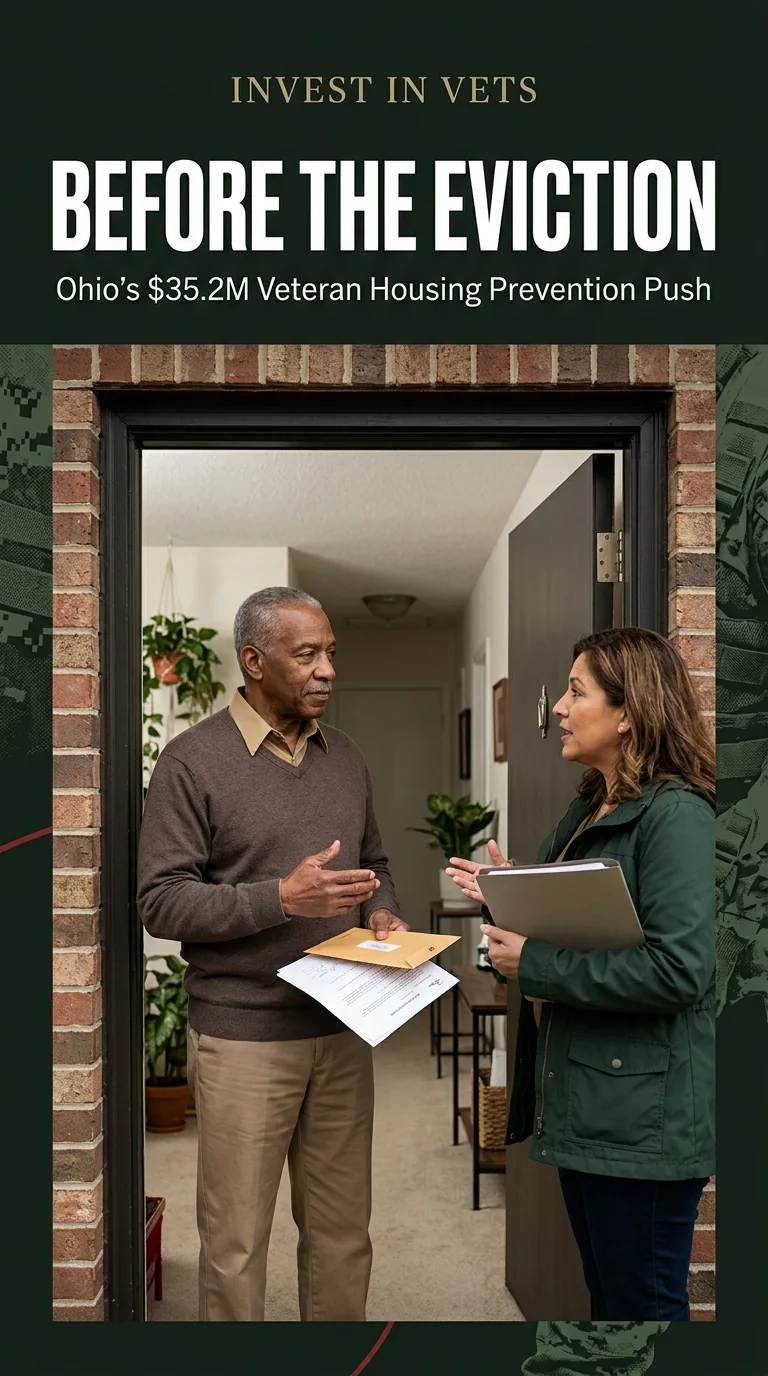
BEFORE THE EVICTION
Ohio’s $35.2 Million Chance to Stop Veteran Homelessness Earlier
Published: September 17, 2026
Focus: Ohio, homelessness prevention, SSVF, Grant and Per Diem, early intervention
A Veteran does not have to be sleeping in a car, a shelter, or on the street before the housing crisis is real. Sometimes the crisis begins with a missed rent payment after a medical problem, a reduced work schedule, a family breakup, a utility shutoff notice, or an eviction filing that arrives before the Veteran knows which door to knock on for help.
That early stage matters because the Department of Veterans Affairs defines an at-risk Veteran, for its homelessness-prevention work, as someone expected to become homeless within the next 30 days and who generally meets income and other eligibility requirements. In other words, the system is designed to intervene before a household loses its housing. The challenge is making sure Veterans, landlords, families, and community organizations recognize that window early enough to use it.
Ohio received a major new opportunity this week. On September 15, 2026, VA announced $35,195,123 in fiscal year 2027 grants to 27 community organizations serving Veterans in Ohio who are homeless or at risk of homelessness. The Ohio awards are part of a national package announced one day earlier: $1.17 billion in grants to 680 organizations, including $855 million through the Supportive Services for Veteran Families program and $318 million through Grant and Per Diem. Those awards begin October 1, 2026.
The most important point is not the size of the announcement by itself. It is what communities do with the money before a housing emergency becomes a homelessness emergency.
PREVENTION IS A DIFFERENT MISSION THAN REHOUSING
Veteran homelessness programs often become visible at the point of greatest crisis: street outreach, shelter placement, transitional housing, or a permanent housing search after someone has already lost a home. Those services remain essential. But prevention asks a different question: what can be done while the Veteran still has a key, an address, and at least some connection to a landlord or housing provider?
VA identifies SSVF as its primary program for preventing homelessness among eligible at-risk Veterans and their families. Prevention services can include crisis resolution, case management, and temporary financial assistance for housing-related expenses such as rent or utility arrears when program rules and individual eligibility allow. The purpose is not simply to cover a bill. The purpose is to stabilize the household long enough to address the reason the housing became fragile in the first place.
That can mean coordinating benefits, helping a Veteran replace lost income, resolving documentation problems, connecting to health care, addressing transportation barriers, negotiating a housing plan, or finding a safer and more sustainable unit before the current arrangement collapses. The exact assistance depends on the Veteran’s situation and the local provider’s screening.
The scale of this work is significant. VA reported in February 2026 that SSVF prevention services kept 33,857 at-risk Veterans and family members from becoming homeless during fiscal year 2025. That figure is a fiscal-year program outcome, not a count from this week, and it should be understood separately from the national Point-in-Time Count.
OHIO’S NEW FUNDING COVERS BOTH PREVENTION AND CRISIS RESPONSE
The September 15 Ohio announcement combines two different program structures. SSVF grants support homelessness prevention, rapid rehousing, case management, and related supportive services. Grant and Per Diem funding supports transitional housing, service centers, transition-in-place models, and specialized housing for groups such as women Veterans and Veterans who are chronically mentally ill, frail, or elderly.
That combination matters because Veteran housing instability is not a single pathway. One household may need a few weeks of help to stop an eviction and regain financial stability. Another Veteran may already be unsheltered and need immediate temporary housing plus intensive services. Another may be in a transitional setting and need a coordinated move into permanent housing. Strong communities need all of those lanes to connect rather than operate as separate silos.
Central Ohio provides a practical example of how that network can look on the ground. VA Central Ohio’s Franklin County homeless-resources page, last updated May 12, 2026, lists Health Care for Homeless Veterans outreach, a Central Point of Access for emergency shelter intake, and SSVF providers including Lutheran Social Services and Volunteers of America. The same page tells Veterans to contact a local SSVF provider directly for eligibility screening.
For Invest in Vets, that is the model worth building around: a clear referral map that tells a Veteran what to do based on where they are in the housing crisis today.
THE NATIONAL NUMBERS SHOW BOTH PROGRESS AND RISK
The most recent national Point-in-Time estimate available today is the January 2025 count. VA reports that 32,495 Veterans experienced homelessness on a single night in January 2025, including 18,977 Veterans in sheltered settings and 13,518 who were unsheltered. That 2025 total was 56.1% lower than the 2010 level and the lowest Veteran homelessness count since HUD began reporting the measure in 2009.
Those results show long-term progress, but they do not mean the prevention problem has been solved. A Point-in-Time Count is a one-night estimate. It does not capture every Veteran who faces eviction, doubles up temporarily with relatives, stays in a motel with personal funds, moves between unstable housing arrangements, or becomes homeless at another point in the year.
VA’s fiscal year 2025 program data adds another view. VA reported that 51,936 Veterans were permanently housed through its homelessness goals during FY2025, and 96.2% of those Veterans remained housed at the end of the fiscal year. The agency also reported that 13,450 Veterans exiting homeless programs or services were connected to employment. These are different measures from the PIT count, but together they show why both housing placement and housing retention matter.
THE BEST TIME TO MAKE THE CALL MAY BE BEFORE THE EVICTION
One of the biggest practical mistakes in homelessness prevention is waiting until the housing loss is complete. Veterans may assume they have to be literally homeless before they qualify for help. Landlords may assume there is no point contacting anyone until an eviction is already underway. Family members may not know that a shutoff notice, rent arrears, or a sudden income loss can be a reason to ask for screening.
Eligibility is never automatic, and SSVF providers must determine whether a household meets program rules. But the correct first move is still early contact.
For a Veteran, early contact means gathering the lease, rent ledger, eviction notice if one exists, utility notices, income information, identification, and any documentation that explains the housing crisis. For a landlord, it can mean giving the Veteran clear written notice of the balance and timeline rather than waiting until communication breaks down. For a case manager or nonprofit, it means helping the Veteran connect to the correct provider while there is still time to negotiate a solution.
The goal should be a warm handoff, not a list of phone numbers.
WHAT INVEST IN VETS CAN BUILD AROUND THIS MOMENT
Ohio’s new FY2027 funding creates an opportunity for community organizations that are not themselves SSVF or GPD grantees to become better connectors. Invest in Vets can help by maintaining a county-by-county referral directory, building relationships with local landlords and property managers, teaching Veterans the difference between prevention, rapid rehousing, transitional housing, and HUD-VASH, and helping Veterans organize the documents needed for an eligibility screening.
The organization can also build a simple early-warning outreach message for landlords: if a Veteran tenant falls behind, contact the tenant early, encourage the Veteran to reach VA or an SSVF provider, and avoid assuming that missed rent automatically means the tenancy cannot be stabilized. That message should never promise payment, because assistance depends on eligibility and local program rules. It should promise something more realistic: a faster connection to the systems designed to evaluate the crisis.
Investors and property owners can contribute in another way by keeping safe, code-compliant units available for Veteran housing referrals and by learning how VA-connected housing programs operate before they receive a referral. Supporters can help fund transportation, document replacement, move-in supplies, outreach, and the administrative work that turns a referral into a completed housing plan.
The strongest housing system is not the one that reacts fastest after someone becomes homeless. It is the one that also recognizes the warning signs early enough to prevent the fall.
VETERAN HELP & RESOURCES
If you are a Veteran who is homeless or at imminent risk of homelessness, call the National Call Center for Homeless Veterans at 1-877-4AID-VET (1-877-424-3838). The call is free, confidential, and available 24 hours a day, 7 days a week.
VA Homeless Programs:
https://department.va.gov/homeless/
Supportive Services for Veteran Families:
https://department.va.gov/homeless/supportive-services-for-veteran-families/
Franklin County / Central Ohio homeless resources:
https://www.va.gov/central-ohio-health-care/programs/va-emergency-resources/homeless-resources/franklin-county-homeless-resources/
If you are in immediate emotional crisis or are concerned about a Veteran, call 988 and press 1, text 838255, or use the Veterans Crisis Line chat.
Veterans: Do not wait for the eviction, shelter stay, or night in the car to ask whether help is available. If housing is becoming unstable, contact VA or a local SSVF provider and request a screening.
Landlords and property managers: If a Veteran tenant is falling behind, communicate early and clearly. Encourage the tenant to contact VA or an SSVF provider before the tenancy reaches the point of no return.
Investors and real estate professionals: Help expand the supply of safe, code-compliant units and learn how Veteran housing programs work before a referral arrives.
Supporters: Help Invest in Vets strengthen the referral network that connects Veterans to verified housing, benefits, transportation, and community resources before a temporary crisis becomes homelessness.
SOURCES
1. U.S. Department of Veterans Affairs, “VA awards $35.2 million in grants to fight Veteran homelessness in Ohio,” September 15, 2026.
https://www.va.gov/northeast-ohio-health-care/news-releases/va-awards-352-million-in-grants-to-fight-veteran-homelessness-in-ohio/
2. U.S. Department of Veterans Affairs, “VA awards $1.17 billion in grants to fight Veteran homelessness,” September 14, 2026.
https://www.va.gov/wilmington-health-care/news-releases/va-awards-117-billion-in-grants-to-fight-veteran-homelessness/
3. VA Homeless Programs, “How Does VA Help Veterans at Risk of Homelessness?” February 16, 2026.
https://department.va.gov/homeless/how-does-va-help-veterans-at-risk-of-homelessness/
4. VA Homeless Programs, “Homeless Veterans in the United States: Point-in-Time (PIT) Count,” current page accessed September 17, 2026; January 2025 PIT data.
https://department.va.gov/homeless/point-in-time-pit-count/
5. VA Homeless Programs, “VA demonstrates continued progress in addressing Veteran homelessness,” May 5, 2026; fiscal year 2025 outcomes.
https://department.va.gov/homeless/va-demonstrates-continued-progress-in-addressing-veteran-homelessness/
6. VA Central Ohio Health Care, “Franklin County Homeless Resources,” last updated May 12, 2026.
https://www.va.gov/central-ohio-health-care/programs/va-emergency-resources/homeless-resources/franklin-county-homeless-resources/