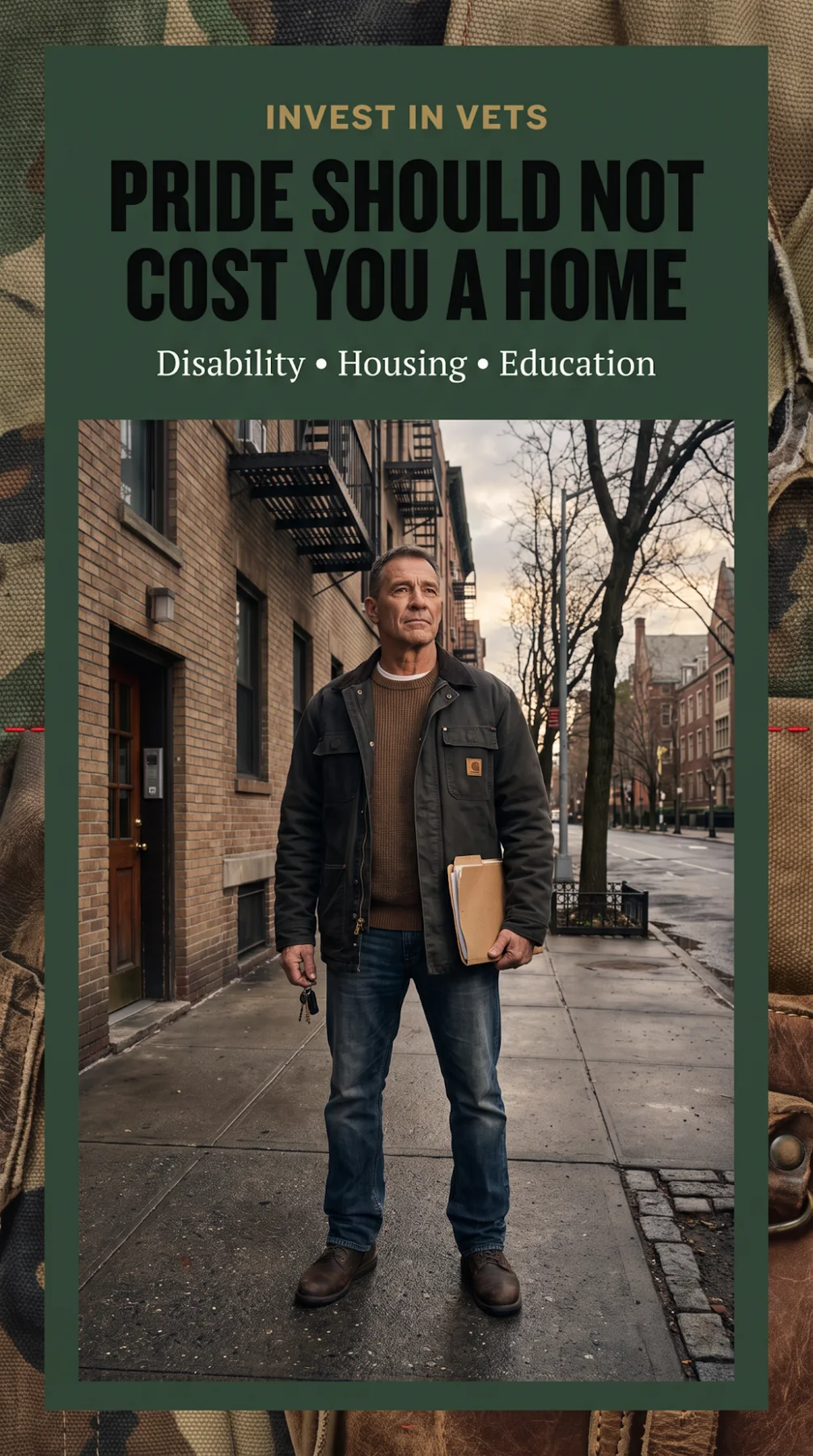
PRIDE SHOULD NOT COST YOU A HOME
For Deployed Veterans, Asking for Help Can Be the First Step Toward Disability Compensation, Housing Stability, and a New Career
Published: September 16, 2026
Focus: Veteran homelessness, deployed Veterans, VA disability, HUD-VASH, Post-9/11 GI Bill, New York City
THE VETERAN WHO SAYS “I’M FINE”
Some Veterans return from deployment trained to carry weight without showing it. That mindset can be useful in a combat zone, but it can become dangerous when the mission changes to building a stable civilian life. A Veteran may couch-surf, live in a car, or fall behind on rent while insisting someone else “needs the help more.” Others avoid discussing trauma, pain, or injuries because asking for help feels like weakness.
There is no national statistic proving that “pride” causes Veteran homelessness, and every Veteran’s path is different. What the national numbers do show is that homelessness remains a real problem even after years of progress. The latest national Point-in-Time estimate available as of this article’s September 2026 publication date is the January 2025 count: 32,495 Veterans were experiencing homelessness on a single night, including 13,518 who were unsheltered. That count was 56.1% below the 2010 level, but it still represents tens of thousands of Veterans without stable housing on that January 2025 night.
For a deployed Veteran who has been trying to handle everything alone, the first move does not have to be a disability claim or a housing application. It can simply be a conversation.
START WITH SOMEONE WHO UNDERSTANDS DEPLOYMENT
VA Vet Centers offer confidential counseling at no cost in a community-based, non-medical setting. Veterans who served in combat zones may qualify for readjustment counseling, and the Vet Center Call Center is available around the clock at 877-927-8387. VA says the call center is staffed by combat Veterans from several eras as well as Veteran family members. A Veteran can talk about deployment, transition, grief, trauma, family pressure, or simply what has been difficult since coming home.
That conversation matters because a disability claim is not an admission that someone cannot function. VA disability compensation exists for illnesses or injuries that were caused or made worse by military service. Mental health conditions can qualify, but so can physical injuries and other service-connected conditions. A Veteran does not have to wait until homelessness, unemployment, or crisis to document what military service changed.
STEP ONE: CLAIM THE DISABILITY BENEFITS YOU EARNED
VA allows Veterans to file disability compensation claims online or with help from an accredited Veterans Service Organization representative, attorney, or claims agent. Supporting evidence can include service records, VA or private medical records, and statements from people who know what happened or how the condition affects the Veteran. VA may also schedule a compensation and pension examination.
For 2026, an 80% service-connected disability rating pays a Veteran with no dependents $2,102.15 per month. That rate became effective December 1, 2025. The amount changes with dependent status, so the same 80% rating can pay more when qualifying dependents are included. VA disability compensation is excluded from federal taxable income.
Not every deployed Veteran should expect an 80% rating. Ratings depend on the individual conditions, evidence, service connection, and VA’s decision. A Veteran should not refuse to file simply because someone else had a “worse deployment.”
STEP TWO: IF HOUSING IS UNSTABLE, ENTER THE HOMELESS-VETERAN SYSTEM
A disability award can create income, but it does not automatically create an affordable apartment in New York City. If a Veteran is homeless or at imminent risk of homelessness, the fastest VA entry point is the National Call Center for Homeless Veterans at 877-424-3838. The line is free, confidential, and available 24/7. VA staff can connect the Veteran with the nearest homeless-program team for assessment and referral.
One possible path is HUD-VASH. HUD-VASH combines a HUD Housing Choice Voucher with VA case management and supportive services. The program is designed for Veterans experiencing homelessness who need ongoing case management to remain stably housed. As of March 2026, VA reported that more than 95,000 formerly homeless Veterans were living in homes through HUD-VASH.
The process is not “get $3,000 a month from the government.” The voucher is rental assistance. The local public housing authority pays its portion to the landlord, while the Veteran is responsible for the calculated tenant share. In New York City, NYCHA’s 2026 payment standards for new rentals and transfers are $2,604 for a zero-bedroom unit, $2,734 for a one-bedroom, and $2,997 for a two-bedroom. Those numbers are ceilings used in subsidy calculations, not cash payments to the Veteran. NYCHA also bases subsidy size on household composition; its current standard generally assigns a single-person household a zero-bedroom subsidy.
A major HUD-VASH rule is especially important for disabled Veterans. Service-connected VA disability compensation is excluded when determining initial HUD-VASH income eligibility. However, VA guidance also states that disability compensation is included when calculating the total tenant payment, housing assistance payment, and family share. In other words, an 80% rating does not simply become “$2,100 plus a free $3,000 apartment.” The rating may help a Veteran qualify financially for stability, while the housing authority still calculates what portion of the rent the Veteran must pay.
STEP THREE: USE EDUCATION BENEFITS TO BUILD THE NEXT MISSION
Once a Veteran has a safer place to live and reliable disability income, education can become the next stabilizing layer. The Post-9/11 GI Bill can cover tuition and provide a monthly housing allowance while a qualifying Veteran is enrolled. For the current academic benefit year, August 1, 2026 through July 31, 2027, VA bases the resident monthly housing allowance on the 2026 Basic Allowance for Housing rate for an E-5 with dependents at the location where the Veteran physically attends most classes.
For the New York City military housing area, the 2026 E-5-with-dependents BAH benchmark is $5,070 per month. That does not mean every student Veteran in New York receives $5,070. The actual Post-9/11 GI Bill payment depends on the Veteran’s eligibility tier, rate of pursuit, school location, class format, and the days actually enrolled during the month. A Veteran generally must be attending more than half time to receive MHA, and there is no MHA during school breaks. Online-only students receive a much lower national maximum; for the current 2026–2027 benefit year, VA lists up to $1,261 per month for many online-only beneficiaries.
For Veterans eligible at the 100% tier and attending full-time in person at a qualifying NYC school, the housing allowance can be transformative. It can make school a realistic full-time mission rather than something squeezed between multiple jobs. VA education benefits, including qualifying GI Bill housing payments, are excluded from federal taxable income.
WHAT THE “$10,000 A MONTH” IDEA REALLY MEANS IN NYC
There is a powerful financial lesson here, but it has to be described correctly. Consider a hypothetical Veteran with no dependents who has an 80% VA disability rating and is fully eligible for the Post-9/11 GI Bill while attending an NYC school in person at a rate of pursuit that qualifies for the full resident MHA. The 2026 disability payment is $2,102.15. The NYC E-5-with-dependents housing benchmark is $5,070. In a qualifying full school month, those two VA payments together can total about $7,172.15 in direct, federally tax-free payments before considering tuition that VA may also pay to the school.
Then add housing assistance. For a single-person NYCHA voucher household, the 2026 zero-bedroom payment standard for a new rental is $2,604. Adding that ceiling to the two direct VA payments produces a rough economic-support benchmark of $9,776.15 for that month. For households legitimately eligible for larger unit sizes, the payment-standard ceiling can be higher and the combined support value can cross $10,000.
But this is not $10,000 of cash deposited into a Veteran’s bank account. The HUD-VASH portion is housing assistance paid toward rent, and the actual subsidy depends on the approved unit, household size, rent, utilities, income calculation, and tenant share. The GI Bill MHA also changes with enrollment and disappears during qualifying breaks. The accurate message is stronger than a hype number: when a Veteran properly uses disability compensation, housing assistance, and education benefits together, those programs can create enough stability to pursue school and rebuild without immediately depending on a full-time civilian job.
STABILITY IS NOT DEPENDENCY
For some Veterans, accepting help can feel like surrendering independence. In practice, these programs can do the opposite. Disability compensation creates a floor under income. HUD-VASH can create a stable address and a case-management relationship. The GI Bill can fund education and provide living support while a Veteran develops skills for the next career.
The goal is not permanent dependence on benefits. It is to stop preventable homelessness long enough for a Veteran to recover, study, rebuild, and decide what the next mission should be. A Veteran should not have to prove strength by sleeping in a car, ignoring an injury, or refusing to make a phone call.
VETERAN HELP & RESOURCES
For homeless or at-risk Veterans: National Call Center for Homeless Veterans — 877-424-3838, free and confidential 24/7.
For deployed/combat Veterans who want to talk confidentially: Vet Center Call Center — 877-927-8387, available around the clock.
For an immediate mental-health crisis or thoughts of suicide: Veterans Crisis Line — call 988 and press 1, or text 838255.
For VA disability claims: https://www.va.gov/disability/how-to-file-claim/
For HUD-VASH information: https://department.va.gov/homeless/hud-vash/
For Post-9/11 GI Bill information and current rates: https://www.va.gov/education/benefit-rates/post-9-11-gi-bill-rates/
Veterans: If deployment changed your body, sleep, mood, relationships, or ability to function, do not decide by yourself that you are “not disabled enough.” Talk to someone, document what happened, and learn what you qualify for. If housing is unstable, make the homeless-Veteran call before the situation becomes an emergency.
Landlords and property managers: A voucher only works when there is a real door behind it. Connect with your local public housing authority and VA homeless program if you have safe units that can accept HUD-VASH participants.
Investors and real estate professionals: Help create a reliable inventory of voucher-friendly housing so that Veterans who finally ask for help do not spend months holding assistance they cannot use.
Supporters: Share verified resources, not rumors. One accurate phone number, one landlord introduction, or one ride to an appointment can move a Veteran from isolation toward stability.
SOURCES
1. U.S. Department of Veterans Affairs, VA Homeless Programs, “Homeless Veterans in the United States: Point-in-Time (PIT) Count.” January 2025 data; page current in 2026.
https://department.va.gov/homeless/point-in-time-pit-count/
2. U.S. Department of Veterans Affairs, Vet Centers, confidential readjustment counseling and Vet Center Call Center.
https://www.vetcenter.va.gov/
https://www.vetcenter.va.gov/VETCENTER/Vet_Center_Services.asp
3. U.S. Department of Veterans Affairs, “How to file a VA disability claim,” updated September 4, 2026.
https://www.va.gov/disability/how-to-file-claim/
4. U.S. Department of Veterans Affairs, “Current Veterans disability compensation rates,” 2026 rates effective December 1, 2025.
https://www.va.gov/disability/compensation-rates/veteran-rates/
5. U.S. Department of Veterans Affairs, VA Homeless Programs, HUD-VASH program overview.
https://department.va.gov/homeless/hud-vash/
6. U.S. Department of Veterans Affairs, “Understanding the Policy Change that Increased Access to HUD-VASH for Disabled Veterans,” April 1, 2026.
https://department.va.gov/homeless/understanding-the-policy-change-that-increased-access-to-hud-vash-for-disabled-veterans/
7. New York City Housing Authority, “Voucher Payment Standards (VPS) and Utility Allowance Schedule,” 2026 standards.
https://www.nyc.gov/site/nycha/section-8/voucher-payment-standards-vps-utility-allowance-schedule.page
8. U.S. Department of Veterans Affairs, “Post-9/11 GI Bill Rates,” current rates for August 1, 2026 through July 31, 2027.
https://www.va.gov/education/benefit-rates/post-9-11-gi-bill-rates/
9. Defense Travel Management Office, official Basic Allowance for Housing Rate Lookup. The 2026 New York City MHA NY219 E-5-with-dependents figure was cross-checked against an independent reproduction of the current DTMO annual dataset.
https://www.travel.dod.mil/Allowances/Basic-Allowance-for-Housing/BAH-Rate-Lookup/
https://militarypaydates.com/bah-rates/ny/new-york-city-ny/
10. Internal Revenue Service, “Veterans tax information and services,” and Publication 970, Veterans’ Benefits.
https://www.irs.gov/individuals/veterans-tax-information-and-services
https://www.irs.gov/publications/p970