INVEST IN VETS • LOCAL HOUSING RESPONSE • Sep 25, 2026
Sioux Falls Builds 25 Homes With an Exit Plan
How a South Dakota partnership pairs transitional tiny homes with case management and a path to permanent housing
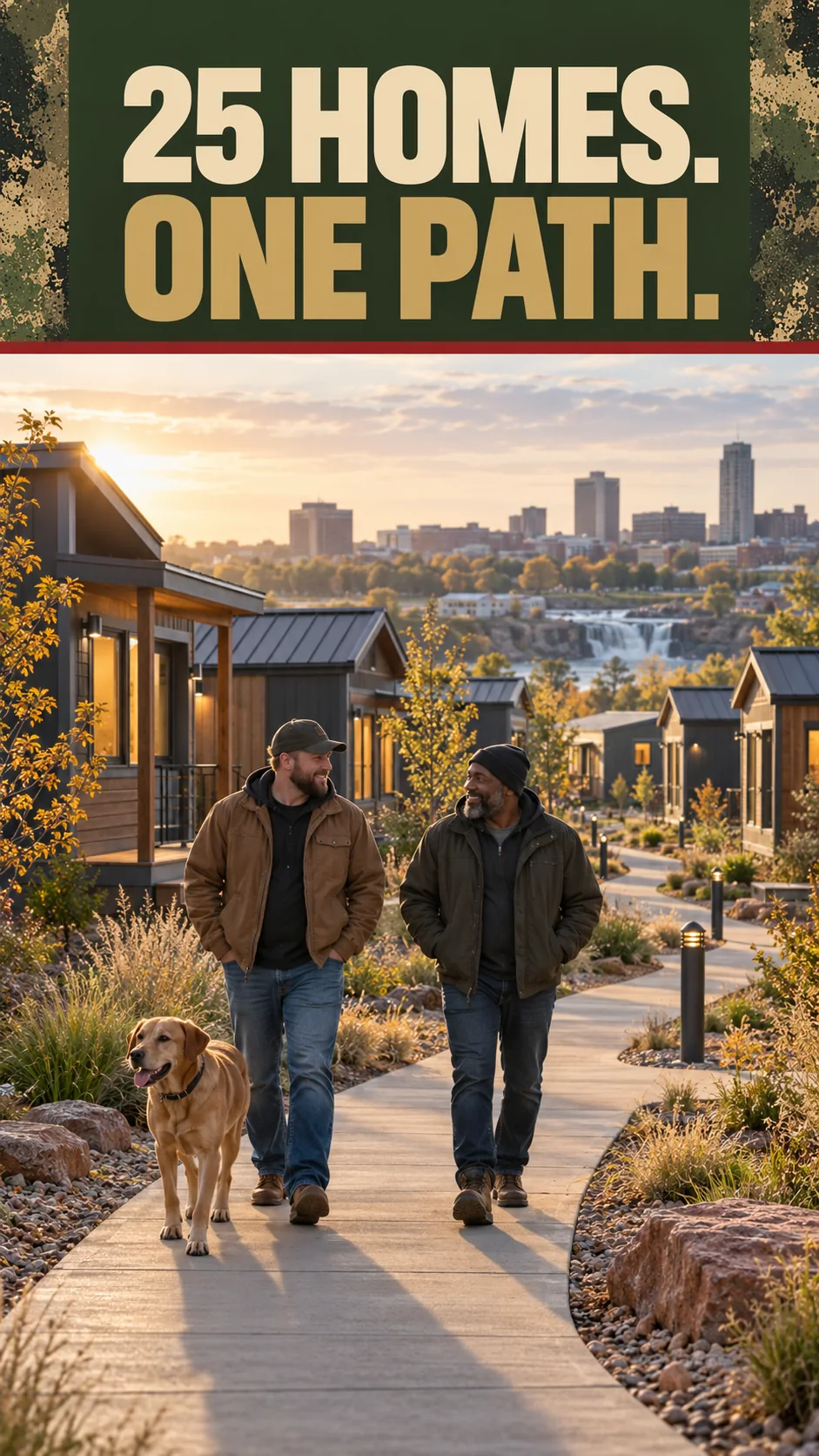
Original Invest in Vets editorial cover • Generated for this article
THE VERIFIED SNAPSHOT
Measure | Verified status as of Sep 25, 2026 |
Location | 367 N Willow Ave in northwest Sioux Falls on a two acre site |
Housing plan | 25 fully furnished tiny homes with a Village Center and on site services |
Housing type | Transitional and rent free not permanent supportive housing |
Delivery | Groundbreaking in 2022 housing began in 2023 and the operator still describes the village as growing |
2025 reach | 14 Veterans welcomed into homes and 60 Veterans served through residential and outreach programs |
A village that must be measured by delivery
Veterans Community Project has given Sioux Falls a concrete housing platform: a purpose built village on two acres with 25 planned tiny homes, a central gathering space and an outreach operation. The national nonprofit broke ground in 2022 and began housing Veterans in 2023. Its current Sioux Falls page describes the site as a growing village, not as 25 occupied homes. That distinction matters. A development plan measures capacity; occupancy and successful exits measure delivery.
The clearest current local outcome is dated to 2025. Veterans Community Project reports that 14 Veterans were welcomed into transitional tiny homes, 60 Veterans received residential or outreach services, and local volunteers contributed 730 hours. Those are operator reported figures, not a city audit, but they show the initiative functioning while construction and service capacity continued to grow. They should not be rewritten as 25 Veterans permanently housed or as proof that Veteran homelessness has ended.
The physical design is intentionally modest. Most VCP homes are about 240 square feet, furnished and designed for privacy, safety and daily routine. The Sioux Falls Village Center adds a fellowship hall, outreach space and a dog wash. The site sits near transit, medical care, shopping and employment. For a Veteran moving from a car, couch, shelter or encampment, a locking door is the beginning of the intervention. The program's real test is what happens after that door closes.
The housing is transitional and the exit is permanent
VCP residents do not own the tiny homes. The organization describes them as rent free transitional housing, with an average stay across its model of about one year. Each resident works with a case manager on permanent housing, health care, income, benefits, transportation and a support network. VCP says its case management ratio is roughly one staff member for every ten Veterans, allowing weekly contact and individualized plans. Pets are allowed, removing a barrier that can keep some people from accepting shelter or treatment.
That structure is important because a temporary home is not the destination. Sioux Falls also operates HUD VASH through the Sioux Falls Housing and Redevelopment Commission and the local VA medical center. HUD VASH combines a Housing Choice Voucher rental subsidy administered by the housing agency with VA case management and clinical services. A VCP stay can stabilize a Veteran while a permanent apartment, a voucher compatible landlord or another appropriate exit is secured. Public sources do not establish that every VCP resident receives HUD VASH, and eligibility must be assessed case by case.
The local need remains visible. The City of Sioux Falls reported 605 people experiencing homelessness in its January 2026 point in time count, including 43 people unsheltered. The one night count identified 27 Veterans. That snapshot was lower than the 625 people counted in 2025, but it is not a census of everyone who loses housing during a year. VCP participated in the count. Its 25 home plan is meaningful local infrastructure, yet the count shows why outreach, prevention, permanent apartments and landlord participation still have to work alongside the village.
Community capital built the platform
The Sioux Falls effort is also a case study in local financing and civic sponsorship. In November 2023, the Greater Sioux Falls Chamber of Commerce opened a Community Appeals campaign with a $1.2 million fundraising goal for VCP's transitional housing and support services. That number was a campaign target, not a published total development cost. The original plan paired the small homes with a roughly 3,000 square foot Village Center and services delivered by VCP and partner organizations.
Nationally, VCP says it is an independent nonprofit rather than a VA program and that federal money represented less than five percent of its support in the last reporting year described on its FAQ. That funding model can accelerate a project when a community has land, donors and champions. It also creates an obligation to publish a complete local capital stack and durable operating plan. Current public pages do not provide a full Sioux Falls project cost, a current occupied home count, or Sioux Falls specific permanent housing retention results. Those are not reasons to discount the project; they are the next accountability questions.
Reaching the Veteran who does not ask
For deployed Veterans who built an identity around endurance and self reliance, the first barrier may not be paperwork. It may be accepting that a housing crisis deserves a response before it becomes an emergency. VCP explicitly invites Veterans to seek housing help, benefits navigation or simply someone to talk to, regardless of discharge status, length of service or type of service. Its model does not use a formal waitlist; outreach staff assess needs and connect people to the most immediate available resource.
A private home, a Veteran informed team and permission to bring a pet can lower the social cost of saying yes. Still, the public data do not measure whether the Sioux Falls model reduces stigma among deployed Veterans, so that should be treated as a practical design hypothesis rather than a proven outcome. Invest in Vets could strengthen it by funding peer outreach, offering confidential first conversations away from crisis settings and training referral partners to ask about housing instability without demanding that a Veteran first adopt the label homeless.
Keep the benefits separate and accurate
Benefits navigation can help stabilize income and open housing options, but three programs are often confused. VA disability compensation is a monthly payment tied to a service connected condition and a VA rating. HUD VASH is not spendable cash; it is rental assistance paid through a housing authority for eligible Veterans experiencing homelessness, combined with VA case management. Post 9 11 GI Bill housing support is an education benefit that depends on eligibility tier, enrollment, training time, modality and the school's location. Not every Veteran qualifies for every program, and none should be promised as an automatic package.
For Sioux Falls, the honest message is simpler: VCP can help a Veteran identify and navigate benefits while providing transitional housing, and the local HUD VASH partnership can support eligible permanent housing placements. A disability claim, a voucher application and school enrollment are separate decisions with separate evidence and timelines. The tiny home itself is not a voucher and its value should never be added to cash income.
What Invest in Vets can adapt
The Sioux Falls model suggests a repeatable partnership sequence. First, secure a well located parcel and a housing operator with a defined service model. Second, recruit visible local champions and a civic fundraising vehicle. Third, build the homes and the service hub in phases while reporting the difference between planned units, available units and occupied homes. Fourth, connect every transitional placement to a permanent housing pipeline that includes the housing authority, VA, landlords and mainstream affordable housing providers.
Invest in Vets could add the piece most transitional programs cannot control alone: a landlord and investor network dedicated to exits. Partners could offer units that meet inspection and rent requirements, hold apartments during document delays, fund deposits or move in costs where allowed, and accept coordinated support from case managers. Investors could also finance small permanent supportive developments or Veteran set asides so that a successful transition does not depend on an already tight rental market.
The discipline is to measure the whole path. Report how many people are contacted, assessed, offered a home, moved in, connected to benefits, placed in permanent housing and still housed six and twelve months later. Publish the median time at each stage and the reasons placements stall. Sioux Falls has built a credible front door. The next proof point is a transparent, durable route through it to permanent housing.
Veteran resources
Sioux Falls Veterans Community Project Call 605 204 6106 or visit vcp.org Sioux Falls
National Call Center for Homeless Veterans Call 877 424 3838 at any time or visit VA homeless Veteran assistance
Veterans Crisis Line Dial 988 then press 1 or text 838255. Enrollment in VA benefits is not required. Visit VeteransCrisisLine.net
A practical call to action
Veterans and families: call before the housing emergency becomes visible to everyone else. Landlords: ask the Sioux Falls housing authority and local Veteran serving organizations how your next available unit can support a permanent exit. Investors and developers: bring sites, apartments and patient capital to the table, not only donations. Supporters: fund case management, furnishings, outreach and the move from transitional housing into a lasting home.
Sources
• Veterans Community Project Sioux Falls location and 2025 outcomes accessed Sep 25, 2026
• Veterans Community Project village development timeline accessed Sep 25, 2026
• Veterans Community Project program and funding FAQ accessed Sep 25, 2026
• City of Sioux Falls 2026 point in time count published Mar 11, 2026
• Greater Sioux Falls Chamber Community Appeals campaign campaign opened Nov 1, 2023
• Sioux Falls Development Foundation village groundbreaking groundbreaking Jun 30, 2022
• Sioux Falls Housing and Redevelopment Commission HUD VASH accessed Sep 25, 2026
• US Department of Veterans Affairs National Call Center accessed Sep 25, 2026