THE LAST MILE TO HOUSING: WHY A VOUCHER ALONE IS NOT ENOUGH TO END VETERAN HOMELESSNESS
The national numbers show real progress—but they also show why the next phase of ending Veteran homelessness has to become more precise.
According to the U.S. Department of Veterans Affairs, the January 2025 Point-in-Time Count identified 32,495 Veterans experiencing homelessness on a single night in the United States. The result was released in 2026 and represented a new record low since Veteran homelessness began being measured nationally in 2009. VA reported that the 2025 figure was 56.1% lower than the 2010 level and about 1.2% lower than the January 2024 count.
That is important progress. But a Point-in-Time Count is exactly what its name says: a one-night snapshot. It does not mean only 32,495 Veterans needed housing assistance during the year, and it does not mean every Veteran who received a voucher was immediately able to move into a home.
In fact, VA reported that during Fiscal Year 2025 it permanently housed nearly 52,000 homeless Veterans—the largest number housed in a single year in seven years—and moved more than 25,000 unsheltered Veterans into interim or permanent housing through outreach efforts. Those numbers show how much movement exists behind a single-night count.
For Invest in Vets, this is where the mission becomes practical.
The challenge is not only identifying a Veteran who needs help. It is helping that Veteran travel the entire distance from homelessness or housing instability to a stable address.
That distance can include benefits, documentation, transportation, a phone, a housing search, a participating landlord, an inspection, deposits and move-in needs, health care, case management and long-term support.
That is the last mile to housing.
1. THE 2025 COUNT SHOWS PROGRESS—AND A WARNING
The January 2025 count of 32,495 homeless Veterans was a record low nationally, but VA emphasized that the pace of improvement had slowed. The agency noted that average Fair Market Rent for a one-bedroom unit rose 4.6% from 2024 to 2025, placing additional pressure on Veterans trying to maintain housing or find an affordable unit.
This matters because homelessness is not only a shelter problem. It is also a housing-market problem.
A Veteran may qualify for assistance and still struggle when:
• local rents exceed practical voucher options;
• landlords do not understand HUD-VASH;
• available units are far from health care or employment;
• application requirements create delays;
• the Veteran lacks transportation to view units or attend appointments;
• the Veteran does not have a reliable phone or internet connection;
• documentation or benefit issues slow the process;
• the Veteran needs ongoing support to remain housed.
That means successful housing work must connect programs that are often discussed separately.
2. HUD-VASH CONTINUES TO PROVIDE THE LONG-TERM HOUSING FOUNDATION
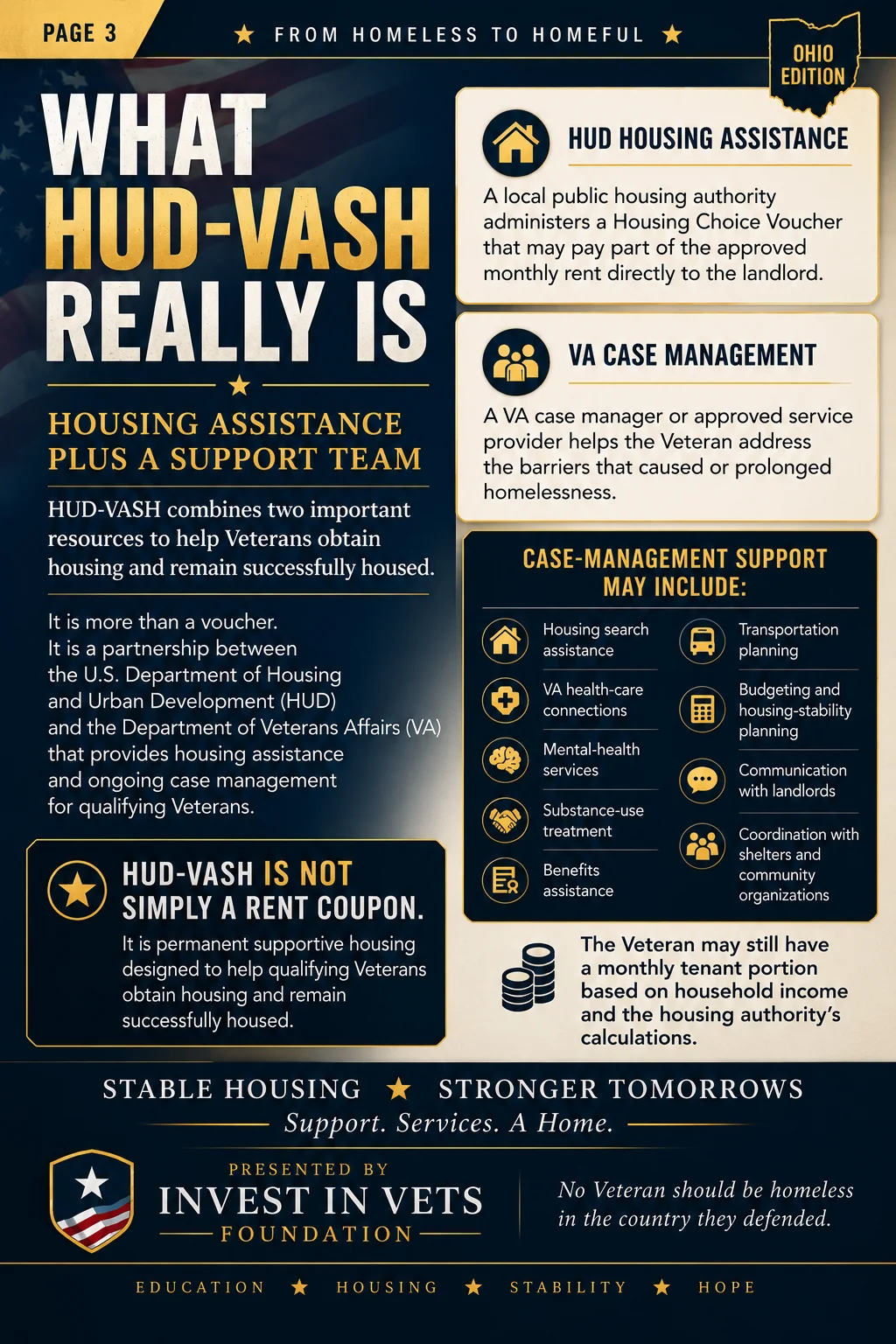
HUD-VASH combines Housing Choice Voucher rental assistance from the U.S. Department of Housing and Urban Development with VA case management and clinical services.
As of March 2026, VA reported that more than 95,000 formerly homeless Veterans were living in leased housing through HUD-VASH. Since 2008, the program has helped nearly 250,000 Veterans obtain permanent housing.
The program is especially important for Veterans who may need ongoing case management after they receive housing. A lease is a major milestone, but stability can depend on continued health care, budgeting support, treatment, landlord communication, benefits coordination and other services.
On June 26, 2026, HUD and VA announced another $33 million for HUD-VASH. The funding supports 2,532 new vouchers across 265 Public Housing Authorities in 44 states. HUD also announced $10 million in administrative fees across 289 PHAs in 46 states to help agencies lease vouchers and improve program delivery.
That second number matters.
Voucher allocation is not the same thing as voucher utilization.
A housing resource becomes valuable only when a Veteran can actually use it.
3. THE NEW $29 MILLION FUND RECOGNIZES THE PRACTICAL BARRIERS
A major development came on August 14, 2026, when VA announced a new $29 million fund authorized under the Senator Elizabeth Dole 21st Century Veterans Healthcare and Benefits Improvement Act.
The assistance is designed for eligible homeless Veterans and Veterans participating in HUD-VASH and is authorized through the end of Fiscal Year 2027.
VA says the fund can support goods and services such as food, shelter, clothing, blankets and hygiene items. It can also support technology—including tablets, smartphones and disposable phones—that can help Veterans stay connected with service providers, prospective landlords and family members.
Transportation is also included.
That can mean transportation to medical appointments, housing searches, employment opportunities, food and essential supplies.
This is more important than it may sound.
Imagine a Veteran receives a housing lead at 10 a.m. but has no vehicle, no bus fare and a disconnected phone. The landlord wants to show the unit that afternoon. The housing opportunity may technically exist, but the Veteran may never reach the front door.
Or imagine a Veteran has a HUD-VASH voucher and a case manager but cannot reliably receive calls from landlords because a prepaid phone ran out of service.
These are not side issues. They can become housing barriers.
The new flexible assistance recognizes that housing stability can depend on small, practical tools that connect larger programs together.
4. 2026 IS ALSO BECOMING A YEAR OF BETTER LOCAL DATA
VA has stated that every VA Medical Center in 2026 is building and maintaining a high-quality by-name list of Veterans experiencing homelessness.
A by-name list is different from relying only on an annual count. It is intended to give local systems a more current understanding of each Veteran, including contact information, housing status and known service needs.
This is exactly the kind of shift Invest in Vets should learn from.
Instead of asking only, “How many homeless Veterans are in this city?” the stronger question becomes:
Who are the Veterans?
What is blocking each Veteran from housing today?
Who owns the next action?
Does the Veteran need benefits assistance?
Does the Veteran already have a voucher?
Is the barrier a landlord?
Transportation?
Identification?
Income?
A security deposit?
A medical or behavioral-health connection?
A housing system becomes more effective when the Veteran is not a statistic but a named person with a known next step.
5. VA’S FY2026 GOALS SHOW THE SHIFT FROM PLACEMENT TO STABILITY
For Fiscal Year 2026, VA published several homelessness goals that help define what successful housing work should look like.
VA aims to permanently house at least 48,000 individual Veterans. It also aims for at least 95% of Veterans housed during FY2026 to remain housed rather than return to homelessness, and it plans to increase outreach and engagement with at least 40,000 unsheltered Veterans.
The 95% housing-retention target may be the most important number for organizations trying to build long-term solutions.
The goal cannot simply be:
Homeless → Voucher → Apartment.
A stronger pathway is:
Outreach → Identification → Benefits → Housing Resource → Housing Search → Landlord → Inspection/Lease → Move-In Support → Case Management → Long-Term Stability.
Every arrow represents work.
And every arrow represents an opportunity for a nonprofit, landlord, public agency or community partner to prevent a Veteran from falling through the gap.
6. LANDLORD RECRUITMENT IS NOT OPTIONAL
HUD-VASH depends heavily on the private rental market. Veterans generally use the voucher to rent an eligible privately owned apartment or home, which means landlords are not an accessory to the program—they are a core part of the housing supply.
This creates one of the clearest opportunities for Invest in Vets.
Veteran outreach should be paired with landlord outreach.
A nonprofit can help property owners understand:
• what HUD-VASH is;
• who administers the voucher locally;
• how rent payments work;
• what inspections are required;
• what case-management support exists;
• who the landlord can call when a problem develops;
• how providing one available unit can directly help move a Veteran out of homelessness.
The June 2026 HUD-VASH investment included administrative funding specifically intended to improve leasing and program delivery. That reinforces a basic truth: issuing vouchers is not enough if communities cannot turn them into leases.
7. WHERE INVEST IN VETS CAN ADD VALUE
Invest in Vets does not need to replace VA, HUD, public housing authorities or SSVF providers.
The opportunity is to connect the pieces.
A practical Invest in Vets housing-navigation model could include:
VETERAN INTAKE
Identify housing status, immediate safety concerns, VA connection, disability/benefit status, income, documentation, family size, transportation and communication needs.
BENEFITS CONNECTION
Help the Veteran understand earned benefits and connect with accredited or official resources when claims or benefit issues require professional assistance.
HOUSING RESOURCE MATCHING
Determine whether the appropriate path may include HUD-VASH, SSVF rapid rehousing or prevention, transitional housing, permanent supportive housing, local rental assistance or another program.
LANDLORD PIPELINE
Maintain a growing list of property owners and managers willing to consider Veterans using vouchers or other rental assistance.
BARRIER TRACKING
Track the exact obstacle between a Veteran and housing: phone, ID, transportation, landlord, deposit, inspection, documentation, benefit delay or another need.
FOLLOW-THROUGH
Continue tracking until the referral becomes a completed action—not simply a phone number handed to a Veteran.
That final point matters.
A list of resources is useful.
A completed housing pathway changes a life.
8. WHAT VETERANS CAN DO TODAY
If you are a Veteran who is homeless or at imminent risk of homelessness, the National Call Center for Homeless Veterans is available 24 hours a day, seven days a week at 877-424-3838 (877-4AID-VET). The call is free and confidential, and trained staff can connect Veterans with local VA homeless-program resources.
Veterans can also ask specifically about HUD-VASH and other VA homeless programs when connected with their local VA team.
If a Veteran is still housed but facing eviction, loss of income or another immediate housing crisis, asking for homelessness-prevention resources early can be critical. Supportive Services for Veteran Families providers may be able to assist eligible very-low-income Veteran households with prevention, rapid rehousing and related supportive services depending on local availability and eligibility.
9. WHAT LANDLORDS CAN DO TODAY
Landlords and property managers can contact their local public housing authority and VA homeless-program team to learn about renting to Veterans participating in HUD-VASH.
The need is straightforward: programs can provide assistance, but communities still need actual homes.
A landlord with one available apartment can become the final link between a housing voucher and a Veteran receiving keys.
10. THE INVEST IN VETS TAKEAWAY
The newest national data gives us reason for hope.
The January 2025 Point-in-Time Count recorded 32,495 Veterans experiencing homelessness, a record low and a 56.1% reduction from 2010.
But the work ahead is becoming more detailed, not less important.
The federal government is adding vouchers. VA is setting aggressive housing and retention goals. Communities are improving real-time by-name data. New funding can support transportation, phones and basic necessities that keep Veterans connected to the housing process.
The next opportunity is to make all of those pieces behave like one system.
For Invest in Vets, that means focusing on the last mile:
Find the Veteran.
Identify the barrier.
Connect the benefit.
Find the landlord.
Secure the lease.
Support the move.
Help the Veteran stay housed.
A housing voucher is powerful.
But a voucher is not the finish line.
The finish line is a Veteran safely inside a stable home—with the resources and support needed to keep it.
VETERAN HELP / RESOURCES
National Call Center for Homeless Veterans
877-424-3838 (877-4AID-VET)
Free, confidential, 24/7
https://department.va.gov/homeless/
HUD-VASH — VA Homeless Programs
https://department.va.gov/homeless/hud-vash/
HUD Find Shelter
https://www.hud.gov/findshelter
HUD-VASH — HUD Program Information
https://www.hud.gov/program_offices/public_indian_housing/programs/hcv/vash
FOR VETERANS
If you are homeless or at risk of losing your housing, call 877-4AID-VET and ask to be connected with your local VA homeless-program team. Do not wait until an eviction, vehicle stay or shelter entry becomes unavoidable.
FOR LANDLORDS
If you have an available rental unit, contact your local public housing authority or VA homeless-program team and ask how to participate in HUD-VASH. One unit can become one Veteran’s permanent home.
FOR INVESTORS / PROPERTY OWNERS
Consider including voucher-compatible units in your housing strategy and building relationships with local housing authorities and Veteran-serving organizations before vacancies occur.
FOR SUPPORTERS
Share official resources, support local Veteran housing organizations, and help connect Veterans to qualified services instead of letting them navigate fragmented systems alone.
SOURCES
1. U.S. Department of Veterans Affairs — “Veteran homelessness continues downward trend: 56% since 2010,” June 25, 2026.
https://news.va.gov/147673/veteran-homelessness-continues-downward-trend/
Key data used: 32,495 Veterans counted homeless in January 2025; record low; 56.1% decline since 2010; nearly 52,000 Veterans permanently housed in FY2025; more than 25,000 unsheltered Veterans moved into interim or permanent housing; 4.6% increase in average one-bedroom Fair Market Rent from 2024 to 2025; 2026 by-name-list initiative.
2. U.S. Department of Housing and Urban Development — “HUD and VA Announce Funding to Support Over 2,500 Homeless Veterans,” June 26, 2026.
https://www.hud.gov/news/hud-no-26-052
Key data used: $33 million for 2,532 new HUD-VASH vouchers across 265 PHAs in 44 states; $10 million in administrative fees across 289 PHAs in 46 states.
3. U.S. Department of Veterans Affairs — “VA launches new program to help homeless Veterans with emergency supplies, transportation,” August 14, 2026.
https://news.va.gov/press-room/va-launches-new-program-to-help-homeless-veterans-with-emergency-supplies-transportation/
Key data used: $29 million fund; eligible goods, technology and transportation assistance; authority through the end of FY2027.
4. U.S. Department of Veterans Affairs — HUD-VASH Program, page last updated August 24, 2026.
https://department.va.gov/homeless/hud-vash/
Key data used: more than 95,000 formerly homeless Veterans living in leased housing through HUD-VASH as of March 2026; nearly 250,000 Veterans housed through the program since 2008; program structure and 24/7 help line.
5. U.S. Department of Veterans Affairs — FY2026 Homelessness Goals Technical Specifications.
https://department.va.gov/homeless/initiatives/homelessness-goals-technical-specifications/
Key data used: goal to permanently house at least 48,000 Veterans; at least 95% housing retention among Veterans housed in FY2026; engagement with at least 40,000 unsheltered Veterans.