INVEST IN VETS • LOCAL HOUSING CASE STUDY
INVEST IN VETS
Oct 2, 2026 | Shoreline, Washington
How Shoreline Turned Public Land Into 20 Veteran Homes
St. Margaret’s Place pairs a city-owned site, county funding, nonprofit housing operations and permanent on-site support.
By Invest in Vets Editorial • Verified case study
100 | 20 | Nov. 2023 | $1 / year |
A Permanent Front Door, Not an Announcement
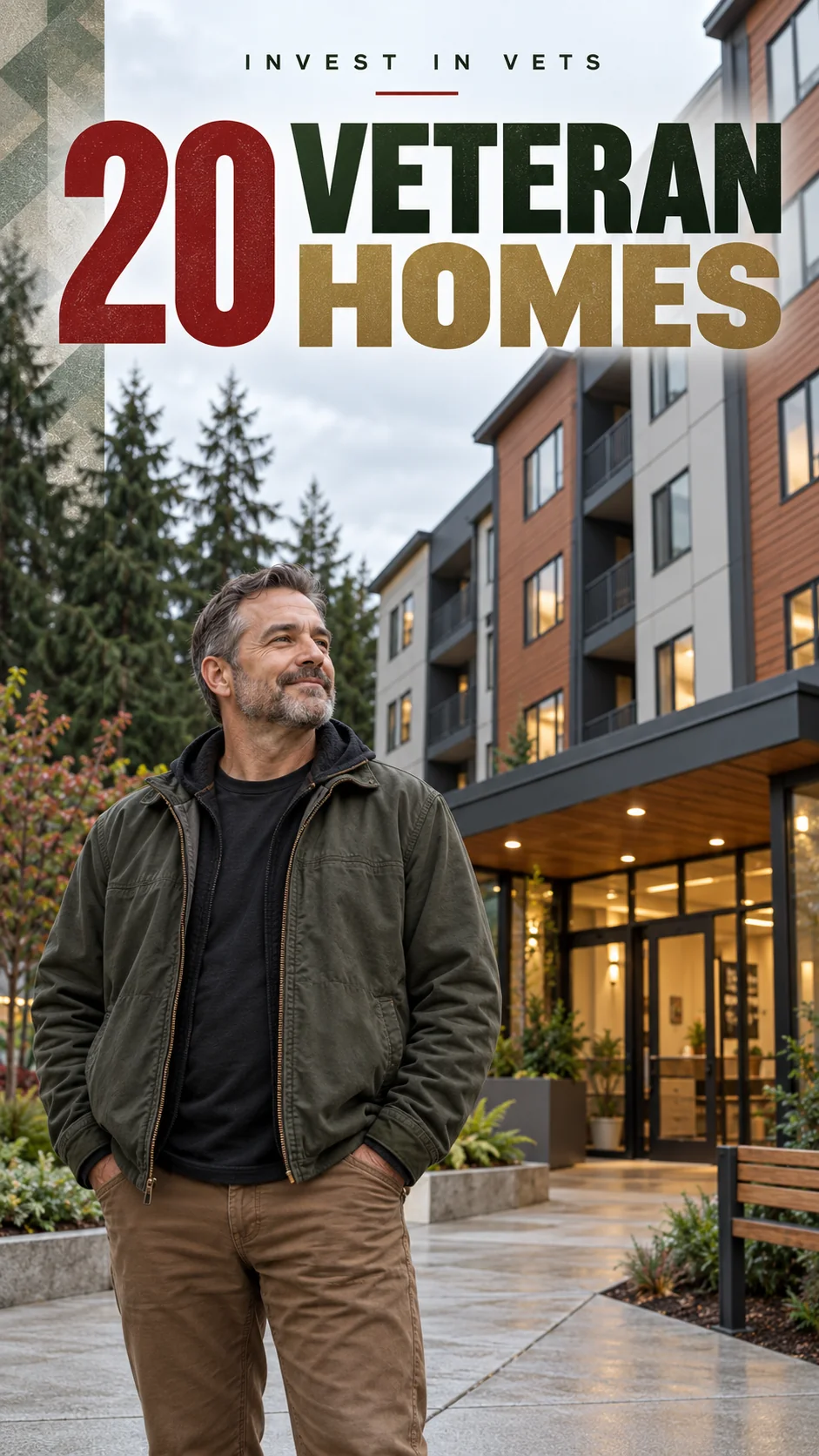
St. Margaret’s Place is no longer a promise on a planning map. The permanent supportive housing building at North 198th Street and Aurora Avenue North in Shoreline opened to tenants in November 2023. It contains 100 apartments for single adults exiting homelessness or at risk of becoming homeless, with on-site staff, resident-service space, community rooms and 5,500 square feet of ground-floor commercial space. Catholic Housing Services reports that 20 apartments were designated for Veterans; a cohort of 20 Veterans moved in when the building opened.
That status matters. The project is open and occupied, not merely proposed, funded or under construction. Local reporting from Sep 22, 2024 described Veterans living together on the fifth floor and organizing peer support. A January 2025 HUD housing inventory separately listed 100 St. Margaret’s Place permanent supportive housing beds available for occupancy. Those sources do not prove that every apartment is filled today, and Invest in Vets should not convert a unit count into a claim that 100 people—or even 20 Veterans—are currently housed without a current occupancy report. They do establish that Shoreline delivered a real building and that Veteran residents were living there after opening.
What the Partnership Actually Delivered
The project began with something many communities already control: public land. Shoreline assembled three parcels totaling 34,360 square feet at the corner of North 198th Street and Aurora Avenue North. A 2021 city staff report estimated the land’s market value at at least $2 million. Rather than sell it for a one-time return, the city approved a 99-year ground lease to Catholic Housing Services for $1 per year, locking the site to affordable housing and supportive services.
King County ran the development-partner process and supported the project with the voter-approved Veterans, Seniors and Human Services Levy and other county funds. Catholic Housing Services became developer, owner-operator and coordinator of wraparound services after an earlier partner merged into another behavioral-health organization. The financing plan also relied on federal Low-Income Housing Tax Credits, secured through an extended-use agreement with the Washington State Housing Finance Commission. The city’s documentation does not publish a final all-in development cost on its current project page, so this article does not assign one.
The resulting modular building includes 80 studios and 20 one-bedroom apartments, according to a March 2023 city project update. Half the residents are at or below 30 percent of area median income and half are at or below 50 percent. Staff are on site around the clock. This is not a voucher alone, a shelter bed or a short stay: it is a permanent home paired with continuing support.
The Veteran Set-Aside Works Inside a Broader Housing Community
The 20 Veteran-designated apartments are part of a 100-unit development serving a wider group of extremely low-income adults. That mixed model is useful. It creates a dedicated lane for Veterans without isolating the entire project from the surrounding community, and it spreads costly features—staffing, common areas, safety systems and service offices—across a larger building.
It also requires precise language. A housing set-aside is not the same as VA disability compensation. Disability compensation is a monthly, tax-free cash benefit for eligible Veterans whose conditions are connected to service; a disability rating is not a prerequisite for asking VA or community providers for help. HUD-VASH, where used, combines rental assistance with VA case management and is not cash paid to the Veteran. Post-9/11 GI Bill housing payments are education benefits tied to eligibility tier, enrollment rate, course modality and school location; they are not a permanent rent subsidy. St. Margaret’s Place should be understood first as permanent supportive housing accessed through the local homeless-response system, not as a universal benefits stack.
Reaching Veterans Who Do Not Lead With “I Need Help”
For deployed Veterans, pride can be both a survival tool and a barrier. Some will avoid a benefits claim because they do not want to be seen as disabled. Others will minimize housing instability, sleep in a vehicle or rotate among friends rather than describe themselves as homeless. A local response succeeds only if it can engage someone before that person is ready to narrate every service-connected condition.
St. Margaret’s Place offers one practical answer: make housing durable, staff it continuously and preserve a Veteran peer group inside the building. The September 2024 local report described a Veteran resident who organized an informal on-site group for fellow Veterans. Peer trust does not replace clinical care, disability claims assistance or case management, but it can lower the threshold for a first conversation. The lesson for Invest in Vets is to fund outreach that starts with housing and respect—“Let’s secure your next step”—rather than requiring a Veteran to adopt a crisis identity before assistance begins.
How Someone Gets In—and What Support Means
St. Margaret’s Place is not a walk-in apartment application. The City of Shoreline says access is through King County’s Coordinated Entry for All system, which assesses housing need and matches people to available resources. The closest listed Regional Access Point is Solid Ground in North Seattle. Eligibility for a Veteran-designated apartment, a HUD-VASH voucher or other assistance must be confirmed by the relevant program; Veteran status alone does not guarantee placement.
Once housed, residents have access to service space and around-the-clock on-site staffing. Local reporting described four to five case managers present at a time, a community kitchen, gathering areas, a garden and a dog run. The important design choice is that services are attached to a lease and a front door. Residents do not have to complete recovery, employment or benefits milestones before they deserve stability. Housing creates the platform from which health care, income, education and reconnection can become possible.
What Invest in Vets Can Adapt
The Shoreline model suggests three concrete partnership moves. First, inventory surplus public parcels near transit and negotiate long-term, mission-restricted ground leases instead of requiring a nonprofit to purchase land at market price. Second, combine a Veteran set-aside with a larger permanent supportive housing project so capital and operating infrastructure serve more people while a defined number of homes remain available to Veterans. Third, build peer support into the operating plan and pay for it: Veteran residents and outreach workers can create trust that a generic referral cannot.
Invest in Vets could convene a local landowner, a housing authority or county homelessness agency, a proven nonprofit operator and VA-connected service partners around one site. Its value would be catalytic: predevelopment grants, landlord or community engagement, flexible move-in funds, peer-navigation contracts and measurement support. The organization should insist on a dashboard that separates total units, Veteran-designated units, units leased, Veterans moved in, returns to homelessness and average time from referral to keys.
The Remaining Gap Is Measurement—and More Doors
St. Margaret’s Place demonstrates that a small city can turn land policy into permanent housing. It does not prove that Veteran homelessness has ended in Shoreline or King County. Public sources confirm the building, the set-aside, the opening and Veteran occupancy after launch, but they do not provide a current unit-by-unit occupancy report or long-term housing-retention outcomes.
The wider need is also current. On Sep 15, 2026, VA announced $45,428,608 in fiscal-year 2027 grants to 17 Washington organizations for homelessness prevention, rapid rehousing, transitional housing and supportive services. That statewide investment can strengthen the service system, but grants do not manufacture apartments. Shoreline’s strongest lesson is physical and repeatable: dedicate land, assign an accountable operator, finance deeply affordable homes, keep support on site and protect a real share of the doors for Veterans.
Veteran Resources
- Housing access in King County: Contact a Coordinated Entry Regional Access Point. Solid Ground—North Seattle: 1501 N. 45th Street, Seattle; 206-694-6833; Monday–Friday, 9 a.m.–5 p.m.
- National Call Center for Homeless Veterans: Call 877-424-3838 for 24/7 help connecting with VA and community housing resources.
- Veterans Crisis Line: Call 988 and press 1, text 838255, or use online chat. Immediate danger: call 911.
- Benefits help: A VA-accredited representative can help evaluate disability-compensation eligibility; asking about housing or mental-health support does not require an existing disability rating.
Veterans: start with one confidential conversation; you do not need to solve every benefit or diagnosis before asking for housing help. Landlords: partner with local housing navigators and accept rental assistance while treating Veterans as ordinary tenants with ordinary dignity. Investors and developers: bring sites, predevelopment capital and affordable-housing expertise to Veteran-serving operators. Supporters: fund peer navigation, deposits, furnishings and the flexible costs that turn a referral into a move-in. Invest in Vets can help assemble those partners around the next address.
Sources
- City of Shoreline — 198th Affordable Housing Project
- City of Shoreline — Aug 16, 2021 ground-lease staff report
- Catholic Community Services — Veterans Find a Permanent Home at St. Margaret’s Place
- Shoreline Area News — Meeting Our Neighbors at St. Margaret’s Place (Sep 22, 2024)
- HUD Exchange — 2025 WA-500 Housing Inventory Count
- VA — Washington State homelessness grants announcement (Sep 15, 2026)
- King County Regional Homelessness Authority — Regional Services Database
- VA — Homeless Veterans resources
- VA — Disability compensation
- VA — Post-9/11 GI Bill rates and eligibility