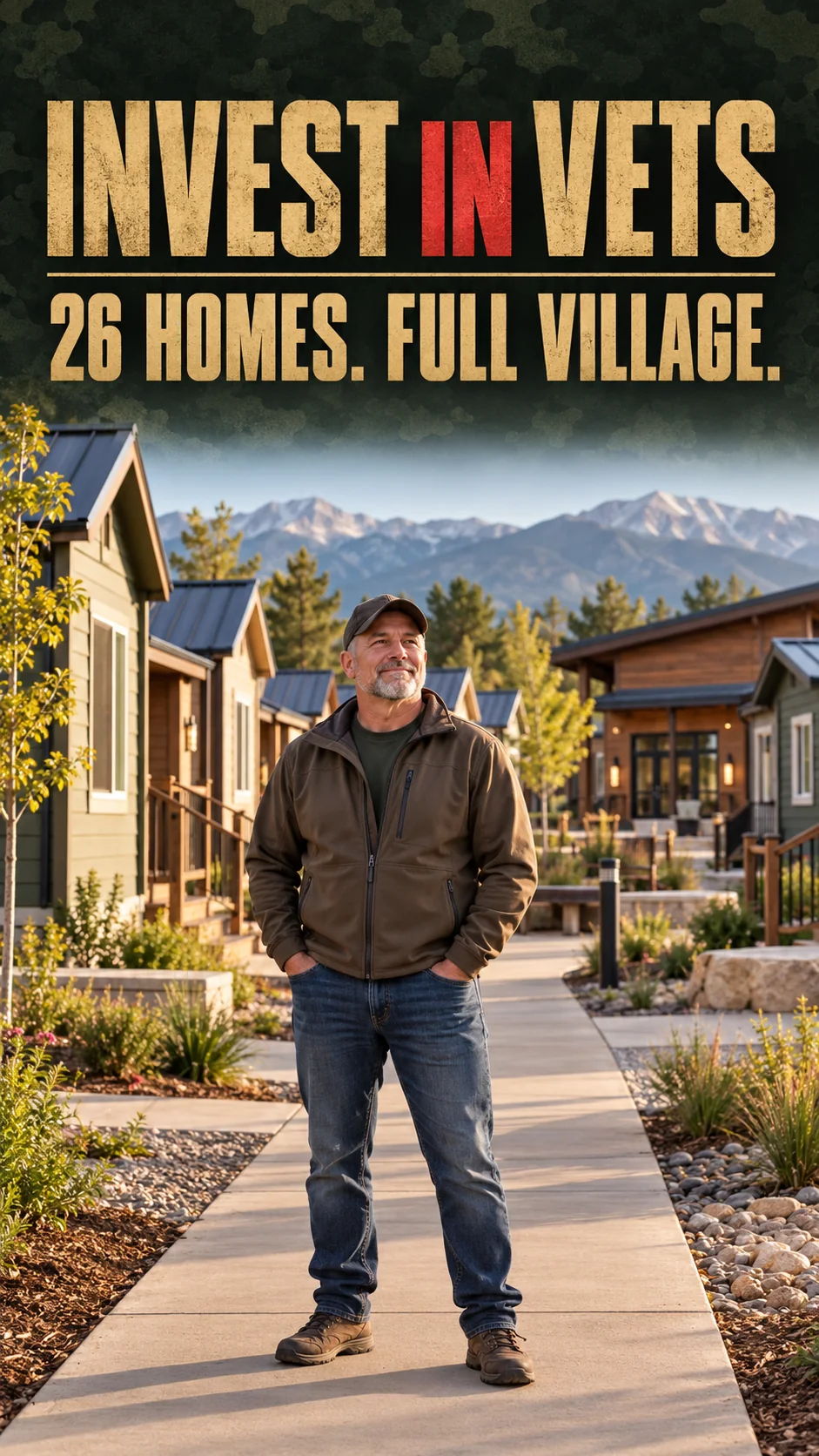
INVEST IN VETS • LOCAL HOUSING CASE STUDY • Sep 30, 2026
Longmont Fills a 26 Home Veteran Village
How a local partnership turned completed tiny homes into an operating bridge toward permanent housing
By Invest in Vets | Longmont Colorado
STATUS | HOUSING | HOME SIZE | SERVICE HUB |
Full Means Operating Not Finished
On Jul 27, 2026, KUSA reported that the Veterans Community Project Village in Longmont, Colorado, had reached full residential capacity after community support helped close an operating funding gap. That is a meaningful milestone because the project is no longer a rendering, a groundbreaking, or a ribbon-cutting promise. It is a completed 26-home community being used for its intended purpose.
The milestone still requires careful language. Full capacity means the Village was reported full at that point in time; it does not mean 26 Veterans entered permanent housing, and it does not prove that Veteran homelessness has ended in Boulder County. These are transitional homes. Their job is to give Veterans privacy, stability, and intensive support while each resident works toward a sustainable permanent home.
What Longmont Built
Veterans Community Project operates the Village at 3095 Mountain Brook Drive on a two-acre site. The completed development contains 26 fully furnished tiny homes ranging from 240 to 320 square feet. All 26 homes are designated for Veterans, including homes designed to accommodate individuals and families. A 3,000-square-foot Community Center anchors the site with case management, gathering space, and wraparound services.
The construction timeline shows why stage labels matter. On May 8, 2023, Boulder County said the Community Center was complete while the first homes were still under construction. The Longmont Community Foundation reports that the residential program opened in September 2023. By Jul 27, 2026, local reporting described the Village as full. Those dates mark three different conditions: service infrastructure completed, homes opened, and residential capacity filled.
The operator reports that 18 Veterans were welcomed into the transitional homes during 2025 and that 219 Veterans received residential or outreach services that year. Those numbers answer different questions. Eighteen is an annual entry count, 219 combines housing and outreach, and 26 is physical housing capacity. None should be presented as a single occupancy or permanent-housing total. VCP also says its national Village model has an 85 percent rate of transition to sustainable permanent housing, but it does not publish that percentage as a Longmont-only outcome on the reviewed location page.
A Partnership That Turned Land Into Doors
The physical village reflects a division of responsibility. Veterans Community Project develops and operates the housing and provides one-on-one case management. HMS Development participated in the project partnership. The City of Longmont waived development fees, lowering a local barrier without pretending that fee relief alone could build or operate the program. Boulder County connected the Village to its coordinated homeless response and funded the outreach center with a $150,000 grant in 2022 and a $250,000 grant in 2023.
Private capital remains part of the operating model. A Jul 14, 2026 announcement documented a new $50,000 corporate donation and said the donor had provided $550,000 to the Longmont effort since 2024. Two weeks later, KUSA reported that community action had closed a funding gap and the Village had reached capacity. The reviewed sources do not disclose a complete all-in construction cost or annual operating budget, so those figures should not be invented. What can be verified is a layered model: land and development cooperation, county support for outreach, private operating support, and a nonprofit accountable for the homes and services.
A Full Village Changes the Job
Once every home is in use, the local challenge shifts from filling doors to maintaining flow. A transitional village succeeds only when residents can move into permanent housing that is affordable, safe, and connected to income and care. Longmont therefore needs landlords willing to accept rental assistance where applicable, flexible move-in funds, accessible units, and case coordination that continues through the handoff.
The distinction between benefits is important. VA disability compensation is a cash benefit based on an approved service-connected condition and rating. HUD-VASH combines rental assistance with VA case management for eligible Veterans and is not spendable cash. Post-9/11 GI Bill housing payments are education benefits whose amount depends on eligibility tier, enrollment, training format, and school location. The VCP tiny home itself is transitional housing, not any one of those benefits. Case managers and Boulder County Veteran Service Officers can help a Veteran understand which separate programs may apply without promising that everyone qualifies for all of them.
Reaching Veterans Who Do Not Ask
Longmont addresses a problem that is often invisible in official counts: a deployed Veteran may be sleeping in a vehicle, rotating between relatives, or paying for short motel stays while refusing the label homeless. Pride, military identity, trauma, and reluctance to discuss a service-connected condition can delay contact until a temporary situation collapses.
VCP makes the first step less institutional. Its Longmont page says Veterans from Northern Colorado and the Denver metro area can request residential intake, emergency help, benefits navigation, document assistance, career coaching, and partner referrals. The program asks for military verification, such as a DD-214, VA card, or state identification showing military status, but says staff can help when a Veteran does not have the document. The operator also states that support is open to those who took the oath regardless of discharge status, length of service, or type of service. That broad front door does not guarantee a residential opening, especially when the Village is full, but it creates a place to begin without a finished benefits claim or a polished explanation of what went wrong.
What Invest in Vets Can Adapt
Longmont offers a replicable partnership sequence. First, identify land where a small community can be integrated into an existing neighborhood. Second, secure local fee relief and a development partner before fundraising is treated as the only solution. Third, build the service center and case-management capacity alongside the homes. Fourth, fund operations and the permanent-housing exit pipeline, not only construction.
Invest in Vets can strengthen this model by publishing separate measures for homes built, homes occupied, Veterans entering each year, people reached through outreach, permanent exits, and housing retained after move-in. It can also recruit landlords before the Village fills, maintain a fund for deposits and accessibility needs, and pair each resident with benefits and employment navigation. A full 26-home Village is evidence that Longmont delivered real housing capacity. The remaining test is whether the community can keep those 26 doors moving Veterans toward permanent homes while ensuring the next Veteran who asks for help is not turned into another invisible wait.
Veteran Resources
- Veterans Community Project Longmont: 720-340-2916. Ask for outreach or residential intake and confirm current availability.
- Boulder County Veteran Service Officers: 303-441-3890. Free benefits navigation with no income requirement.
- National Call Center for Homeless Veterans: 877-424-3838. Confidential help is available 24 hours a day.
- Veterans Crisis Line: Dial 988 then press 1, or text 838255. VA enrollment is not required.
Veterans: call before a couch, car, or motel becomes the permanent address. Landlords: tell VCP, Boulder County, and local VA partners when a safe unit is available for a permanent exit. Investors and developers: support land, fee relief, operating reserves, and affordable move-on housing with transparent outcome reporting. Supporters: fund transportation, identification documents, furnishings, accessibility needs, and outreach to Veterans who may never call themselves homeless.
Sources
- Veterans Community Project Longmont location and program page
- Boulder County May 8, 2023 partnership and grant announcement
- KUSA Jul 27, 2026 full capacity report
- Longmont Community Foundation VCP program profile
- Jul 14, 2026 corporate funding announcement
- Veterans Community Project national model and outcomes
- Boulder County Veteran Services and current contacts
- Metro Denver Homeless Initiative 2026 Point in Time method
- VA HUD VASH program information
- VA National Call Center for Homeless Veterans