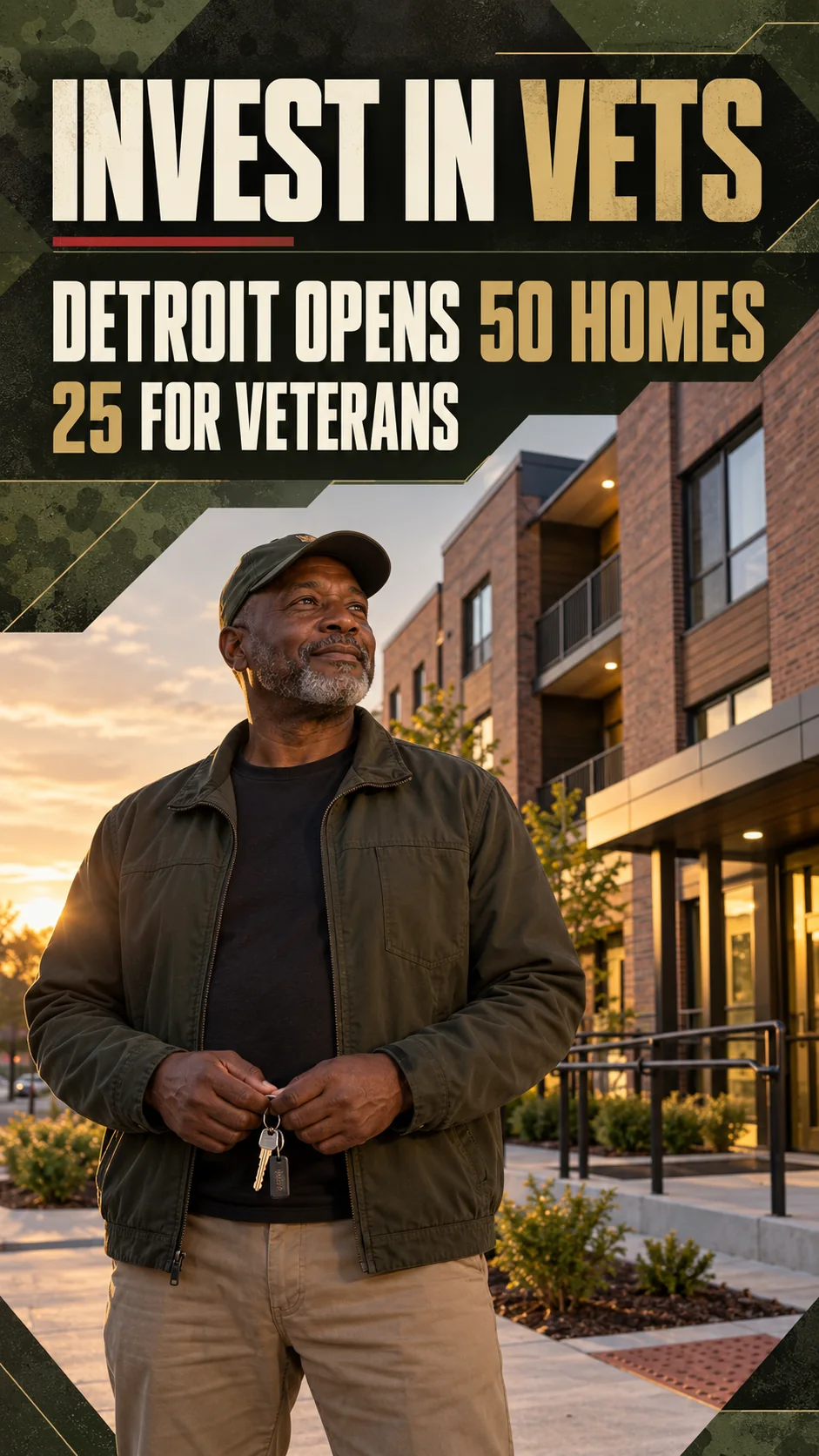
Detroit Opens 50 Supportive Homes at Davis Veterans Village
Status checked Oct 6, 2026. The development opened on Feb 25, 2026; Detroit Housing Commission currently lists its site-based waitlist as open, but a current occupied-unit count is not publicly posted.
A Completed Building With a Defined Veteran Set-Aside
Detroit has added a concrete housing resource to its response to Veteran homelessness. Benjamin O. Davis Veterans Village opened at 20129 Conner Street on the city’s east side in February 2026. The approximately $16 million development contains 50 one-bedroom apartments. Local reporting and the City of Detroit describe 25 units as permanent supportive housing for Veterans facing chronic homelessness; the remaining 25 are for residents with disabilities and are not documented as Veteran-exclusive.
That distinction keeps the story accurate. Detroit delivered 50 affordable apartments, but the confirmed Veteran-designated portion is 25 units. Veterans with disabilities may also qualify for other units depending on program rules, yet the public sources reviewed do not establish that every apartment is reserved for a Veteran. Nor does an opening ceremony prove full occupancy. BridgeDetroit reported that 44 units remained available on Feb 25, 2026, when one Veteran resident spoke at the event. Detroit Housing Commission now lists the property’s waitlist as open, but neither the Commission nor the City publishes a current lease-up total.
Verified Project Snapshot
FACT | VERIFIED STATUS |
Location | 20129 Conner Street, Detroit, Michigan |
Responsible partnership | City of Detroit, Communities of HOPE, Premier Property Management, Detroit Housing Commission, MSHDA, LISC Detroit, Slavik Company and financial/philanthropic partners |
Total units | 50 completed one-bedroom apartments |
Veteran-designated units | 25 permanent-supportive units for Veterans facing chronic homelessness |
Other units | 25 units for residents with disabilities; not documented as Veteran-exclusive |
Housing assistance | 25 Detroit Housing Commission and 25 MSHDA project-based vouchers; resident rent capped at 30% of monthly income |
Current stage | Open since February 2026; DHC waitlist listed open; current occupancy not publicly reported |
How Detroit Assembled the Housing
The development illustrates how local housing delivery often depends on several forms of capital and operating support working together. Detroit’s earlier project announcement described an approximately $16.4 million budget, including $1.4 million in American Rescue Plan Act funding and $300,000 in HOME-ARP funding through the City’s Housing and Revitalization Department. The completed-project announcement rounded the investment to $16 million and credited a broader public-private coalition.
The long-term affordability mechanism is as important as the construction money. Twenty-five project-based vouchers come from the Detroit Housing Commission and 25 from the Michigan State Housing Development Authority. These vouchers are tied to the property rather than handed to residents as cash. The public sources state that residents pay no more than 30% of monthly income toward rent, subject to screening, income verification, voucher rules, and the property’s eligibility process.
Project-based assistance gives the building an operating foundation, while onsite case management and services address the reasons a lease alone may not be enough. The public record identifies mental-health, substance-use, and employment resources, along with common spaces, security monitoring, a dog park, a game room, a theater room, and 24-hour emergency maintenance. These features do not guarantee housing stability, but they create a platform for coordinated support.
An Access Route That Is Open but Not Automatic
Detroit Housing Commission’s current project-based voucher page lists Benjamin O. Davis Veterans Village as a one-bedroom property with an open waitlist and provides the property phone number, 810-629-9500. BridgeDetroit also identified Detroit’s Coordinated Assessment Model, or CAM, at 313-305-0311 as the main entry point for people in Detroit, Hamtramck, and Highland Park seeking shelter or other housing resources.
An open waitlist is an opportunity to apply, not a promise of a unit. DHC explains that each property maintains its own list and that preferences, household income, assets, eligibility documents, and program funding can affect selection. Veterans seeking the 25 homelessness-focused units may need coordinated-entry and supportive-housing eligibility verification. Applicants should keep contact information current and respond promptly to document requests; a pre-application or waitlist status is not final approval.
Pride Should Not Be the Price of Entry
For a deployed Veteran, the hardest step may be acknowledging that housing, grief, trauma, work disruption, or substance use has become unmanageable. Davis Veterans Village pairs private apartments with peer proximity and onsite support, allowing a person to enter through a housing or employment conversation before choosing whether to discuss a service-connected condition. That lowers the pressure to make disability the opening sentence.
Detroit also has a confidential, no-cost Vet Center in a non-medical setting. Its official VA page says eligible Veterans do not need to be enrolled in VA health care, rated for a service-connected disability, or receiving another VA benefit. Eligibility for Vet Center services still depends on qualifying circumstances, but the absence of a required disability rating can matter to a Veteran who is ready to talk but not ready to file a compensation claim.
Benefits Are Separate Tools
VA disability compensation, HUD-VASH rental assistance, and Post-9/11 GI Bill education benefits are different programs. Disability compensation is tax-free monthly cash for eligible service-connected conditions, with the amount depending on the rating and, in some cases, dependents. Housing help does not require a Veteran to obtain a disability rating first.
HUD-VASH combines rental assistance with VA case management for eligible Veterans experiencing homelessness. A voucher pays housing assistance through the rental system; it is not spendable cash, and local payment standards, rent reasonableness, inspection, income, and case-management rules apply. The Post-9/11 GI Bill may provide a monthly housing allowance to an eligible student, but the amount depends on eligibility tier, enrollment rate, training modality, and the school’s location. Nothing in the Davis Village sources indicates that a resident automatically receives all three benefits.
What Detroit Should Report Next
The next accountability question is sustained use. Public reporting should show how many of the 25 Veteran-designated apartments are occupied, how long qualified Veterans wait from referral to move-in, how many applicants cannot complete screening, and how residents fare at six and twelve months. The same reporting should separate the 25 homelessness-focused units from the 25 disability-focused units so the project’s Veteran impact is not inflated.
Detroit’s January 2025 one-night count identified 110 Veterans in emergency shelter, transitional housing, or other homelessness programs across Detroit, Hamtramck, and Highland Park. A 25-unit set-aside is therefore meaningful but not sufficient by itself. Permanent housing must be paired with prevention, rapid rehousing, landlord participation, and pathways from outreach into available units.
What Invest in Vets Can Adapt
The transferable lesson is the structure of the partnership. A developer and property manager delivered the building; the City contributed federal recovery and homelessness funds; state and local housing agencies attached project-based vouchers; and service partners created an onsite support lane. Invest in Vets can use that sequence when approaching municipalities, housing authorities, health systems, developers, and mission-aligned investors.
The strongest partnership proposal would define the unit split before fundraising, identify which units are truly Veteran-designated, secure operating assistance before opening, and publish one referral path. Invest in Vets can add peer navigation for Veterans who distrust systems or avoid disability conversations, while landlord and investor partners can contribute properties, acquisition capital, rehabilitation expertise, or units tied to enforceable affordability and service standards.
A Mission-Focused Next Step
Veterans, landlords, investors, service providers, and supporters can help build the next local housing lane. Donate to Invest in Vets to support the cause, or buy a $5 practical guide through the Mission Support Shop. Every digital guidebook was listed at $5 when verified on Oct 6, 2026. Donating supports Invest in Vets’ mission; buying a guide provides a practical resource while supporting its work. A purchase is separate from a charitable donation, and no housing or benefit outcome is guaranteed.
VETERAN RESOURCES
Where to Start
Detroit Housing Commission project-based voucher listings — Check the Benjamin O. Davis Veterans Village listing, current waitlist status, and property contact.
Detroit Coordinated Assessment Model — Call 313-305-0311 for coordinated access to shelter and housing resources in Detroit, Hamtramck, and Highland Park.
VA Detroit homeless Veteran care — Connect with VA help for immediate shelter, permanent housing, prevention, health care, employment, and treatment.
Detroit Vet Center — Confidential, no-cost counseling in a non-medical setting; a VA disability rating is not required.
National Call Center for Homeless Veterans — Call 877-424-3838 for 24/7 confidential help.
Veterans Crisis Line — Call 988 and press 1, text 838255, or use online chat.
SOURCES
Reporting Sources
City of Detroit — Completed-project announcement dated Feb 26, 2026 (accessed October 6, 2026).
City of Detroit — Project groundbreaking, financing, and partner announcement (accessed October 6, 2026).
Detroit Housing Commission — Current project-based voucher property listing and waitlist status (accessed October 6, 2026).
BridgeDetroit and Detroit Free Press — Opening-day reporting, unit availability, rent structure, and application route (accessed October 6, 2026).
Michigan State Housing Development Authority — HUD-VASH program explanation (accessed October 6, 2026).
U.S. Department of Veterans Affairs — VA Detroit homeless Veteran care (accessed October 6, 2026).
U.S. Department of Veterans Affairs — Detroit Vet Center services and access conditions (accessed October 6, 2026).
Homeless Action Network of Detroit — 2025 Point-in-Time and Housing Inventory reporting hub (accessed October 6, 2026).
Invest in Vets — Mission Support Shop with verified $5 digital guidebooks (accessed October 6, 2026).
Invest in Vets — Donation page (accessed October 6, 2026).