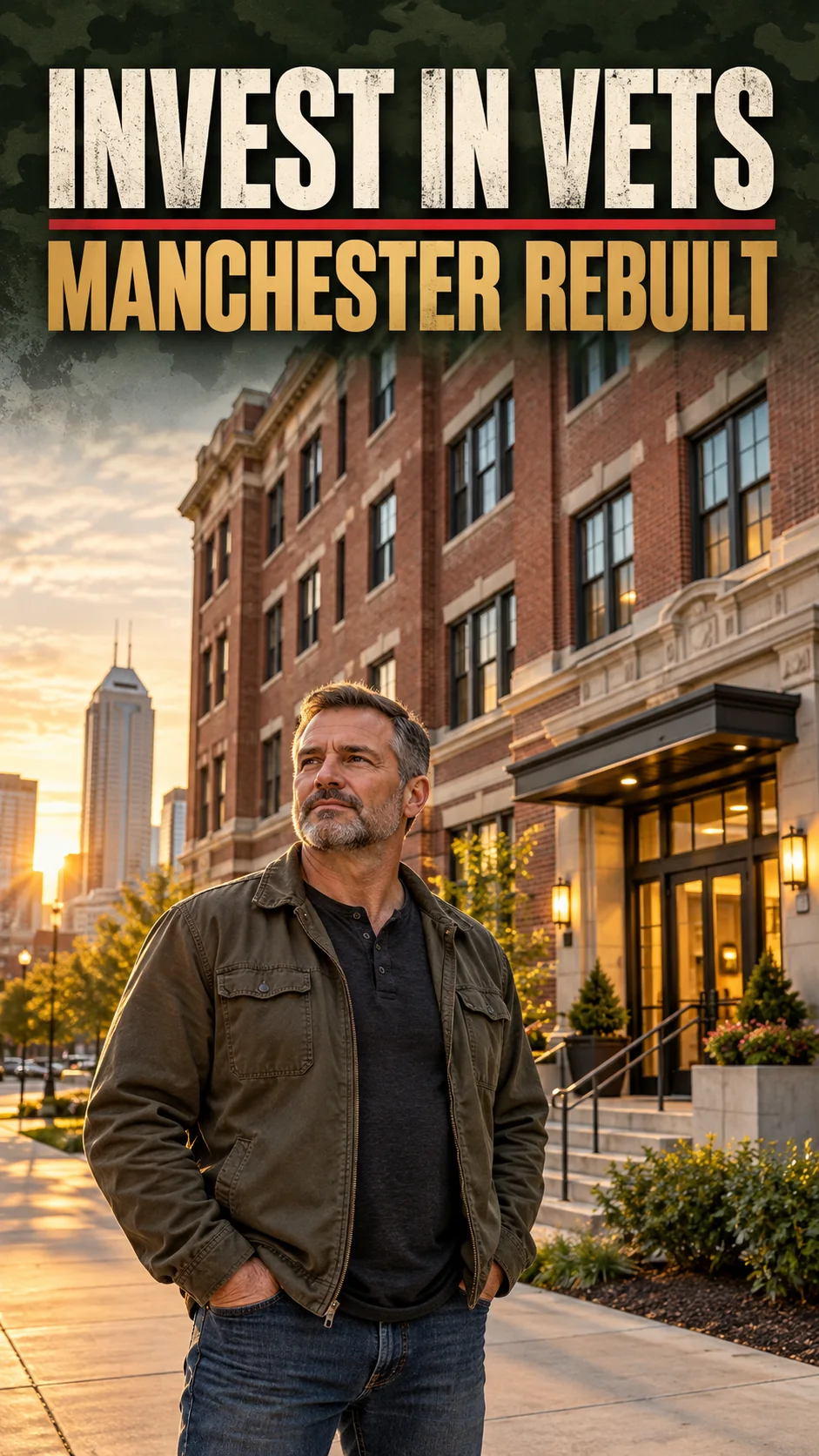
INVEST IN VETS • LOCAL HOUSING CASE STUDY • Oct 1, 2026
Indianapolis Rebuilds Manchester Apartments After a Fire Displaced 48 Veterans
How a nonprofit, VA partners, designers, contractors, donors, and landlords restored a local bridge from homelessness to permanent housing
By Invest in Vets | Indianapolis Indiana
STATUS | LATEST OPERATOR TOTAL | ACCESSIBILITY | FIRE IMPACT |
Rebuilding More Than a Burned Building
On Aug 12, 2026, HVAF of Indiana announced that Manchester Apartments in downtown Indianapolis was fully restored and open again. The milestone closed a 22-month recovery from the Oct 26, 2024 electrical fire that displaced 48 Veterans and severely damaged the nonprofit’s largest transitional-housing property. This was not a new project drawn on paper. It was the recovery and expansion of an operating housing link that Indianapolis had abruptly lost.
The distinction matters. Manchester Apartments is not proof that Veteran homelessness has ended in Indianapolis, and reopening units is not the same as moving every resident into permanent housing. It is a restored place where Veterans can leave the street, receive intensive support, and prepare for a permanent exit. The city still counted 137 Veterans experiencing homelessness on Jan 28, 2026, up from 125 one year earlier, even though that remained the second-lowest local count since 2005.
What Reopened and What It Means
HVAF’s latest reconstruction update says Manchester’s North and South towers now offer 64 total units for homeless Veterans, including five ADA-compliant apartments. The South Tower contains 42 units and an expanded food, clothing, and hygiene pantry. The North Tower first reopened in 2025 with 19 renovated transitional units and 23 beds; by September 2025 it was at capacity, and HVAF later reported that the North Tower had served 58 unique Veterans by June 2026.
One reporting discrepancy should remain visible. Mirror Indy reported on Aug 5, 2026 that the completed complex contained 61 units—10 more than before the fire—while HVAF’s later August reconstruction page states 64 combined units. Because the reviewed sources do not reconcile the difference, Invest in Vets should use 64 only as the operator’s current reported total and retain 61 as the contemporaneous local count. The sources also say most apartments are transitional and some are permanent supportive housing, but they do not publish the exact split. No responsible article should call all units permanent housing.
That same caution applies to occupancy. HVAF said on August 12 that the property was fully open, but the reviewed sources do not provide a verified count of residents physically moved into the rebuilt South Tower by that date. Open units, occupied units, annual entries, and permanent exits are separate measures.
A Local Partnership Held the Bridge
HVAF operated the response from the day after the fire. It moved displaced Veterans into hotels, later leased an off-site location to restore temporary capacity, and continued case management while rebuilding. Guidon Design, a local Veteran-owned firm, helped redesign the heavily damaged South Tower; Commercial Restoration Company handled reconstruction. Insurance proceeds funded the basic recovery, while charitable contributions paid for improvements beyond insurance coverage, including stronger fire-safety systems, upgraded electrical panels, new windows, appliances, and storage.
Community participation was tangible. American Legion Auxiliary posts and related Legion organizations furnished every South Tower unit with household goods. The pantry was redesigned to make food, clothing, and hygiene supplies easier to distribute. The reviewed sources do not disclose a complete reconstruction price or the respective shares paid by insurance and donors, so those amounts should not be invented. What is documented is the partnership architecture: nonprofit operator, Veteran-owned designer, restoration contractor, insurers, community donors, and volunteers.
Housing Must Keep Moving
Transitional housing works only when a permanent exit is available. Indianapolis paired the Manchester rebuild with a coordinated “One Team” process led by VA Indiana and HVAF, a local grantee of VA’s Supportive Services for Veteran Families and Grant and Per Diem programs. During a focused surge from July 25 through Jul 31, 2026, the partners moved 16 Veterans into permanent housing; four more moved the following week when landlords started leases on the first of the month. VA reported 20 permanent placements in total and said the local partners planned to repeat the surge every three months.
That result shows why landlords are part of the housing infrastructure. Case conferencing can clear paperwork, benefits, deposits, transportation, and move-in barriers, but it cannot produce a lease where no unit is available. The Indianapolis Housing Agency separately administers HUD-VASH rental assistance for eligible Veterans referred by VA. HUD-VASH combines rental assistance with VA case management; it is not cash paid to a Veteran. VA disability compensation is a separate cash benefit based on service connection and rating. Post-9/11 GI Bill housing payments are education benefits whose amount depends on eligibility tier, enrollment, training format, and school location. Manchester housing is not any of those benefits, though case managers can help residents navigate programs that may support a permanent move.
Reaching the Veteran Who Will Not Ask
A deployed Veteran may sleep in a vehicle, rotate among relatives, or stretch motel stays while refusing to describe the situation as homelessness. Pride, military identity, trauma, and reluctance to discuss a service-connected condition can make a formal intake feel like surrender. Indianapolis reduces that barrier by using multiple front doors. HVAF’s outreach coordinator is also a Veteran and goes directly to camps, while the organization offers housing, employment support, therapy, legal help, rapid rehousing, and basic supplies from one service network.
HVAF states that it serves Veterans, active-duty members, Reservists, and National Guard members regardless of discharge status. That broad outreach policy does not mean every person qualifies for every federally funded program or for immediate placement at Manchester. It means someone can begin the conversation before a disability rating, HUD-VASH referral, or perfectly organized service record is in hand. For a Veteran whose pride has delayed help, that first conversation can be the difference between prevention and a crisis.
What Invest in Vets Can Adapt
Manchester offers a practical continuity plan for Veteran housing. First, protect residents immediately when a building fails; hotels and leased backup space preserved housing while reconstruction proceeded. Second, rebuild for greater safety and accessibility rather than merely restoring the previous floor plan. Third, connect transitional beds to a scheduled permanent-housing exit process that brings VA, SSVF, GPD, housing authorities, landlords, and nonprofit case managers to the same table. Fourth, recruit community groups for specific move-in needs—housewares, food, hygiene supplies, and transportation—rather than relying on vague goodwill.
Invest in Vets can strengthen the model by publishing one reconciled unit inventory and a recurring dashboard that separates physical units, beds, units occupied, annual residents served, permanent exits, and housing retention. It can also develop a landlord reserve for deposits, accessibility modifications, and short vacancy holds during voucher processing. Indianapolis rebuilt the bridge. The next test is whether every restored door keeps moving Veterans toward durable homes while leaving room for the next person willing to ask.
Veteran Resources
- HVAF of Indiana: 317-951-0688. Ask for housing or outreach help; main service center at 45 East 10th Street, Indianapolis.
- Indianapolis Housing Agency HUD-VASH: 317-261-7200. HUD-VASH referrals come through VA; landlords can ask IHA about leasing procedures.
- National Call Center for Homeless Veterans: 877-424-3838. Free and confidential, 24 hours a day.
- Veterans Crisis Line: Dial 988 then press 1, or text 838255. VA enrollment is not required.
Veterans: call before a couch, car, or motel becomes the permanent address. Landlords: tell HVAF, IHA, and VA Indiana when a safe unit can support a permanent exit. Investors and developers: fund accessible units, move-in reserves, and affordable housing beyond the transitional campus. Supporters: provide practical move-in goods, transportation, and operating support while asking for transparent outcome reporting.
Sources
- HVAF August 2026 Manchester Apartments reconstruction update
- HVAF Aug 12, 2026 complete restoration announcement
- Mirror Indy Aug 5, 2026 inspection and unit report
- Indiana Public Media Jun 6, 2025 North Tower reopening report
- HVAF housing programs eligibility and services
- VA Sep 10, 2026 Indianapolis One Team housing surge
- WFYI Jul 29, 2026 Indianapolis homelessness count
- Indianapolis Housing Agency HUD VASH program
- HVAF current contact and outreach information
- VA Indiana homeless Veteran care
- VA National Call Center for Homeless Veterans