INVEST IN VETS • LOCAL HOUSING CASE STUDY • SEPTEMBER 27, 2026
Old Buildings, Permanent Homes: Milwaukee’s Soldiers Home Is a Veteran-Housing Blueprint
A 101-apartment historic rehabilitation shows how VA land, a housing authority, private development capital and local services can work as one permanent-housing system.
By Invest in Vets | Milwaukee, Wisconsin
DELIVERY | STATUS | ACCESS |
A Landmark Put Back to Work
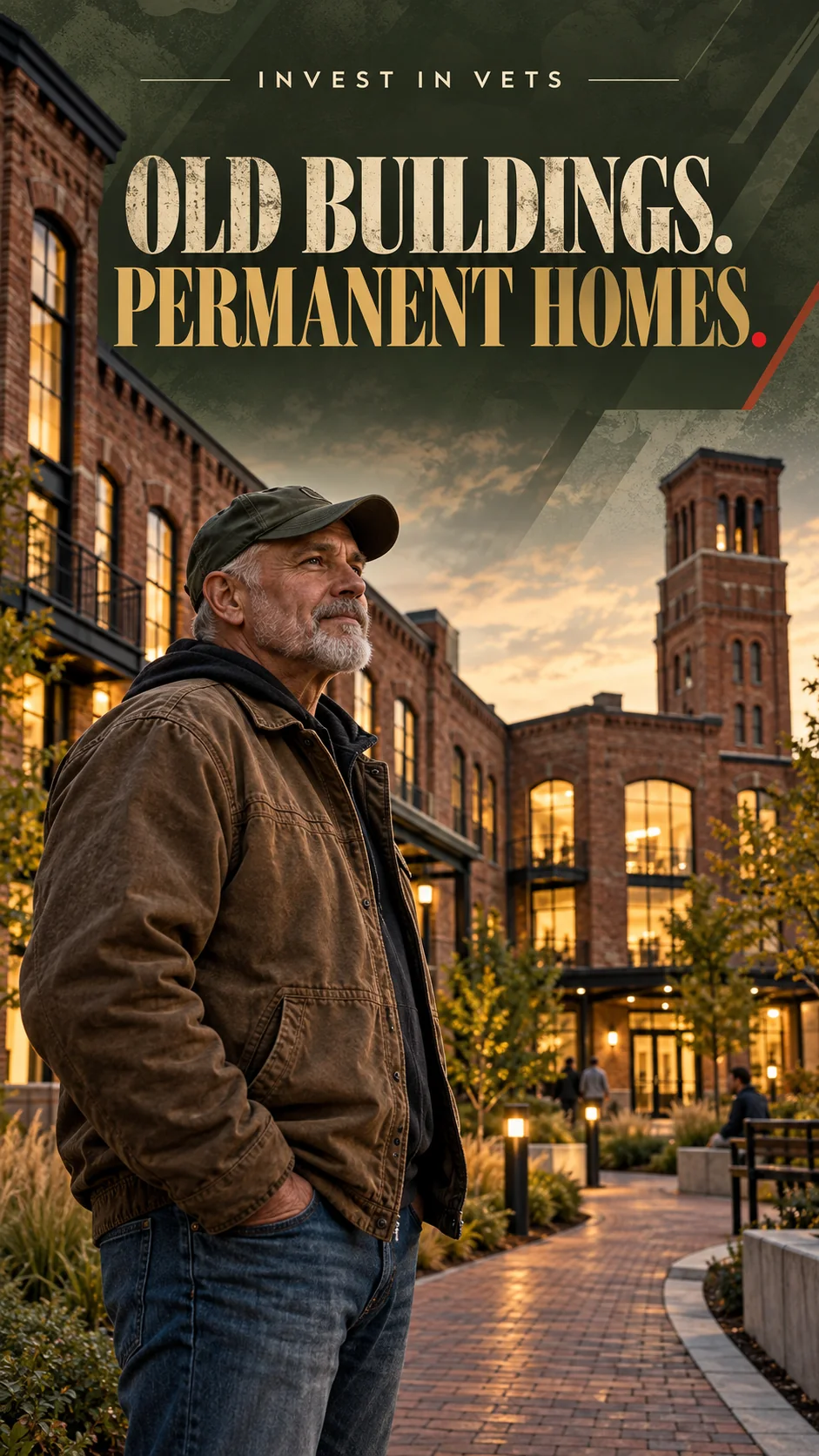
Milwaukee did not solve a housing shortage by waiting for a perfect vacant lot. It treated an underused federal campus as a housing asset. On the grounds of the Clement J. Zablocki VA Medical Center, the Milwaukee Soldiers Home project restored historic buildings that had once served Veterans, then stood vacant and deteriorating, and returned them to that mission as permanent supportive housing.
The operating project is concrete and countable: 101 apartments, all created for Veterans and their families who are homeless or at risk of homelessness. The Alexander Company, the project’s developer and architect, says six rehabilitated buildings reopened in March 2021 and lists the $44 million development as active. A national VA Enhanced-Use Lease page updated Aug 11, 2026 also confirms 101 units and describes seven structures, including four duplexes. The public sources differ in how they count the restored structures, but they agree on the housing result: 101 permanent supportive homes. That distinction matters because a project’s headline number should describe deliverable units, not architectural counting conventions.
This is no longer a proposal, award or construction promise. The homes opened more than five years ago. At opening, project partners reported that Veterans began moving in during March 2021. Invest in Vets found no current public, project-specific occupancy figure, so this case study does not equate the 101-unit inventory with 101 Veterans housed today. The accurate status is that the development is open and operating; current availability requires direct screening through the local housing system.
The Partnership Behind the Apartments
The project’s strength is not a single grant or a single institution. VA retained the land and used an Enhanced-Use Lease, a federal tool that can place underused VA property into long-term service through a public or private lessee. VA’s current program guidance permits leases of up to 99 years for supportive housing or projects that directly or indirectly benefit Veterans. The lessee takes responsibility for financing, design, rehabilitation, operation and maintenance rather than leaving VA to carry every development risk.
In Milwaukee, the Housing Authority of the City of Milwaukee is the owner partner; the Center for Veterans Issues operates the housing; the Milwaukee VA Medical Center provides case management and supportive services through HUD–VASH; and The Alexander Company led the development and design team. That structure gives each participant a defined job: stewardship of federal property, affordable-housing ownership, day-to-day operations, clinical and housing-stability services, and specialized historic redevelopment.
The $44 million capital stack was equally layered. The developer identifies both 9% and 4% federal Low-Income Housing Tax Credits, federal and state historic tax credits, military construction funds, Capital Magnet Fund resources, a National Park Service Save America’s Treasures grant, corporate foundations and contributions from more than 650 donors. The mix is useful beyond preservation circles. It shows that Veteran housing can be financed by combining housing, historic, federal-property and philanthropic tools around one clearly defined outcome.
Permanent Housing, Not a Temporary Bed
The Soldiers Home is not a shelter, a domiciliary or short-term transitional lodging. VA described it before opening as permanent supportive housing. Veterans enter through HUD–VASH, which pairs HUD rental assistance with VA case management. A qualifying resident generally contributes a share of income toward rent, while the subsidy supports the lease and VA staff provide services based on need. The voucher is rental assistance within a housing program; it is not cash deposited for unrestricted spending.
Eligibility should not be reduced to a social-media formula. VA disability compensation is a separate, tax-free federal benefit tied to a service-connected condition and rating. HUD–VASH is a housing program for eligible Veterans experiencing homelessness, with local referral, income and program screening. Post-9/11 GI Bill housing payments are education benefits available only to eligible students while enrolled, and the amount changes with eligibility tier, course load, school location and whether study is in person or online. One benefit does not automatically unlock the others, and no Veteran should assume a quoted apartment value or voucher payment standard is personal income.
That clarity is especially important for deployed Veterans who learned to keep problems inside. Pride, identity and fear of being judged can delay the first call until an eviction, couch-surfing arrangement or vehicle becomes a crisis. The right outreach message is not “prove you are broken.” It is “let us screen the housing problem and build a plan.” A disability claim may be appropriate for a service-connected condition, but a disability rating and HUD–VASH eligibility are different determinations. Milwaukee’s model creates a front door where housing and case management can begin together.
Measured Progress—and the Remaining Gap
The broader Milwaukee VA system continues to show housing activity beyond this one campus. In a Dec 2, 2025 release, the Zablocki Health Care System reported 394 unique Veterans permanently housed during federal fiscal year 2025. That is a systemwide outcome across its service area, not a Soldiers Home occupancy report and not proof that Veteran homelessness has ended. It does, however, show that the apartments sit inside a larger outreach and placement network rather than functioning as an isolated building.
The remaining gap is visibility. Public sources verify the project’s capacity, opening, partners and service model, but not a current unit-by-unit occupancy rate, wait time or turnover pipeline. Those are the operating measures a replication partner should request: referrals received, time from referral to lease, lease-up and vacancy, housing retention, returns to homelessness, and the share of households connected to benefits, health care and employment support. Buildings create capacity; transparent operations show whether capacity is reaching people quickly and sustaining housing.
What Invest in Vets Can Adapt
Milwaukee offers a practical sequence. First, inventory underused public or institutional land and buildings near health and transit services. Second, establish a Veteran-specific use and a unit count before fundraising. Third, divide the work among a landholder, experienced developer, housing authority or subsidy administrator, service provider and operator. Fourth, finance the project with sources matched to the asset—historic credits for rehabilitation, housing credits for affordability, grants for public benefit and philanthropy for gaps. Finally, publish operating outcomes after opening, not just ribbon-cutting numbers.
For Invest in Vets, the most actionable opportunity is partnership development. The organization can convene VA asset managers, municipalities, preservation groups, community lenders, housing authorities and Veteran-service providers around a local property screen. It can also help normalize early referral for deployed Veterans who may never use the word homeless. The lesson from Milwaukee is not that every community needs a Victorian landmark. It is that idle property, disciplined roles and permanent housing resources can be combined into homes that remain in service long after the opening ceremony.
Veteran Resources
- Housing help, 24/7: National Call Center for Homeless Veterans — 877-424-3838 (877-4AID-VET). Free and confidential.
- Milwaukee-area care: VA Milwaukee Homeless Veteran Care connects Veterans who are homeless or at risk with housing, prevention, health, employment and treatment services.
- Crisis support, 24/7: Dial 988 then press 1, text 838255, or use the Veterans Crisis Line chat. Enrollment in VA benefits or health care is not required to connect.
Veterans: Make the call before the last safe place is gone; a screening is a practical housing step, not a surrender of identity. Landlords: Offer units to local HUD–VASH teams and ask how inspections, rent support and case management work. Investors and developers: bring adaptive-reuse, tax-credit and patient-capital expertise to Veteran-designated projects. Supporters: fund outreach, move-in costs, furnishings and the service infrastructure that turns an apartment into stable housing.
Sources
1. The Alexander Company — Milwaukee Soldiers Home — current project page; accessed Sep 27, 2026
2. U.S. Department of Veterans Affairs — Enhanced-Use Lease — updated Aug 11, 2026
3. VA News — Renovated Soldiers Home almost ready for homeless Vets — published Feb 12, 2021; eligibility and rent structure
4. VA Milwaukee — Homeless Veteran Care — updated Dec 29, 2025
5. VA Milwaukee — Milwaukee VA helped house nearly 400 Veterans locally — published Dec 2, 2025
6. VA Homeless Programs — HUD–VASH access policy for disabled Veterans — published Apr 1, 2026
7. Veterans Crisis Line — current 24/7 contact information; accessed Sep 27, 2026