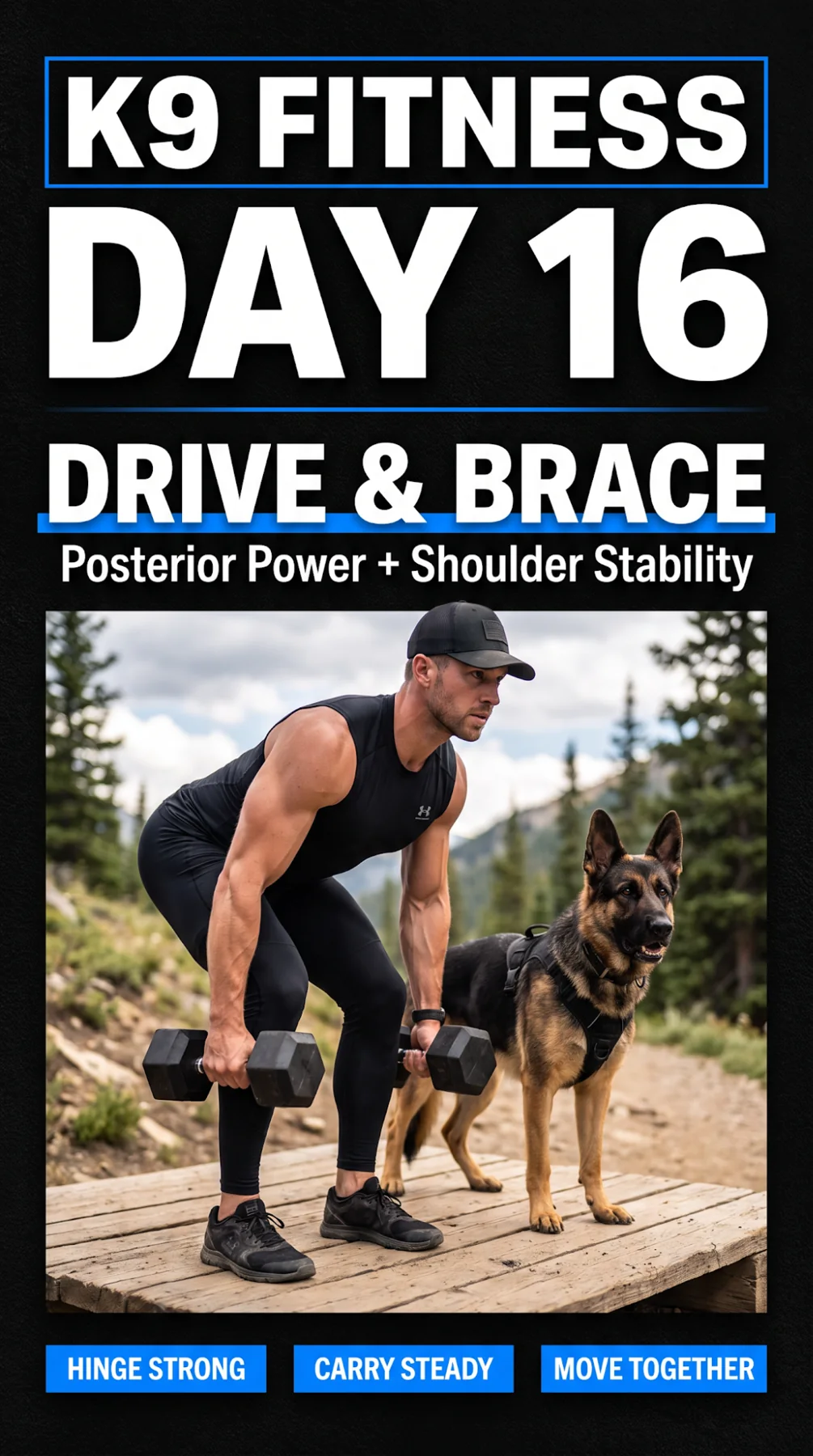
K9 FITNESS — DAY 16 OF 30
DRIVE & BRACE
Posterior Power + Shoulder Stability
Day 15 gave you a midpoint snapshot of how your squat, press, single-leg balance, stepping control, and recovery are coming together. Day 16 uses that information to move into the second half of the course with a more specific job: build the backside of the body while teaching the trunk and shoulders to stay organized under load. Rather than chasing more exercises, today narrows the focus to strong hip extension, controlled bracing, and steady carries—the kind of qualities that make strength useful outside the workout.
Posterior-chain strength matters because the glutes, hamstrings, spinal stabilizers, and surrounding hip muscles help you stand up, climb, lift, carry, and decelerate safely. At the same time, shoulder stability depends on more than pressing weight overhead. Your shoulder blades, trunk, grip, and rib position all contribute to how well you can carry an awkward bag, hold a leash, move equipment, or stabilize yourself on uneven ground. Today connects those systems instead of training them as separate parts.
This session is not meant to feel frantic. Most sets should finish with clean technique still available. The win is a strong hinge without rounding, a carry without leaning, a press without losing rib position, and a steady pace you could repeat. That is the kind of strength that can keep improving for the rest of the course.
WHY THIS DAY MATTERS
The first half of the program introduced the major patterns—squat, lunge, hinge, step, press, stabilize, and carry. From Day 16 forward, those patterns begin to overlap more intentionally. A Romanian deadlift teaches you to create force through the hips. A suitcase carry asks you to resist being pulled sideways. A controlled push press teaches you to transfer force from the lower body through a stable trunk into the shoulders. Together, they build a body that can produce force and control it.
That combination has a direct real-life connection. Picking up a laundry basket, moving groceries, carrying a child, handling work gear, climbing a hill, or walking a dog that changes direction unexpectedly all require more than isolated muscle strength. They require you to keep your feet under you, your trunk organized, and your shoulders connected while the load changes. Today trains that coordination on purpose.
SESSION OVERVIEW
• Target time: 35–45 minutes
• Equipment: one or two dumbbells or similarly manageable weights; optional sturdy bench/counter for support
• Effort: moderate; stop most strength sets with about 2 clean repetitions still available
• Primary focus: posterior-chain power, anti-lean core strength, shoulder stability, and loaded movement
• Day 16 rule: create force without losing position
WARM-UP — 6 TO 7 MINUTES
Use the warm-up to rehearse the exact movement qualities you need later. Keep the pace easy enough that you can notice your foot pressure, hip motion, and shoulder position. Nothing in the warm-up should feel like a test.
1. EASY WALK OR MARCH — 90 seconds
Walk or march with relaxed shoulders and an even rhythm. Let the arms swing naturally and gradually increase your pace.
2. HIP-HINGE WALL TAP — 10 reps
Stand a short step in front of a wall with your back toward it. Push your hips backward until they lightly touch the wall, then stand tall by driving the floor away. Keep the spine long and the knees softly bent rather than turning the movement into a squat.
3. REVERSE LUNGE + REACH — 6 per side
Step one foot back into a comfortable reverse lunge and reach the arms forward or slightly overhead. Return to standing under control. Use a wall or chair for balance if needed.
4. GLUTE BRIDGE — 10 reps
Lie on your back with knees bent and feet planted. Exhale gently, press through the feet, and lift the hips until the body forms a comfortable line from shoulders to knees. Avoid over-arching the lower back.
5. WALL SLIDE OR ARM CIRCLE — 8 wall slides or 15 circles each direction
Move the shoulders through a comfortable range without forcing the arms overhead. Keep the ribs from flaring as the arms rise.
6. LIGHT SUITCASE MARCH — 20 seconds per side
Hold one light weight by your side and march slowly in place. Stay tall and resist leaning toward or away from the load.
BLOCK A — POSTERIOR POWER
3 rounds • Rest 60–75 seconds between rounds
This block teaches you to generate force from the hips while keeping the torso and shoulders connected. Use a load that makes the final two repetitions challenging but still controlled. If the hinge position starts to change, reduce the weight or shorten the range.
1. DUMBBELL ROMANIAN DEADLIFT — 8–10 reps
Hold one or two dumbbells in front of the thighs. Soften the knees, push the hips backward, and lower the weights close to the legs until you feel tension through the hamstrings without losing a long spine. Stand by pressing the floor away and bringing the hips forward; do not lean backward at the top.
FORM CUE: Hips travel back; weights stay close; stand tall without overextending.
2. REVERSE LUNGE TO KNEE DRIVE — 8 reps per side
Step back into a controlled reverse lunge, then drive through the front foot to return to standing and bring the back knee forward to a comfortable balance position. Pause briefly before the next repetition. Hold a wall if balance would otherwise make the movement sloppy.
FORM CUE: Front foot stays grounded; torso stays tall; balance before speed.
3. STANDING DUMBBELL PUSH PRESS — 8 reps
Hold light dumbbells at shoulder height. Make a shallow dip through the knees and hips, then stand powerfully as the weights travel overhead. Finish with the ribs controlled and the arms in a comfortable overhead position. Use less weight than you think you need; the goal is coordinated force, not a max press.
FORM CUE: Small dip, strong stand, stacked finish.
BLOCK B — BRACE + SHOULDER STABILITY
3 rounds • Rest about 60 seconds between rounds
The second block asks you to stay organized while the load tries to pull you out of position. This is where the day earns the word “brace.” A good brace is not a breath hold or a rigid stomach; it is enough trunk tension to keep your ribs and pelvis controlled while you continue breathing.
1. SUITCASE CARRY — 30–40 seconds per side
Hold one dumbbell at your side and walk slowly in a clear space. Keep both shoulders level, avoid leaning, and let the free arm swing naturally. If walking space is limited, use a slow in-place march.
FORM CUE: Walk tall; zipper line stays vertical; quiet steps.
2. GLUTE BRIDGE MARCH — 8 reps per side
Lift into a comfortable bridge, then slowly raise one foot a few inches without letting the pelvis rotate or drop. Replace the foot and alternate sides. Make the movement smaller if the hips begin to wobble.
FORM CUE: Hips level; small march; breathe through the brace.
3. INCLINE SHOULDER TAP — 8–10 reps per side
Place the hands on a sturdy counter, bench, or wall. Set the body in a straight line, then lift one hand to tap the opposite shoulder without twisting through the trunk. Use a higher surface to make the movement easier.
FORM CUE: Push the surface away; feet stay quiet; minimize rotation.
4. CALF RAISE + FRONT-RACK HOLD — 12 reps
Hold one light dumbbell at the chest or two light dumbbells at shoulder height. Rise onto the balls of the feet, pause briefly, and lower under control. Keep the torso tall and the shoulders relaxed away from the ears.
FORM CUE: Straight up, slow down, ribs stacked.
FINISHER — HOLD THE LINE
2 rounds • Rest 45 seconds between rounds
The finisher combines a loaded hold with simple lower-body and shoulder-control work. The goal is to keep round two looking almost as clean as round one. Stop early if your posture changes dramatically.
• FARMER CARRY OR LOADED MARCH — 40 seconds
• BODYWEIGHT HIP HINGE — 12 reps
• COUNTER OR WALL SHOULDER TAPS — 20 total
• EASY WALK + BREATHING — 30 seconds
If the second round stays controlled, you are building useful work capacity. If the second round falls apart, that is not failure; it is feedback that your current load or duration is enough for today.
CANINE PARTNER OPTION — TERRAIN CONTROL WALK
If your dog is healthy and accustomed to regular walking, add an easy 10–15 minute leash walk on gently rolling terrain later in the day. Use calm pauses for a sit, stand, or heel position rather than turning the outing into repeated jumps or sprint work. The goal is shared control on changing terrain: you practice steady posture and leash handling while your dog practices calm movement, footing, and attention.
Keep the route age- and ability-appropriate. Puppies, senior dogs, dogs with known orthopedic or neurologic concerns, and dogs showing limping, stiffness, hesitation, or unusual fatigue should not be pushed through hills, stairs, jumping, or weighted exercise. Choose safe footing, avoid hot surfaces, bring water when needed, and shorten the session if your dog’s gait or enthusiasm changes.
COOLDOWN — 4 TO 5 MINUTES
• EASY WALK — 60 seconds
• STANDING HAMSTRING HINGE STRETCH — 30 seconds per side
• HALF-KNEELING HIP-FLEXOR STRETCH — 30 seconds per side
• FIGURE-FOUR OR GLUTE STRETCH — 30 seconds per side
• CROSS-BODY SHOULDER STRETCH — 30 seconds per side
• DOORWAY CHEST STRETCH — 30 seconds
• SLOW BREATHING — 5 relaxed breaths
RECOVERY NOTE
Day 16 places more tension on the hamstrings, glutes, grip, and trunk than the midpoint session did. Mild muscular fatigue afterward can be expected, especially if loaded hinges and carries are still relatively new. Keep recovery simple: eat normally, include adequate protein and carbohydrate across the day, stay hydrated, and use easy walking or everyday movement instead of adding another hard lower-body session.
Pay attention to the quality of any soreness. A general worked feeling is different from sharp pain, joint catching, numbness, sudden weakness, dizziness, chest pain, or unusual shortness of breath. Those are reasons to stop the exercise and seek appropriate medical guidance rather than trying to push through.
DAILY MISSION — PRACTICE THE HINGE IN REAL LIFE
Choose one ordinary task today—lifting a laundry basket, picking up a grocery bag, moving a backpack, or taking a light object from the floor—and deliberately use the same hinge pattern you practiced in the workout. Get close to the object, keep your feet planted, send the hips back, maintain a long spine, and stand through the legs and hips. Use a light enough object that the task stays controlled.
The purpose is not to turn chores into extra exercise. It is to teach your body that good movement patterns are useful outside the training session. When technique begins to show up automatically in daily life, the program is doing more than adding repetitions—it is building skill.
COURSE PROGRESS — DAY 16 OF 30
You are now into the second half of the 30-day course. The first fifteen days built and checked the foundation; Day 16 begins the phase where strength patterns are combined more deliberately. Expect more controlled power, carries, longer time under tension, unilateral work, and shoulder-stability challenges over the coming days, but not every day will simply become harder.
Progress will continue to come from better execution, smarter loading, and recovery you can repeat. Keep notes on which hinge load feels strong, which side is steadier during carries and lunges, and whether the push press stays stacked as fatigue rises. Those observations will help you make the next training days more precise.
SAFETY NOTE
This program is general fitness education, not individualized medical care. Use weights you can control through the full set and train on a stable, uncluttered surface. For carries, clear enough space that you do not need to dodge furniture or turn sharply under load. For incline shoulder taps, use a counter, bench, or wall that cannot slide or tip.
Stop an exercise if you experience sharp pain, dizziness, chest pain, sudden weakness, numbness, unusual shortness of breath, or another concerning symptom. If you have a recent injury or surgery, significant joint or back pain, a condition that affects balance or exercise tolerance, or specific rehabilitation restrictions, use qualified medical or rehabilitation guidance before progressing the program.