INVEST IN VETS • LOCAL HOUSING CASE STUDY • Sep 29, 2026
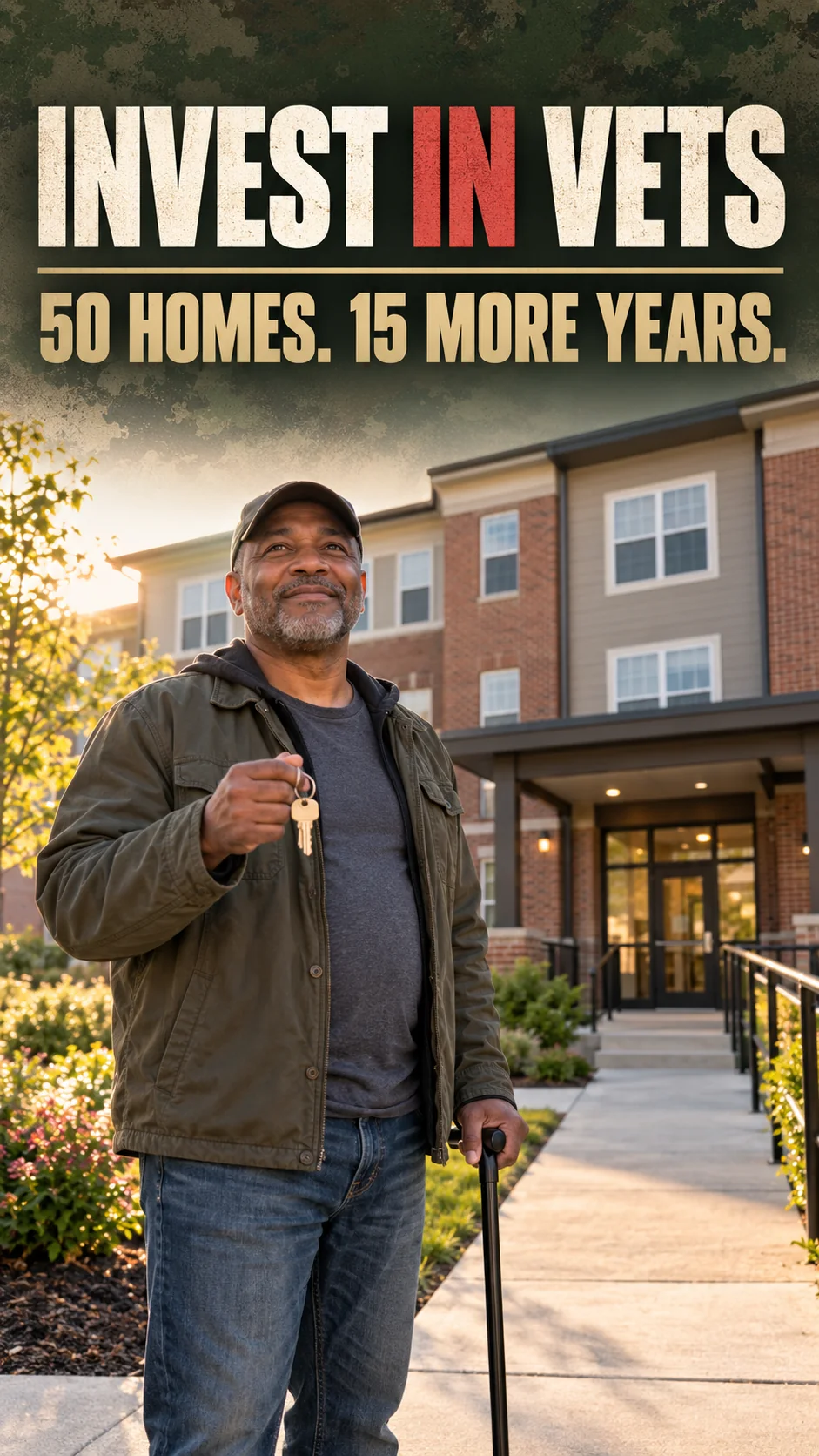
Columbus Preserves Fifty Veteran Apartments Through 2040
How a local housing authority protected an operating Veteran community for fifteen more years
By Invest in Vets | Columbus Ohio
OPERATING | DESIGNATED | 2026 COMMITMENT | AFFORDABILITY |
Preservation Is Housing Delivery
Columbus did not announce 50 future Veteran apartments in July 2026. It protected 50 apartments that are already operating. The Columbus Metropolitan Housing Authority approved a $10.7 million project-based voucher commitment for every unit at Commons at Livingston, an established one-bedroom community at 3349 East Livingston Avenue. The 15-year term extends affordability through 2040 for disabled Franklin County Veterans.
That distinction matters. New construction attracts attention, but preservation prevents an existing housing asset from drifting out of reach. Commons at Livingston is open and serving Veterans now. National Church Residences describes the handicap-accessible property as housing homeless Veteran men and women, with onsite service coordination, employment assistance, a community room, fitness room and laundry. CMHA’s Jul 28, 2026 action did not add another 50 units. It secured the rental-assistance structure behind the 50 already there.
The public record does not provide a current occupied-unit count. Invest in Vets should therefore describe the development as 50 operating and Veteran-designated apartments, not 50 Veterans newly housed in 2026 and not proof that Columbus has ended Veteran homelessness.
What CMHA Approved
CMHA’s board included Commons at Livingston in a larger package of more than $125 million in affordable-housing actions approved on Jul 28, 2026. Across all projects, that package covered acquisition, preservation, renovation and development affecting 451 units. The Veteran-specific share is precise: $10.7 million for a project-based voucher contract at Commons at Livingston, covering all 50 apartments for 15 years.
Project-based assistance is attached to designated apartments rather than carried by a household to any qualifying rental. That gives the property a predictable affordability stream and gives the local system a dedicated place for eligible Veterans. It is not a cash payment to residents. The housing authority pays assistance under the rental program, while the resident contributes the required tenant share under applicable rules.
The property itself is not new. A 2012 development profile described 25 one-bedroom apartments for disabled Veterans and 25 for Veterans who were both chronically homeless and disabled. CMHA’s 2026 announcement now describes all 50 as affordable apartments for disabled Franklin County Veterans. The important 2026 milestone is preservation of that complete Veteran inventory through 2040.
A Local Partnership With Distinct Roles
The model works because no single institution has to perform every function. National Church Residences owns or operates the community and provides the physical housing and onsite services. CMHA supplies the long-term project-based rental assistance. VA Central Ohio identifies and assists Veterans who are homeless or at risk, including through outreach, housing navigation, health care and HUD-VASH case management when that program is appropriate.
These roles should not be blurred. Commons at Livingston’s 2026 announcement identifies a project-based voucher contract, but it does not label all 50 apartments as new HUD-VASH vouchers. Separately, CMHA’s administrative plan says its HUD-VASH program accepts VA referrals, can use tenant-based and project-based vouchers, does not maintain a public HUD-VASH waitlist and can allow single-room occupancy, shared housing and cooperative units. That broader policy shows how Columbus can match different Veterans to different housing forms without pretending that every Veteran qualifies for every program.
VA disability compensation is separate from rental assistance and depends on an approved service-connected disability rating. CMHA’s HUD-VASH policy states that service-connected disability income is excluded when determining HUD-VASH income eligibility but included when calculating rent. Post-9/11 GI Bill housing payments are also separate education benefits, dependent on eligibility, enrollment level, training format, benefit tier and school location. A voucher is not spendable income, and none of these benefits should be added together as if every Veteran automatically receives the same monthly amount.
Why the Timing Matters in Franklin County
The Community Shelter Board conducted its 2026 Point-in-Time Count on Jan 22, 2026. It identified 2,587 people experiencing homelessness across Columbus and Franklin County, including 96 Veterans. The Veteran count was one lower than the 97 recorded in 2025, but the overall system was under growing pressure: unsheltered homelessness rose 43 percent, from 455 people in 2025 to 651 in 2026.
The Commons at Livingston inventory equals more than half of the 96 Veterans counted on that one January night, but those figures are not directly interchangeable. A Point-in-Time Count is a snapshot; the property serves households over time; and no public source reviewed on Sep 29, 2026 gives a current vacancy or turnover number. The responsible conclusion is narrower: preserving 50 dedicated apartments protects substantial local capacity at a moment when the wider homelessness system is becoming more strained.
Columbus also received $64,503 in HUD-VASH administrative-fee funding announced on Jun 26, 2026. HUD said those fees are intended to help housing authorities lease vouchers and improve program delivery. The same federal award schedule does not list CMHA for new HUD-VASH vouchers. That means the local opportunity is operational: reduce referral delays, recruit units where tenant-based vouchers are used, complete inspections quickly and keep existing Veteran apartments leased to eligible households.
Reaching Veterans Who Do Not Ask
A deployed Veteran may resist the word homeless even while sleeping in a vehicle, moving between relatives, paying for short motel stays or preparing to lose an apartment. Pride, military identity and reluctance to discuss trauma or a service-connected condition can keep that Veteran outside the front door of the system. Columbus has several practical entry points that do not require someone to present a finished benefits claim or know which housing program fits.
VA Central Ohio’s homeless team offers outreach and housing assistance for Veterans who are homeless or at risk. Its published contacts include the HUD-VASH supervisor and Health Care for Homeless Veterans outreach. A Veteran can begin by asking for a housing screening and explaining where they expect to sleep in the next few weeks. That first conversation can address immediate safety, prevention, treatment, benefits and referral options without promising a Commons at Livingston vacancy.
For outreach partners, the lesson is to describe the first step as problem-solving rather than surrender. A housing screen can happen before an eviction, before a car becomes the permanent address and before untreated service-related conditions turn into a crisis. The property’s onsite service coordination is valuable precisely because the apartment is only one part of maintaining stability.
What Invest in Vets Can Adapt
The Columbus model offers a preservation strategy Invest in Vets can use in other markets. First, identify an operating Veteran property where affordability will expire, a subsidy contract is nearing renewal or service funding is thin. Second, bring the housing authority, owner, VA team and service provider together early enough to protect the units before a crisis. Third, separate the public dashboard into units operating, units occupied, vacancies, referrals pending and housing retained after move-in.
Invest in Vets can also support the last mile that public financing rarely covers well: transportation to inspections and appointments, identification documents, move-in supplies, landlord communication, small accessibility modifications and outreach to Veterans who avoid institutional settings. Investors can help with acquisition and preservation capital, but they should accept long affordability periods and transparent outcome reporting. Landlords remain essential for Veterans whose needs are better served in scattered-site housing.
Commons at Livingston demonstrates that ending Veteran homelessness requires more than announcing new doors. It also requires keeping existing doors affordable, connected to services and accessible to the people those homes were built to serve.
Veteran Resources
- VA Central Ohio HUD VASH supervisor: 614-967-3530. Ask for a housing screening if you are homeless or at risk of losing housing.
- Health Care for Homeless Veterans outreach: 614-257-5499. Outreach staff connect eligible Veterans with health care benefits and housing resources.
- Commons at Livingston property office: 614-235-4426. The property is Veteran-focused but availability and eligibility must be confirmed.
- National Call Center for Homeless Veterans: 877-424-3838. Free confidential assistance is available 24 hours a day.
- Veterans Crisis Line: Dial 988 then press 1 or text 838255. VA enrollment is not required.
Veterans: ask for a housing screening before a temporary arrangement collapses. Landlords: tell CMHA and VA Central Ohio when a safe unit is available and ask how to accept housing assistance. Investors and developers: help preserve Veteran properties with long affordability commitments rather than waiting for buildings to fail. Supporters: fund transportation furnishings accessibility needs and outreach that reaches Veterans who may never call themselves homeless.
Sources
1. Columbus Metropolitan Housing Authority Jul 28, 2026 investment announcement
2. National Church Residences Commons at Livingston property page
3. Community Shelter Board 2026 Point in Time Count report
4. CMHA Housing Choice Voucher administrative plan approved Apr 25, 2025
5. HUD Jun 26, 2026 HUD VASH award announcement and local schedule
6. VA Central Ohio Homeless Veteran Care updated Mar 2, 2026
7. VA Franklin County homeless resources updated May 12, 2026
8. VA HUD VASH program information updated Jun 23, 2026
9. Affordable Housing Finance development profile Jul 1, 2012