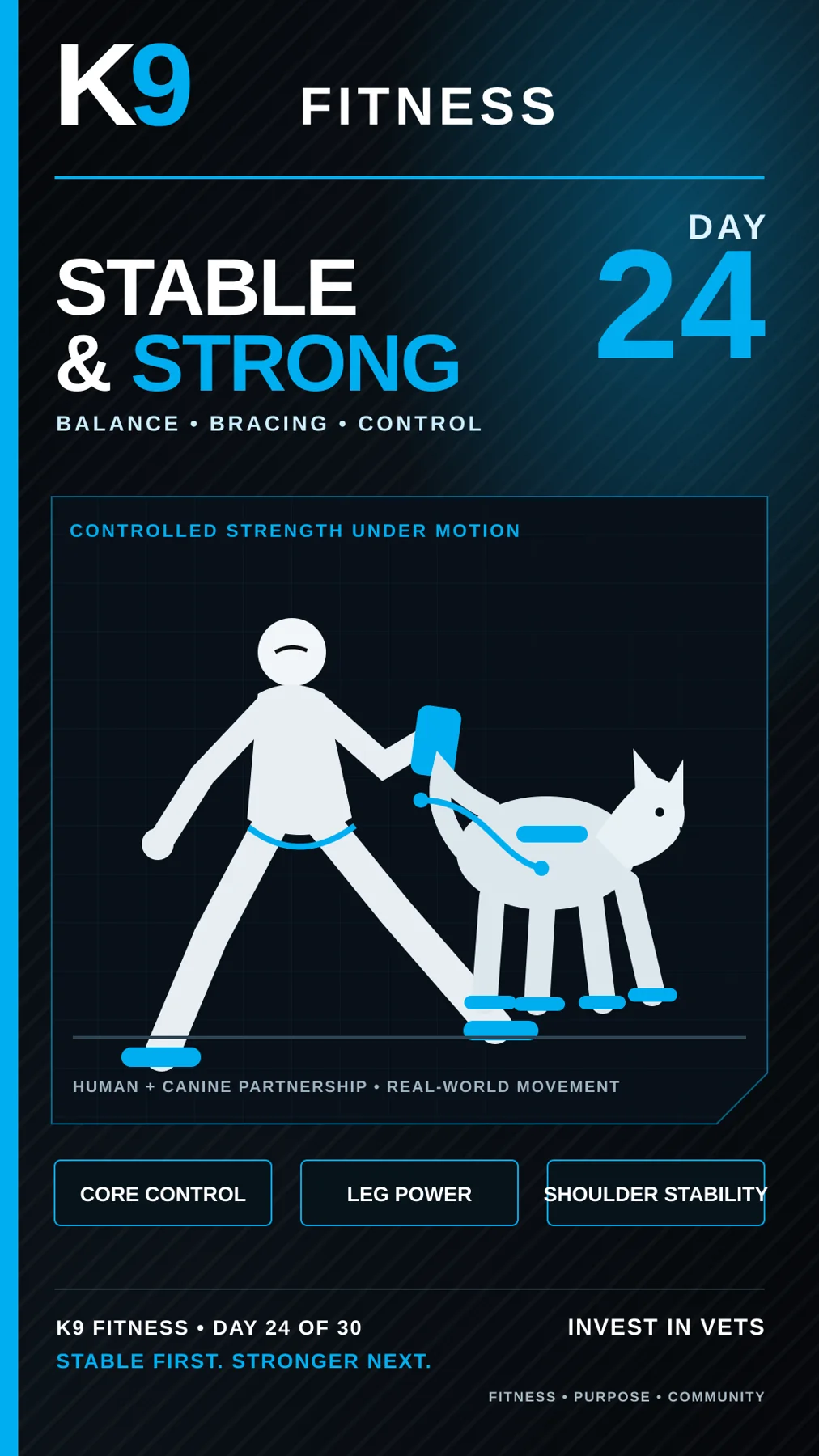
K9 FITNESS — DAY 24 OF 30
STABLE & STRONG
Balance, Bracing + Shoulder Control
September 22, 2026
DAY 24 PURPOSE
Day 23 asked the whole body to connect step, press, and carry patterns after the recovery-focused reset on Day 22. Day 24 keeps that integration but changes the challenge: instead of chasing more load, you will practice staying organized while the body moves through slower unilateral positions. The goal is to build useful strength that remains steady when one leg is doing more work, the trunk has to resist rotation, or the shoulders are working while your base of support is changing.
Today’s theme is stability under motion. That means the feet stay active, the knees track cleanly, the ribs remain stacked over the pelvis, and the shoulders stay away from the ears even when the set starts to feel difficult. You should be able to breathe throughout the work. If you need to hold your breath, rush the lowering phase, or twist to complete a repetition, the load or range is too aggressive for today’s purpose.
The canine connection is practical. Walking with a dog often involves starts, stops, curb steps, direction changes, uneven ground, and moments when the leash hand has to stay calm while the rest of the body adjusts. Your dog is not resistance equipment. The shared lesson is control: you practice balance and bracing during the workout, then carry that posture into an easy walk where transitions stay smooth and the leash remains relaxed.
SESSION OVERVIEW
• Target time: 35–45 minutes
• Equipment: sturdy step or low bench, one or two light-to-moderate dumbbells, optional wall or chair for balance
• Effort: moderate; keep about 2–3 clean repetitions in reserve on most strength sets
• Primary focus: unilateral leg control, shoulder stability, anti-rotation strength, deceleration, posture under movement
• Day 24 rule: own the position before adding speed, load, or range
WARM-UP — 7 TO 9 MINUTES
The warm-up should make the hips, ankles, trunk, and shoulders feel more responsive without creating fatigue. Move slowly enough to notice where you are stiff or uneven. Use that information to choose the easier variation later if one side feels less stable.
1. EASY MARCH + ARM SWEEP — 60–90 seconds
March in place or walk through clear space while sweeping the arms forward and overhead within a comfortable range.
FORM CUE: Keep the ribs down and let the arms move without forcing the lower back to arch.
2. ANKLE ROCK + HEEL RAISE — 8 reps per side
Shift the knee forward over the toes while keeping the heel down, then rise into a controlled calf raise.
FORM CUE: Keep the foot tripod planted through the heel, big-toe base, and little-toe base.
3. REVERSE-LUNGE REACH — 6 reps per side
Step one foot back into a short lunge while reaching both hands forward, then return to standing.
FORM CUE: Let the front leg control the movement; do not drop quickly into the bottom.
4. WALL SLIDE — 8 reps
Stand with your back or forearms near a wall and slide the arms upward through a comfortable range.
FORM CUE: Keep the neck long and avoid shrugging to create more range.
5. LATERAL STEP + REACH — 6 reps per side
Step to the side, sit the hips slightly back, and reach forward before returning to center.
FORM CUE: Keep the working knee aligned with the middle toes.
6. INCLINE SHOULDER TAP — 6 reps per side
Place the hands on a sturdy bench, countertop, or wall and alternate light shoulder taps.
FORM CUE: Keep the hips and ribs as quiet as possible instead of rotating with each tap.
BLOCK A — STABILITY STRENGTH
3 rounds • Rest 60–90 seconds between rounds
Block A trains you to create force without losing alignment. The movements are deliberately unilateral or asymmetrical, which makes the trunk and smaller stabilizing muscles work harder even when the dumbbells are not heavy. Slow repetitions will do more for today’s goal than adding weight.
1. REVERSE LUNGE TO KNEE DRIVE — 6 reps per side
Step back into a controlled reverse lunge, drive through the front foot, and finish tall with the trailing knee lifted to a comfortable height.
FORM CUE: Pause briefly at the top instead of swinging through the balance position.
MODIFICATION: Remove the knee drive and return to a normal standing position between reps.
2. HALF-KNEELING SINGLE-ARM PRESS — 8 reps per side
Use a comfortable half-kneeling position and press one light dumbbell overhead.
FORM CUE: Keep the glute on the down-knee side lightly active and avoid leaning away from the weight.
MODIFICATION: Press from a chair or stop short of overhead if full range is uncomfortable.
3. LATERAL STEP-UP — 8 reps per side
Stand beside a low step, place the closest foot on it, and stand tall before controlling the return to the floor.
FORM CUE: Push through the whole working foot and keep the knee from collapsing inward.
MODIFICATION: Use a lower step or hold a rail for balance.
4. INCLINE SHOULDER TAP — 8 reps per side
From a sturdy elevated plank position, lift one hand to touch the opposite shoulder, then switch.
FORM CUE: Widen the feet if needed so the hips stay level.
MODIFICATION: Use a wall instead of a bench.
5. SUPPORTED SINGLE-LEG RDL REACH — 6 reps per side
Hold a wall or chair lightly with one hand. Hinge over one leg while the other leg reaches back, then return to standing.
FORM CUE: Keep the hips square and think “long spine” instead of reaching farther.
MODIFICATION: Keep the back toes on the floor in a kickstand position.
BLOCK B — BRACE + PACE
3 rounds • Rest about 60 seconds between exercises as needed
Block B adds modest fatigue while asking you to preserve the same positions from Block A. This is where many people start to hurry. Instead, let the pace stay smooth enough that your shoulders remain level and your feet continue to land quietly.
1. FRONT-RACK SPLIT SQUAT — 8 reps per side
Hold one or two light dumbbells at the shoulders and perform controlled split squats.
FORM CUE: Keep the front foot planted and lower straight down rather than drifting forward.
MODIFICATION: Hold one dumbbell at the chest or use bodyweight only.
2. SUITCASE MARCH — 30 seconds per side
Hold one dumbbell at your side and march slowly in place.
FORM CUE: Do not lean away from the weight; keep the shoulders and hips level.
MODIFICATION: Use a lighter load or perform a static suitcase hold.
3. SCAPTION RAISE — 10 reps
With very light dumbbells or no weight, raise the arms about 30–45 degrees forward from the sides until they reach a comfortable height.
FORM CUE: Move smoothly and stop before the shoulders shrug.
MODIFICATION: Use no weight and shorten the range.
4. STEP-DOWN WITH PAUSE — 6 reps per side
Stand on a low step and slowly lower the opposite heel toward the floor, pausing briefly before returning.
FORM CUE: Control the descent and keep the knee tracking over the middle toes.
MODIFICATION: Use a smaller step or hold a rail.
5. SINGLE-ARM FRONT-RACK CARRY — 30–40 seconds per side
Hold one dumbbell at shoulder height and walk through clear space at a calm pace.
FORM CUE: Keep the ribs stacked and avoid leaning or rotating toward the weight.
MODIFICATION: March in place or hold the weight at your side instead.
FINISHER — STABLE & STRONG CIRCUIT
Complete 2 smooth rounds. Work for 30 seconds at each station and rest 15 seconds between stations. Rest 60 seconds between rounds.
• LOW STEP-UPS
• INCLINE SHOULDER TAPS
• SUITCASE MARCH — switch sides halfway
• BODYWEIGHT SPLIT SQUAT — switch sides halfway
The finisher is optional. Its job is to challenge posture while you are slightly tired, not to turn the session into a race. Skip the second round if your balance becomes sloppy, your shoulders start shrugging, or your breathing is too rushed to maintain control.
CANINE PARTNER OPTION — CONTROL WALK
If your dog is healthy, comfortable on leash, and accustomed to regular walking, finish with an easy 10–20 minute walk. During the walk, practice five or six calm transitions: slow down, stop, change direction, step onto or off a curb when safe, then return to an easy pace. Let your feet turn with your body instead of twisting on a planted leg, and keep the leash hand relaxed.
For your dog, choose a pace and surface appropriate for age, conditioning, weather, and health. Avoid repeated stairs, jumping, forced running, or long hill work if your dog is young, older, sore, recovering, or not conditioned for those demands. The goal is partnership and controlled movement, not exhausting the dog.
COOLDOWN — 5 TO 7 MINUTES
• EASY WALK — 60–90 seconds
• HALF-KNEELING HIP-FLEXOR STRETCH — 30 seconds per side
• CALF STRETCH — 30 seconds per side
• CROSS-BODY SHOULDER STRETCH — 30 seconds per side
• WALL LAT STRETCH — 30 seconds
• SEATED OR STANDING HAMSTRING STRETCH — 30 seconds per side
• SLOW BREATHING — 5 relaxed breaths
RECOVERY NOTE
Day 24 uses unilateral work, carries, and shoulder-stability drills, so fatigue may show up as a subtle loss of balance before the larger muscles feel exhausted. That is your signal to stop the set rather than squeeze out extra repetitions. Mild muscle fatigue is expected, but the session should not leave a joint feeling less stable, more painful, numb, or restricted.
Support recovery with regular meals, adequate protein and carbohydrate, hydration, and enough sleep opportunity. If your legs feel heavy from Day 23, keep the step height low and use bodyweight on more of today’s movements. The course is progressing through quality, not through forcing a heavier session every day.
DAILY MISSION — STABLE FIRST
Pick one ordinary transition today—standing up from a chair, climbing a flight of stairs, stepping out of a vehicle, carrying a bag, or changing direction while walking. Slow the first repetition down and notice whether your foot is planted, your knee is tracking cleanly, and your shoulders are level.
The point is not to turn daily life into another workout. It is to recognize that useful strength shows up in transitions. When the body can control the first step, the next movement usually becomes easier and safer.
COURSE PROGRESS — DAY 24 OF 30
After today, six training days remain. Days 17 through 21 developed deceleration, upward drive, lateral strength, hinging, and split-stance control. Day 22 reduced stress, Day 23 reconnected those qualities through step, press, and carry patterns, and Day 24 reinforces the same system with more emphasis on balance, bracing, and controlled pace.
The final six days can now build toward stronger endurance and more confident transitions without abandoning the technical standards that got you here. Progress means being able to repeat good movement under manageable fatigue, not simply collecting harder exercises.
SAFETY NOTE
This course is general fitness education, not individualized medical care. Use a stable step, secure footwear, clear floor space, and loads you can control without breath-holding, shrugging, twisting, or losing balance. Overhead work should remain comfortable and should not create pinching, numbness, tingling, or a feeling that the shoulder is unstable.
Stop the session for sharp pain, sudden weakness, numbness, tingling, dizziness, chest pain, fainting, severe shortness of breath, or another concerning symptom. If you are recovering from surgery or injury, have significant joint or back pain, balance limitations, cardiovascular restrictions, or are following a rehabilitation plan, follow qualified medical or rehabilitation guidance before progressing.